

Stock News•3 weeks ago
Applied Materials Is Silently Powering the AI Boom. Here's Why.
Applied Materials collaborates with major AI expansion companies, positioning it as a key enabler in the semiconductor supply chain.
Key Takeaways
Applied Materials (NASDAQ: AMAT) is indeed emerging as a quintessential "pick-and-shovel" beneficiary of the artificial intelligence (AI) boom, providing the indispensable tools and technologies required to manufacture the advanced chips powering this revolution. The company's recent Q1 fiscal 2026 earnings report and subsequent guidance have cemented this narrative, showcasing robust demand fueled by hyperscalers and a tightening chip supply chain. CEO Gary Dickerson explicitly stated that the outlook is "fueled by the acceleration of industry investments in AI computing," emphasizing the need for higher-performance, more energy-efficient chips. This isn't just about more chips; it's about fundamentally better chips, and AMAT is at the heart of their creation.
The market has certainly taken notice. Shares of AMAT have seen significant momentum, with a 30-day return of 17.23% and a staggering 1-year total shareholder return of 130.34% as of late February 2026. This surge reflects investor confidence in the company's ability to capitalize on the multi-year growth cycle driven by AI infrastructure buildouts. Applied Materials is not merely participating in this growth; it's enabling it, providing the critical wafer fabrication equipment (WFE) and advanced packaging solutions that are in high demand.
Consider the sheer scale of the opportunity: the global semiconductor industry revenues are projected to potentially reach $1 trillion in 2026, several years earlier than previously predicted, with AI adoption as the primary catalyst. Applied Materials expects its semiconductor equipment business to grow by more than 20% in 2026, with demand weighted towards the second half of the year. This aggressive forecast, coupled with increased long-term visibility from customers extending into 2027, paints a picture of sustained, high-intensity investment in the foundational layers of AI computing. AMAT's position as the largest U.S. semiconductor equipment maker means it's uniquely poised to capture a substantial share of this unprecedented spending.
Applied Materials' impressive performance and optimistic outlook are directly attributable to its strategic focus on the cutting-edge technologies essential for AI chip production, particularly leading-edge logic, High-Bandwidth Memory (HBM) DRAM, and advanced packaging. These segments are experiencing immense capital intensity as chipmakers race to meet the escalating demands of AI data centers. The company's Semiconductor Systems segment, which accounted for $5.14 billion of its Q1 revenue, is at the forefront, with "foundry, logic, and other" comprising 62% and DRAM 34% of that revenue. This mix clearly highlights the shift towards AI-centric manufacturing.
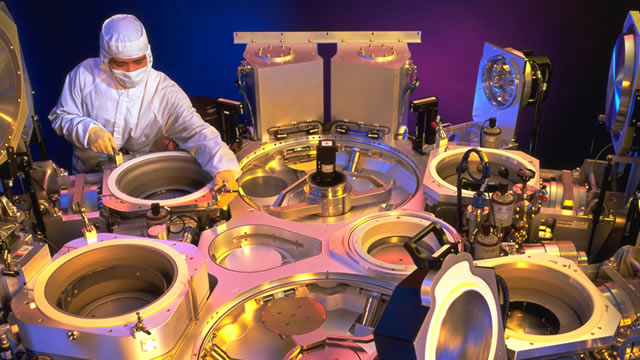
Specifically, AMAT is a leader in advanced packaging WFE spending, which is rapidly increasing in 2026, driven by HBM and 3D chiplet stacking. The company holds a number one market position in these critical areas and anticipates advanced packaging to be one of its highest growth businesses this year. This isn't just about supplying equipment; it's about co-innovating with industry leaders. Applied Materials recently launched its first EPIC co-development agreement with Samsung Electronics, a clear move to accelerate R&D and technology transfer into high-volume manufacturing for these complex AI components. Such partnerships are crucial for staying ahead in a rapidly evolving technological landscape.
Furthermore, the company is actively expanding its product portfolio to support the next generation of semiconductors. Applied Materials plans to launch more than a dozen new products in 2026, including innovations specifically for advanced logic and DRAM. These new systems target technologies like gate-all-around (GAA) transistors for 2nm-and-beyond chips, which are fundamental to achieving the performance and energy efficiency required by AI workloads. The ability to deliver these specialized deposition, etch, and materials systems positions AMAT to extend its market share through multiple technology inflections, ensuring its relevance as chip architectures become increasingly sophisticated.
Applied Materials' financial performance reflects a company effectively leveraging the AI-driven surge in semiconductor demand, demonstrating strong operational efficiency and robust growth metrics. For the trailing twelve months (TTM), the company reported an impressive gross margin of 48.7%, an operating margin of 29.1%, and a net margin of 27.8%. These figures underscore AMAT's pricing power and efficient cost management within a competitive industry. The Q1 FY2026 results further highlighted this, with gross margins expanding to 49.1%, marking the highest level in 25 years for the company. This isn't a fluke; it's a testament to the high value placed on its specialized equipment.
The company's profitability is equally compelling. TTM Earnings Per Share (EPS) stood at $9.89, contributing to a healthy Return on Equity (ROE) of 38.9% and Return on Invested Capital (ROIC) of 22.6%. These returns indicate that AMAT is generating substantial value for its shareholders and effectively deploying its capital. While the company's FY2025 year-over-year growth showed a slight dip in Net Income (-2.5%) and Free Cash Flow (-23.9%), this was largely a reflection of a transitional period and aggressive capacity expansion in anticipation of future demand. The more recent Q1 FY2026 results, with net income of $2.03 billion and basic EPS of $2.55, demonstrate a strong rebound and renewed profitability.
Looking ahead, the guidance for Q2 FY2026 projects revenue of approximately $7.65 billion (plus or minus $500 million) and adjusted profit of $2.64 per share (plus or minus 20 cents). These figures significantly exceed analysts' average estimates of $7.01 billion and $2.28, respectively, signaling management's strong confidence in the accelerating demand environment. Applied Materials also generated $1.69 billion in cash from operations in Q1 and returned $702 million to shareholders through $337 million in share repurchases and $365 million in dividends, reinforcing its commitment to shareholder value. The company's balance sheet remains strong, with a current ratio of 2.71 and a debt-to-equity ratio of 0.33, providing ample liquidity and financial flexibility to fund future growth initiatives.
Applied Materials presents a compelling investment case driven by powerful catalysts, yet investors must also weigh the inherent risks in the volatile semiconductor industry. The primary catalyst is the relentless demand from the AI computing revolution, which is driving a multi-year growth cycle for semiconductor equipment. Industry forecasts, such as those from SEMI, project global semiconductor equipment sales to reach $126 billion in 2026 and $135 billion in 2027, with AMAT's leadership in advanced logic, HBM DRAM, and advanced packaging positioning it to capture a significant share. The company's planned launch of over a dozen new products in 2026, including three for advanced logic and DRAM, will further fuel technology displacement cycles and market share gains.
However, the bullish narrative is not without its challenges. Geopolitical tensions, particularly U.S. export restrictions on China, represent a significant headwind. China revenue declined 7% in Q1 FY2026 and now accounts for 27% of semiconductor equipment sales, down from higher levels. While AMAT recently settled a $252.5 million export control violation with the Department of Commerce, the risk of future restrictions and their impact on revenue trajectory remains. This uncertainty not only reduces the addressable market but also enables Chinese competitors to gain market share in restricted segments.
Another critical risk is the cyclical nature of the semiconductor industry. While AI demand currently provides robust support, memory market volatility and potential overcapacity in HBM by 2027-2028 could lead to margin compression and reduced capital spending. Applied Materials is vulnerable to such corrections, given memory equipment represents a significant portion of its revenue. Furthermore, macroeconomic uncertainty, competitive pressures from rivals like ASML and Lam Research, and the potential for technology disruption from alternative computing architectures or consolidated manufacturing processes could impact AMAT's long-term growth trajectory. Despite these risks, AMAT's broad capabilities, significant R&D investments ($3.6 billion last year), and strategic focus on materials engineering provide a strong defensive moat.
Applied Materials' current valuation reflects both its strong market position and the significant growth potential tied to the AI boom, but it also raises questions about whether the market has fully priced in future upside. Trading at $372.30, AMAT's stock has nearly doubled in the past year, pushing its market capitalization to $295.46 billion. This rapid appreciation has led to a TTM P/E ratio of 37.66 and a P/S ratio of 10.47. Compared to the broader market, these multiples suggest a premium, indicating high investor expectations for sustained growth.
The bull case for this valuation is compelling. AMAT is guiding for over 20% growth in its semiconductor equipment business for calendar 2026, a significant acceleration into what CEO Gary Dickerson calls a "tipping point" in AI-driven semiconductor demand. When a company is positioned at the epicenter of a multi-year capital expenditure supercycle, a P/E of around 27x forward earnings (based on analyst estimates) might not be unreasonable. Analysts have certainly rushed to raise their price targets, with some like Citi lifting to $400 from $250, and UBS to $405 from $285, implying an additional 8-10% upside even after the recent surge.
However, a more cautious perspective suggests that some of the future AI-driven growth might already be baked into the current share price. Some valuation models, like one from Simply Wall St, have pointed to a fair value of around $194.11, suggesting the stock could be overvalued by a significant margin. This discrepancy highlights the ongoing debate between growth-oriented investors betting on the AI supercycle and value investors focused on more traditional metrics. While AMAT's strong Q1 beat and clarified export-control exposure provide near-term tailwinds, the inherent cyclicality of the chip equipment spending and the persistent geopolitical overhang on China revenue remain key swing factors that could challenge a sustained premium valuation. Investors must weigh the company's undeniable leadership and growth prospects against the potential for market corrections or unforeseen industry shifts.
For investors, Applied Materials represents a high-conviction play on the foundational infrastructure of the AI revolution, but careful consideration of its valuation and the broader market dynamics is crucial. The company's robust Q1 FY2026 performance and optimistic guidance for over 20% growth in its semiconductor equipment business for 2026 confirm its central role as a "pick-and-shovel" provider. AMAT's leadership in advanced logic, HBM DRAM, and advanced packaging technologies ensures it is directly benefiting from the massive capital expenditures by hyperscalers and chip manufacturers.
While the stock trades at a premium, its strong margins, high returns on capital, and significant R&D investments underscore its competitive moat and ability to innovate. The ongoing AI-driven demand, coupled with strategic co-development initiatives and a robust product pipeline, provides a clear runway for continued growth into 2027. Investors should monitor AMAT's fiscal Q2 results in mid-May, TSMC's monthly revenue data for broader foundry trends, and the Q1 2026 capital expenditure numbers from major AI infrastructure players like Microsoft, Google, Amazon, and Meta.
Applied Materials is not just riding the AI wave; it's enabling it. For those seeking exposure to the physical layer of the AI buildout, AMAT remains a compelling option, albeit one that requires an understanding of both its immense potential and the cyclical and geopolitical risks inherent in the semiconductor industry.
Want deeper research on any stock? Try Kavout Pro for AI-powered analysis, smart signals, and more. Already a member? Add credits to run more research.