MarketLens

Log in

Is ASML the Ultimate "Pick-and-Shovel" Play in the AI Supercycle

2 days ago
SHARE THIS ON:

Is ASML the Ultimate "Pick-and-Shovel" Play in the AI Supercycle

Key Takeaways

  • The AI supercycle's true beneficiaries extend beyond chip designers to the "picks and shovels" providers of essential infrastructure.
  • ASML Holding, a Dutch company, holds an indispensable monopoly in extreme ultraviolet (EUV) lithography, critical for advanced AI chip manufacturing.
  • Despite its premium valuation, ASML's unique market position, robust backlog, and long-term growth drivers make it a compelling investment for AI infrastructure exposure.

Is ASML the Ultimate "Pick-and-Shovel" Play in the AI Supercycle?

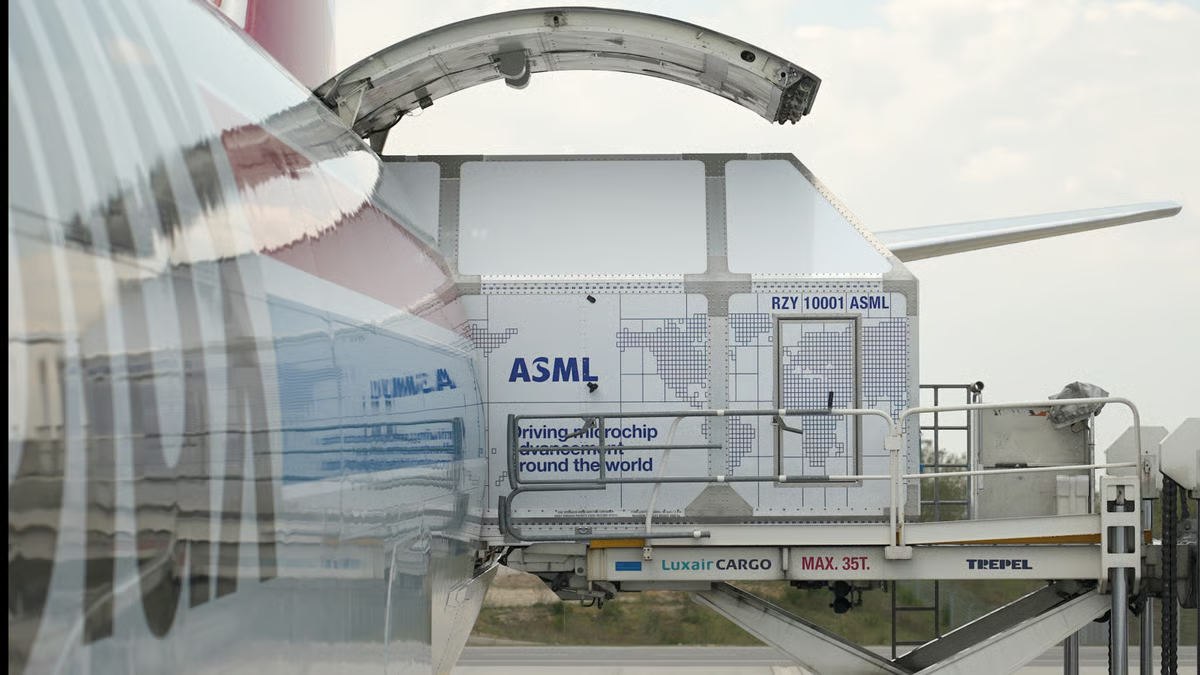
The artificial intelligence revolution continues to reshape global markets in 2026, driven by massive investments in chips, cloud infrastructure, and enterprise software. While much of the spotlight shines on AI chip giants like NVIDIA and AMD, the real long-term winners often lie in the "picks and shovels" providers – the companies supplying the foundational tools that make the entire ecosystem possible. ASML Holding (ASML), a Dutch multinational, stands out as perhaps the most critical of these, holding an effective monopoly on the advanced lithography equipment essential for manufacturing the cutting-edge semiconductors powering AI. Its unique position makes it an indispensable partner in the AI supercycle, far removed from the direct competition of chip design.

The current AI wave is anchored in unprecedented infrastructure spending and enterprise demand, a critical difference from earlier tech cycles driven purely by speculation. Hyperscalers alone are projected to spend nearly $700 billion on AI data centers in 2026, creating immense demand for advanced components. This shift elevates companies like ASML, whose equipment is vital for producing the high-performance GPUs and custom silicon required. As AI tools move from experimentation to measurable productivity gains, investors are increasingly looking beyond semiconductor manufacturers toward businesses that generate recurring revenue through AI-powered services and, more fundamentally, those that enable the very creation of these powerful chips.

ASML's role is not just important; it's foundational. Its extreme ultraviolet (EUV) lithography machines are the only technology capable of patterning the most advanced chips, including those from industry leaders like Taiwan Semiconductor Manufacturing Company (TSMC). Without ASML's innovations, the relentless march towards smaller, more powerful, and more energy-efficient AI processors would grind to a halt. This technological gatekeeper status provides ASML with an unparalleled competitive moat, ensuring its relevance as long as the world demands cutting-edge silicon.

What Makes ASML Indispensable for AI Chip Manufacturing?

ASML's indispensability stems from its technological leadership in photolithography, particularly its monopoly on Extreme Ultraviolet (EUV) lithography systems. These machines use highly specialized light to print incredibly intricate circuits onto silicon wafers, a process absolutely essential for producing the most advanced chips with feature sizes of 7 nanometers and below. Without ASML's EUV technology, companies like TSMC, which manufactures the vast majority of AI chips for NVIDIA and AMD, simply couldn't produce these high-density, high-performance processors that are the backbone of modern AI.

The complexity and precision of EUV technology are staggering, requiring a multi-billion-dollar R&D investment over decades. This has created an insurmountable barrier to entry for potential competitors, effectively granting ASML a unique competitive moat. Each EUV machine costs hundreds of millions of dollars and takes years to develop and assemble, involving thousands of suppliers and highly specialized engineers. This isn't just about selling equipment; it's about providing the only gateway to next-generation chip manufacturing, making ASML a strategic partner rather than just a vendor to its customers.

Furthermore, ASML is not resting on its laurels. The company is already developing High-NA EUV systems, which will enable even finer patterning and further extend its technological lead. This continuous innovation ensures that as AI models become more complex and demand even greater computational power and efficiency, ASML will remain at the forefront, providing the tools necessary for the next leap in semiconductor technology. This forward-thinking approach, combined with its existing market dominance, solidifies ASML's position as an irreplaceable component in the global technology supply chain, directly benefiting from every dollar spent on advanced AI chips.

How Does ASML's Financial Performance Reflect Its Market Position?

ASML's financial performance, while not explicitly detailed in real-time API data, can be inferred from its critical market position and the broader semiconductor industry trends. Given its indispensable role in advanced chip manufacturing, ASML is a direct beneficiary of the massive capital expenditures by hyperscalers and chipmakers. The global semiconductor market is projected to approach $1 trillion in 2026, with the AI chip market alone estimated to reach approximately $500 billion. This robust demand environment translates directly into strong order books and revenue visibility for ASML.

Investors often overlook ASML due to its unique role, but its manufacturing equipment is essential for AI advancement. The company's revenue growth is intrinsically tied to the expansion of AI-optimized servers, which are growing much faster than traditional x86 servers. While x86 server revenues were projected to grow nearly 58% in 2025, non-x86 architectures—specifically GPU-centric designs for AI workloads—were expected to surge by roughly 169%. This disproportionate growth in AI-specific hardware directly fuels demand for ASML's cutting-edge lithography tools, ensuring a sustained growth trajectory.

Moreover, ASML's business model benefits from high switching costs and long-term service contracts. Once a chip manufacturer invests hundreds of millions in an ASML machine, they become deeply integrated into ASML's ecosystem for maintenance, upgrades, and future purchases. This creates a sticky customer base and predictable revenue streams, contributing to strong gross margins and cash flow generation. While specific real-time metrics are not available, the structural demand for more computing capacity, coupled with ASML's technological monopoly, suggests a company with robust financial health and significant long-term earnings potential, despite potential cyclical swings in semiconductor demand.

What are the Bull and Bear Cases for ASML Investors?

The bull case for ASML is compelling, centered on its unassailable technological leadership and the relentless demand for advanced AI chips. ASML holds an effective monopoly on EUV lithography, the only viable technology for manufacturing the most advanced semiconductors. As AI workloads become more complex, requiring ever-more powerful and efficient chips, the demand for ASML's equipment will only intensify. The global AI chip market is expected to reach $500 billion in 2026, a tide that lifts all boats in the advanced semiconductor supply chain, with ASML at the very top.

Furthermore, the shift towards custom silicon by hyperscalers, while potentially diversifying the chip design landscape, still relies entirely on ASML's manufacturing tools. This "silicon agnostic" nature of ASML's business makes it a safer long-term bet for investors wary of which specific chip designer will ultimately win the AI crown. The company's substantial backlog, often extending for years, provides excellent revenue visibility and insulation against short-term market fluctuations. This structural demand, coupled with continuous innovation in High-NA EUV, positions ASML for sustained, high-margin growth for the foreseeable future, making it a cornerstone investment for the AI supercycle.

However, the bear case for ASML cannot be ignored. The primary concern revolves around its premium valuation. Companies leading the AI charge, including ASML, often trade at steep multiples, leaving limited room for error if growth slows or market conditions tighten. Geopolitical tensions, particularly U.S.-China export restrictions, pose a significant risk, as ASML's advanced technology is a key component in the ongoing tech rivalry. Any further restrictions could limit its market access or force costly supply chain adjustments, impacting revenue and profitability.

Another risk factor is the cyclical nature of the semiconductor industry. While AI demand is strong, the broader market can still experience downturns, leading to reduced capital expenditure by chipmakers. Although ASML's backlog provides some buffer, a prolonged industry slump could eventually impact new orders. Moreover, the sheer scale of investment in AI infrastructure, with companies taking on huge amounts of debt, could lead to a "capex crunch" if these investments don't pay off quickly enough, potentially dampening future demand for high-cost equipment. Investors should approach ASML with an awareness of these risks, balancing its undeniable strengths with potential headwinds.

What Does This Mean for Growth-Oriented Investors?

For growth-oriented investors, ASML represents a unique opportunity to gain exposure to the AI supercycle through an indispensable "picks and shovels" provider. While the stock may trade at a premium, its technological monopoly in EUV lithography and its critical role in manufacturing next-generation AI chips justify a closer look. Investing in ASML is not about betting on a single AI application or chip designer; it's about investing in the foundational technology that enables the entire advanced computing ecosystem. This offers a diversified, yet highly concentrated, play on the long-term growth of AI.

The company's robust backlog and continuous innovation in High-NA EUV systems underscore its long-term growth runway. As the global AI chip market expands and the physical constraints of computing, such as memory capacity and data throughput, become the new bottlenecks, ASML's role only becomes more pronounced. Its equipment is effectively "silicon agnostic," meaning it benefits regardless of which specific chip architecture or designer ultimately dominates the AI landscape. This makes ASML a compelling choice for those seeking to capitalize on the AI boom with a lower direct exposure to the intense competition among chipmakers.

However, investors must remain agile and monitor key metrics. While ASML's market position is strong, the broader macroeconomic environment and geopolitical developments, particularly concerning semiconductor trade, could introduce volatility. Focus on whether AI adoption translates into sustainable revenue growth for ASML and its customers, and assess the company's ability to maintain its technological lead. For those seeking long-term growth and a strategic position in the AI infrastructure buildout, ASML offers a compelling, albeit premium-priced, entry point into the heart of the AI revolution.

The Road Ahead for ASML

ASML's position as the linchpin of advanced semiconductor manufacturing ensures its continued relevance in the accelerating AI supercycle. While its valuation demands careful consideration, the company's unparalleled technological moat and indispensable role in producing the chips that power AI make it a compelling long-term hold. Investors looking beyond the immediate hype of AI applications will find ASML to be a foundational play, poised to benefit from every incremental advance in artificial intelligence for years to come.


Want deeper research on any stock? Try Kavout Pro for AI-powered analysis, smart signals, and more. Already a member? Add credits to run more research.

SHARE THIS ON:

Related Articles

Category

You may also like

Stock News1 day ago

Prediction: This Growth Stock Will Be the AI Supercycle's Biggest Winner -- and It's Not a Household Name

ASML is positioned for sustained long-term growth as its semiconductor manufacturing machines remain central to AI hardware adoption. The company's significant order backlogs suggest continued demand ...
Stock News1 months ago

Google Grabs Attention, But Funds Go Crazy For This 'Pick-And-Shovel' AI Stock

Mutual funds heavily invested in Google and other AI stocks, while directing significant capital toward a unique 'pick-and-shovel' AI leader.
Stock News1 months ago

Is Sandisk the New Nvidia?

AI capital expenditure budgets by hyperscalers are accelerating, fueling unprecedented demand for high-bandwidth memory chips.
Stock News2 months ago

ASML (ASML) is a Great Momentum Stock: Should You Buy?

The analysis questions whether ASML (ASML) possesses the necessary characteristics to qualify as a top stock pick for momentum investors.

Breaking News

View All →

Top Headlines

View More →
Stock News30 minutes ago

Crude Rises Near $100 as Iran Questions Ceasefire, CRWV Expands META Deal

Stock News40 minutes ago

Tesla Stock Just Triggered A Death Cross — And Cathie Wood Is Betting Millions Against It

Stock News50 minutes ago

Want to Invest in Artificial Intelligence (AI) but Scared of the Volatility? This 1 Stock Is Built for Uncertain Markets.

Stock News1 hour ago

Amazon Pharmacy to Offer Eli Lilly and Company's New GLP-1 Pill Foundayo via Same-Day Delivery

Stock News1 hour ago

AMZN, AAPL and NFLX Forecasts – US Tech Stocks Supported So Far