MarketLens

Log in

Is Big Tech's Massive AI Spending Spree Sustainable

2 days ago
SHARE THIS ON:

Is Big Tech's Massive AI Spending Spree Sustainable

Key Takeaways

  • Big Tech faces intense scrutiny in Q2 2026 as investors demand clear monetization strategies to justify the $630 billion to $700 billion in AI infrastructure capital expenditure.
  • The AI competition has escalated into an "infrastructure war," with hyperscalers like Microsoft and Google investing heavily in proprietary chips and data centers to reduce reliance on third-party suppliers.
  • Meta Platforms and Alphabet's Google are grappling with a new wave of social media addiction lawsuits, shifting legal theories that could force significant platform changes and impact profitability.

Is Big Tech's Massive AI Spending Spree Sustainable?

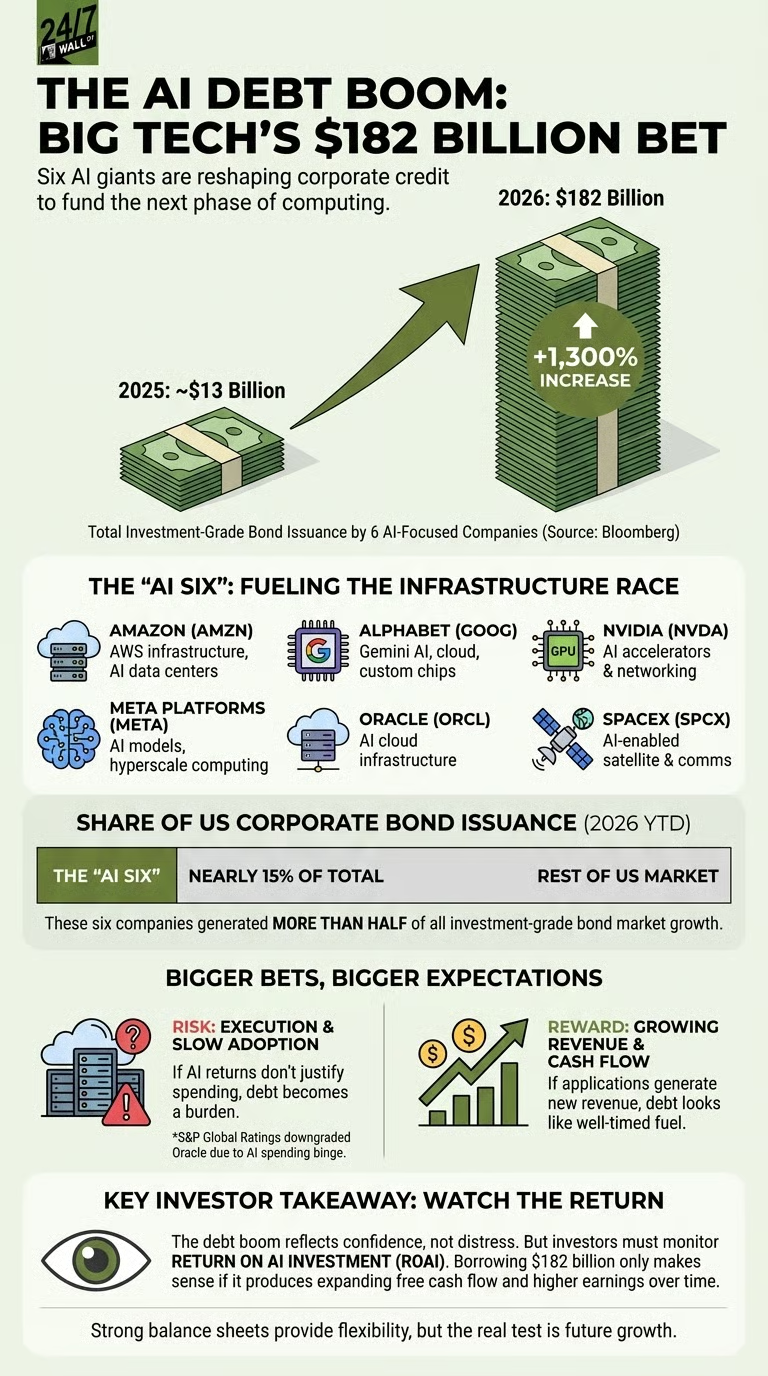
The technology sector is currently in the midst of an unprecedented capital expenditure surge, with the "Magnificent Seven" companies collectively pouring hundreds of billions into AI infrastructure. This aggressive investment, totaling an estimated $630 billion to $700 billion in 2026 alone from Amazon, Google, Meta, and Microsoft, dwarfs previous tech buildouts and signals a profound industry-wide bet on artificial intelligence. Investors are now keenly watching Q2 earnings to determine if this colossal spending is translating into tangible revenue growth and sustainable margins, or if the industry is building ahead of demand, risking an "AI bubble" scenario.

Amazon, for instance, has committed a staggering $200 billion to its capital expenditure budget for 2026, primarily focused on expanding AWS data centers and developing in-house AI chips. Alphabet is not far behind, projecting $175 billion to $185 billion in CapEx, with approximately 60% allocated to AI servers like GPUs and TPUs. Microsoft's annualized run rate points towards nearly $150 billion in spending, while Meta Platforms plans to invest $115 billion to $135 billion, its most aggressive infrastructure buildout to date. These figures highlight the scale of the "AI infrastructure war," where dominance is increasingly tied to physical assets rather than just software.

The market's reaction to this spending has been mixed, reflecting a core tension: the promise of AI versus the immediate financial strain. While investors recognize the long-term potential of building the "railroads and power grids of the digital era," there's growing anxiety about the timing and visibility of returns. Early 2026 earnings calls saw shares of Microsoft and Amazon slide after signaling CapEx plans that exceeded expectations, despite strong cloud and ad growth. Conversely, Meta's stock surged on evidence of AI-driven ad lift and a disciplined cost outline, demonstrating that the market is rewarding firms that can demonstrate revenue and margin payback alongside increased investment.

This massive CapEx surge has significant implications for free cash flow (FCF). Analysts warn that big tech FCF could drop by up to 90% in 2026 as capital expenditure dramatically outpaces revenue growth from nascent AI products. Amazon, for example, is projected to face negative free cash flow of $17 billion to $28 billion, while Alphabet's FCF could plummet from $73.3 billion in 2025 to $8.2 billion this year. The question for Q2 is whether these companies can demonstrate enough AI-driven revenue acceleration to alleviate these FCF concerns and justify the unprecedented investment.

How Are Big Tech Giants Monetizing Their AI Bets?

The enormous capital expenditure by Big Tech on AI infrastructure is only one side of the coin; the other, more critical side, is how these companies plan to monetize these investments and translate them into sustainable profits. Q2 earnings will be a crucial litmus test for whether the promised AI supercycle is delivering tangible returns, particularly in high-margin segments like cloud computing and digital advertising. Investors are looking for clear evidence that the "build it and they will come" strategy for AI is paying off.

Google Cloud's performance will be a key indicator for Alphabet, with analysts expecting around 25% year-over-year growth. A surge to over 40% YoY growth would signal successful monetization of its massive AI backlog, potentially triggering a broader rally in AI infrastructure stocks. However, growth below 30% would suggest struggles in monetizing Gemini 3 integrations at scale, despite the heavy CapEx. Alphabet is also targeting $75 billion to $78 billion in total advertising revenue, with a focus on whether AI-powered search improves or weakens ad click-through rates and if YouTube Shorts monetization continues to grow.

Microsoft's Azure cloud unit is another focal point, with expectations for 37-38% growth. Achieving 40% growth or more would confirm strong AI demand and enterprise cloud expansion, bolstering investor confidence. The company's rollout of Maia 200, its second-generation in-house AI chip, is also critical. Success here could significantly reduce Microsoft's reliance on Nvidia, potentially expanding Azure's gross margins, which have been under pressure due to high hardware costs. Forward guidance from Microsoft will be closely watched, as an upgraded outlook could push technology indices higher.

For Amazon, the focus remains squarely on AWS growth, which accelerated to 24% YoY at the end of 2025. The market needs to see that AI demand is robust and supply-constrained, rather than slowing due to reduced customer spending. A growth rate of 28% or more would be a strong bullish signal, while anything below 22% would raise fears that AI investments are not yielding sufficient returns. Amazon also needs to demonstrate continued strength in retail ad revenue, targeting over $18 billion, to offset some of the CapEx pressure. The challenge for all these hyperscalers is to show that their massive investments are not just building capacity, but actively generating high-margin revenue streams that justify the unprecedented spending.

What Does Increased AI Competition Mean for Big Tech?

The AI landscape is rapidly evolving, with competition shifting dramatically from a focus on algorithmic prowess to an all-out infrastructure war. This strategic pivot means Big Tech companies are now locked in a fierce battle to secure physical assets like data centers, power, and semiconductors, rather than just competing on model performance. The implications for market share, supply chain dynamics, and even energy markets are profound, and Q2 earnings will offer a glimpse into who is winning this capital-intensive race.

The competitive dynamics are particularly evident in the cloud sector. OpenAI, once heavily reliant on Microsoft, has diversified its partnerships, striking multibillion-dollar agreements with Nvidia, Broadcom, Oracle, Amazon, and Google. This move signals a broader trend where even leading AI developers are seeking multiple infrastructure partners, intensifying the competition among hyperscalers. Microsoft, in response, is pushing its own Maia 200 AI chip, aiming to reduce its dependence on Nvidia and gain greater control over its hardware costs and supply chain. This vertical integration strategy is a direct outcome of the escalating infrastructure war.

Google is also making significant strides in the AI chip space with its TPUs (Tensor Processing Units) and has recently expanded chip deals with Broadcom and Anthropic. This move not only strengthens Google Cloud's offerings but also positions Alphabet as a key supplier in the AI ecosystem, potentially generating an additional $2.5 billion to $7.5 billion in high-margin revenue in 2026 and 2027. Furthermore, Google's deal with Apple to use its Gemini model for Siri's overhaul is a massive vote of confidence, but it also raises questions about the financial terms and potential impact on Google's existing search revenue, as AI-powered search could cannibalize traditional ad-driven queries.

The shift to infrastructure also means securing stable power supplies, with companies like Microsoft and Meta even exploring direct investment in power plant construction. This "energy war" underscores the extreme capital requirements of the new AI era. Nvidia, as the dominant supplier of AI chips, remains a critical player, with its data center revenue expected to show around 70% growth. However, the increasing in-house chip development by hyperscalers could eventually temper Nvidia's growth trajectory, creating a more diversified and competitive chip market. The Q2 reports will reveal which companies are best navigating this complex, capital-intensive competitive landscape.

How Are Social Media Addiction Lawsuits Impacting Meta and Google?

Beyond the intense AI race, Meta Platforms and Alphabet's Google are facing a growing legal storm centered on social media addiction, with recent verdicts and ongoing lawsuits posing significant financial and operational risks. This wave of litigation marks a critical shift in legal strategy, moving away from First Amendment and Section 230 defenses to tort law theories that accuse platforms of designing defective products that cause harm, particularly to children and adolescents. The outcomes of these cases could force fundamental changes in how these platforms operate, impacting their core business models.

In a landmark development, a Los Angeles jury recently found Meta and YouTube (owned by Google) negligent in a personal injury case, awarding approximately $6 million. This verdict, representing a test case for thousands of plaintiffs, highlights increasing judicial scrutiny on tech companies' legal responsibilities. Even more impactful, a New Mexico jury ordered Meta to pay $375 million for failing to adequately protect minors from child predators. These rulings are not isolated incidents; attorneys general in over 40 states have sued Meta, alleging the company deliberately designed features to addict children, and an Oakland court is set to decide if platforms like Meta, TikTok, Snap, and YouTube are defective products.

The legal theories being deployed are particularly challenging for Big Tech. Instead of focusing on content, which has historically been protected by Section 230 of the Communications Decency Act, plaintiffs are arguing that the design of social media platforms themselves constitutes a public nuisance or a defective product. For example, New Mexico is contending that Meta's platform architecture harms the general public, and if the judge agrees, the remedy could be an "abatement" – a court order requiring Meta to eliminate the harmful condition. This could entail court-mandated real age verification, algorithm changes, and even independent monitors overseeing compliance.

The financial and reputational fallout is already evident. Meta's stock has fallen about 13% this year and is down nearly 30% from its 52-week high of $796.25, with investor concerns over these lawsuits contributing to the negative sentiment. While the immediate financial awards are significant, the long-term impact of potential regulatory changes and mandated platform redesigns could be far more substantial, affecting user engagement, advertising revenue, and operational costs. Q2 earnings calls will likely see analysts pressing Meta and Google for updates on these legal challenges and their potential impact on future profitability and product development.

What Does This Mean for Investors in Q2 2026?

For investors, Q2 2026 presents a complex and high-stakes environment for Big Tech, where the narrative has shifted from pure growth to a critical evaluation of return on investment and risk management. The unprecedented AI capital expenditure, intensifying competition, and mounting legal challenges collectively create a landscape demanding careful analysis beyond headline revenue figures. This earnings season will differentiate companies that can effectively monetize their AI bets from those that are merely spending heavily, and those that can navigate regulatory headwinds from those that face significant operational overhauls.

Companies demonstrating strong cloud growth, particularly in AI-driven services, and showing early signs of margin expansion despite CapEx, will likely be rewarded. Microsoft's ability to show Azure growth above 40% and positive traction with its Maia 200 chip will be crucial. Similarly, Google Cloud's performance and the monetization of AI in its core advertising business will be key. For Amazon, the market needs to see robust AWS growth to justify its massive spending, while Meta must prove its AI investments are translating into sustained ad revenue growth and that its operating margins remain resilient amidst its infrastructure buildout.

The legal challenges facing Meta and Google introduce a new layer of uncertainty. Investors should pay close attention to management commentary regarding these lawsuits, any provisions for potential liabilities, and, most importantly, any forward guidance on how platform design or operational strategies might be adjusted. The possibility of court-ordered algorithm changes or stringent age verification could impact user engagement and, consequently, advertising revenue, making these legal battles a material financial risk.

Ultimately, Q2 earnings will serve as a critical checkpoint for the "Magnificent Seven." The market is no longer content with aspirational AI roadmaps; it demands concrete evidence of monetization, disciplined capital allocation, and effective risk mitigation. Investors should scrutinize segment performance, free cash flow trends, and forward guidance for signs of sustainable profitability in this new, capital-intensive AI era.

The upcoming Q2 earnings season for Big Tech will be a defining moment, separating the true AI winners from those merely participating in the spending spree. Investors must look beyond the hype and focus on tangible returns, operational efficiency, and the ability to navigate a rapidly evolving regulatory and competitive landscape. The companies that demonstrate clear monetization pathways for their massive AI investments, while effectively managing legal and competitive pressures, will be best positioned for long-term success.


Want deeper research on any stock? Try Kavout Pro for AI-powered analysis, smart signals, and more. Already a member? Add credits to run more research.

SHARE THIS ON:

Related Articles

Category

You may also like

News1 week ago

Big Tech's $635 billion AI spending faces energy shock test, S&P Global says

Big Tech's $635 billion AI spending faces a major hurdle as the Middle East crisis clouds energy cost prospects, according to S&P Global research head Melissa Otto.
Stock News3 weeks ago

Nvidia Just Spent More Than Iceland's Economy In 30 Days — What Is Jensen Huang Building?

NVIDIA committed over $36 billion to AI partners and suppliers in just over a month, an expenditure roughly equivalent to Iceland's entire annual economic output.
Stock News2 months ago

The $530 Billion AI Question: Which Big Tech Stock Is Winning?

Big Tech plans $530B AI infrastructure spending by 2026, but monetization remains unclear. Meta sees improved advertiser ROI from AI models. Google currently leads, monetizing AI directly via Search a...
Stock News2 months ago

AI Spending Forecasts Reach Jaw-Dropping Heights

AI expenditures are accelerating, leading to prominent doubts regarding whether the consistently rising spending levels are justified by current performance metrics.

Breaking News

View All →

Top Headlines

View More →
Stock News2 hours ago

Nvidia vs. Micron: Which AI Chip Stock Has More Upside Potential?

Stock News3 hours ago

2 Monster EV Stocks Worth Owning While the Sector Is Still Out of Favor

Stock News4 hours ago

The S&P 500 smashed back above 2 key moving averages, in a rare display of strength. Here's what history shows happens next.

Stock News4 hours ago

5 Artificial Intelligence (AI) Stocks Trading at Bargain Prices After the March Correction

Stock News4 hours ago

Apple: The Infrastructure Play On Local AI Adoption