MarketLens

Log in

Is NVIDIA's AI Dominance Unassailable, or is AMD Closing the Gap

2 days ago
SHARE THIS ON:

Is NVIDIA's AI Dominance Unassailable, or is AMD Closing the Gap

Key Takeaways

  • NVIDIA maintains a commanding lead in the AI chip market, driven by its integrated hardware-software ecosystem and superior growth rates, justifying its premium valuation.
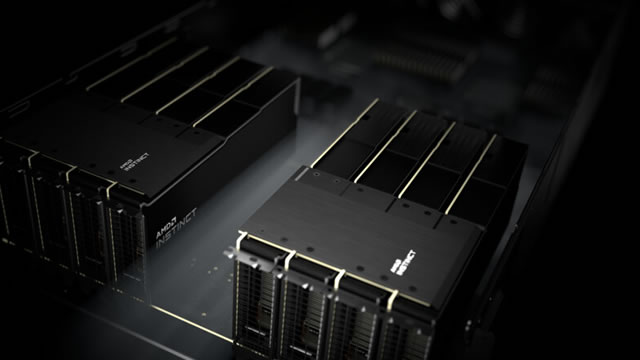
  • Advanced Micro Devices, despite a recent 20% stock pullback, is rapidly gaining traction with its Instinct accelerators and strategic partnerships like the $10 billion OpenAI deal, positioning it as a credible challenger.
  • While NVIDIA offers stability and continued dominance, AMD presents a higher-risk, higher-reward opportunity for investors seeking exposure to a rapidly expanding AI market with significant upside potential if it executes flawlessly.

Is NVIDIA's AI Dominance Unassailable, or is AMD Closing the Gap?

The semiconductor landscape is currently defined by the insatiable demand for artificial intelligence (AI) compute, and at the heart of this revolution are NVIDIA (NASDAQ: NVDA) and Advanced Micro Devices (NASDAQ: AMD). NVIDIA, the undisputed leader, has seen its shares surge an astonishing 1,110% since 2023, riding the crest of the AI wave. However, AMD has also delivered impressive returns, climbing 209% over the same period, with a notable 65% gain since 2025, outpacing NVIDIA's 30% in that specific timeframe. This dynamic sets the stage for a critical question: which AI powerhouse offers the superior investment opportunity for 2026 and beyond?

NVIDIA currently trades at $190.74, commanding a staggering market capitalization of $4.64 trillion. Its growth has been nothing short of phenomenal, with TTM revenue soaring 114.2% year-over-year and net income jumping 144.9%. This performance is largely fueled by its data center segment, which saw a 66% growth rate in Q3 2025, with analysts expecting a 67% company-wide growth for Q4. The company's full-stack approach, integrating hardware, networking, and its foundational CUDA software ecosystem, has created a formidable moat that continues to drive its market leadership.

On the other side, AMD, currently priced at $195.32 with a market cap of $318.44 billion, has experienced a recent 2.42% dip today and a more significant 20% drop over the last month. Despite this pullback, AMD's Q4 2025 results were strong, with revenue of $10.3 billion beating estimates and data center revenue growing 39% year-over-year to $5.4 billion, driven by demand for its Instinct MI440X AI accelerator. The company's strategic moves, including a landmark partnership with OpenAI, suggest it is aggressively challenging NVIDIA's dominance, making this a compelling comparison for investors.

The core of this analysis will delve into each company's competitive advantages, growth catalysts, valuation metrics, and the inherent risks. We'll examine whether NVIDIA's established ecosystem and superior margins make it the safer bet, or if AMD's aggressive product roadmap and strategic partnerships offer a more attractive entry point and greater upside potential in the evolving AI landscape. The market is clearly betting big on AI, but discerning the long-term winner requires a deeper look beyond recent stock performance.

What Are NVIDIA's Key Strengths and Growth Catalysts in AI?

NVIDIA's strength in the AI market is not merely about its cutting-edge GPUs; it's a multi-layered competitive moat built over decades. At its core is the CUDA software ecosystem, a platform launched in 2006 that has become the de facto standard for AI development. Millions of developers have built applications and models on CUDA, creating immense switching costs for customers. This deep entrenchment means that even if competitors offer technically comparable hardware, migrating away from NVIDIA's established software stack is a costly and risky proposition for hyperscalers and enterprises.

The company's market share further solidifies its position. NVIDIA commanded an estimated 92% of the global GPU market at the end of Q3 fiscal 2025, a testament to its technological lead and ecosystem lock-in. This dominance translates into significant pricing power and robust profitability, with TTM gross margins at an impressive 70.1% and net margins at 53.0%. Analysts expect NVIDIA to sustain gross margins around 75% in fiscal 2027, driven by its high-margin data center GPUs and growing software and services business.

Looking ahead to 2026, several catalysts are poised to drive NVIDIA's continued growth. The upcoming launch of its Vera Rubin systems (R100 platform) in the second half of 2026 is expected to spark another significant hardware upgrade cycle, following the success of its Blackwell systems. Furthermore, the shift from AI "training" to "inference" – the daily use of AI models – is anticipated to expand the volume of chips needed by an order of magnitude. NVIDIA is also aggressively moving towards a software-as-a-service (SaaS) model with its AI Enterprise suite, offering more stable, recurring revenue streams.

Beyond traditional data centers, NVIDIA is tapping into emerging trends like "Sovereign AI," where nations are building their own national AI clouds, and the expansion into "Edge AI" and humanoid robotics using its Isaac platform. These new demand sources, coupled with the industry's transition to HBM4 (high-bandwidth memory 4), which is critical for next-gen models, ensure a diverse and robust growth trajectory for NVIDIA. The company's ability to innovate across hardware, software, and networking, combined with its overwhelming market share, makes its dominance a formidable force in the AI era.

How is AMD Challenging NVIDIA's Lead in the AI Chip Market?

Advanced Micro Devices is not merely a distant second; it's rapidly emerging as a credible alternative to NVIDIA, leveraging its strong product roadmap and strategic partnerships to chip away at the market leader's dominance. The company's recent Q4 2025 earnings highlighted significant momentum, with $10.3 billion in revenue and data center revenue surging 39% year-over-year to $5.4 billion, primarily driven by its Instinct MI440X AI accelerator. This performance demonstrates AMD's increasing traction in the critical AI segment.

A pivotal moment for AMD came with its multi-year, multi-generation partnership with OpenAI, announced in October 2025. This landmark deal involves OpenAI deploying 6 gigawatts (GW) of AMD Instinct GPUs to power its next wave of AI infrastructure, starting with a 1 GW rollout of MI450 GPUs in H2 FY 2026. This agreement is expected to generate tens of billions of dollars in revenue for AMD and be highly accretive to its non-GAAP earnings per share, validating the performance and scalability of AMD's AI accelerators for enterprise-level AI workloads.

AMD's competitive strategy also hinges on offering cost-effective solutions and focusing on memory leadership. While NVIDIA's full stack often commands a premium, AMD's products are generally cheaper, which can be a significant advantage when capital budgets tighten. The company's Instinct MI300X and MI350X chips are already supporting AI workloads, and the upcoming MI400 series (CDNA "Next") in 2026 promises continued performance improvements. This aggressive product cadence, combined with its strong EPYC CPU portfolio, which holds over 50% market share among hyperscalers, allows AMD to offer a compelling integrated solution.

Despite its progress, AMD acknowledges the challenge of NVIDIA's entrenched CUDA ecosystem. However, it is making significant strides with its open-source ROCm software stack, which has seen substantial improvements, including a 2.7x inferencing performance increase for MI300X since launch. While still trailing CUDA in maturity and ecosystem breadth, the continuous development and expanding framework support are crucial for attracting developers and reducing customer switching costs. AMD's ability to succeed as a strong #2 player will depend on its focus on differentiation, cost-effectiveness, and building customer loyalty through consistent execution.

How Do Their Valuations and Financials Stack Up?

When comparing NVIDIA and AMD, the valuation metrics reveal a tale of two different investment profiles, albeit both trading at premiums reflecting the high growth expectations in the AI sector. NVIDIA, with its dominant market position and explosive growth, trades at a TTM P/E of 46.78x. While this might seem high, it's considerably lower than AMD's TTM P/E of 73.53x. Looking at forward earnings, the discrepancy narrows but still favors NVIDIA, with some reports indicating NVIDIA at 23x forward earnings compared to AMD's 30x to 31x.

NVIDIA's financial health is exceptional, marked by superior margins and robust cash flow generation. Its TTM gross margin of 70.1% and net margin of 53.0% far outstrip AMD's 49.5% gross margin and 12.5% net margin. This margin advantage gives NVIDIA greater pricing power and flexibility for R&D investments. Furthermore, NVIDIA's TTM revenue growth of 114.2% and net income growth of 144.9% are significantly higher than AMD's 34.3% revenue growth and 164.2% net income growth, though AMD's net income growth is impressive from a smaller base.

From an efficiency standpoint, NVIDIA also leads. Its Return on Equity (ROE) is an astounding 103.8%, compared to AMD's 7.2%. Similarly, NVIDIA's Return on Assets (ROA) is 61.6%, versus AMD's 5.6%. These metrics underscore NVIDIA's ability to generate substantial profits from its assets and shareholder equity. Both companies maintain healthy balance sheets with low debt-to-equity ratios (NVDA: 0.09, AMD: 0.07) and strong current ratios (NVDA: 4.47, AMD: 2.85), indicating solid liquidity.

Despite AMD's higher TTM P/E, its forward P/E of 31x and a PEG ratio of 0.7 (according to one source) suggest that its growth is reasonably priced, especially given its impressive 217% year-over-year earnings growth. However, the market is clearly paying a premium for AMD's potential to capture a larger share of the AI market. NVIDIA's valuation, while high in absolute terms, appears more justified by its current growth rates, market dominance, and superior profitability. Investors must weigh AMD's higher growth potential from a smaller base against NVIDIA's established leadership and financial strength.

What Are the Key Risks and Headwinds for Both AI Giants?

Even with their formidable positions, both NVIDIA and AMD face significant risks that could impact their future performance. For NVIDIA, a primary concern is CapEx digestion by hyperscalers. There's a persistent fear that after massive investments in AI infrastructure, these large customers might slow down orders, leading to a multi-quarter slowdown. While analysts have consistently underestimated AI capital expenditures, this remains a potential headwind. Another risk is software portability. Open-source tools like OpenAI’s Triton and Meta’s PyTorch are making it easier for developers to write code not locked into NVIDIA’s CUDA ecosystem, potentially eroding its moat over time.

NVIDIA also faces supply concentration risks, being heavily dependent on TSMC for manufacturing and SK Hynix/Samsung for high-bandwidth memory. Any disruption in the Taiwan Strait, for instance, could pose a significant "black swan" event. Furthermore, increased competition from AMD's improving offerings, Intel's Gaudi series, and custom silicon from "Magnificent Seven" companies like Google (TPUs), Amazon (Trainium), and Meta (MTIA) could pressure NVIDIA's market share and margins, despite its current dominance.

For AMD, the biggest challenge remains the ROCm software maturity gap compared to CUDA. While improving, it still lags in ecosystem breadth and developer tools, making it harder to attract and retain customers accustomed to NVIDIA's robust platform. AMD's performance per watt also trails NVIDIA in some workloads, and its interconnect technology is less advanced than NVLink, which could limit its appeal for the most demanding, large-scale AI deployments. The company also needs to prove its long-term viability for enterprise commitments and navigate intense competition from multiple directions.

Industry-wide risks also loom large. The sustainability of AI spending is questioned, with concerns about potential infrastructure oversupply and pressure on the return on investment (ROI) for AI initiatives. Technology disruption could also shift the landscape, with more efficient AI architectures or breakthroughs in model efficiency reducing overall compute requirements. Regulatory scrutiny, particularly antitrust concerns for NVIDIA, and geopolitical tensions impacting supply chains are additional factors that could introduce volatility and uncertainty for both companies.

The Road Ahead: Which Offers Superior Upside Potential for 2026?

Considering the comprehensive analysis, both NVIDIA and Advanced Micro Devices are poised to capitalize on the booming AI market, but they offer distinct risk-reward profiles for investors looking to 2026 and beyond. NVIDIA, with its unassailable market leadership, robust financial performance, and deep ecosystem moat, represents a more stable, albeit premium-priced, investment in the AI revolution. Its consistent innovation, strong margins, and clear growth catalysts like the Rubin launch and expansion into Edge AI and software services provide a compelling case for continued outperformance. Wall Street analysts have a consensus price target of $267.00 for NVDA, implying a significant upside from its current $190.74.

AMD, on the other hand, presents a higher-risk, higher-reward proposition. Despite its recent stock pullback, the company's aggressive product roadmap, particularly with the Instinct MI450 and MI400 series, and its landmark $10 billion OpenAI partnership, signal a serious challenge to NVIDIA's dominance. AMD's ability to offer competitive performance at a potentially lower cost, coupled with its improving ROCm software stack, positions it to capture a larger share of the rapidly expanding AI market. Analysts project a consensus price target of $288.46 for AMD, suggesting even greater upside from its current $195.32.

For investors prioritizing market leadership, proven execution, and superior profitability, NVIDIA remains the "no-brainer" pick, as some analysts suggest. Its ability to command premium pricing and maintain high margins, even amidst increasing competition, underscores its enduring strength. However, for those with a higher risk tolerance and a belief in AMD's ability to flawlessly execute its strategy and close the software gap, the company offers a more attractive entry point and potentially greater percentage gains as it expands its market share from a smaller base.

Ultimately, the choice between NVIDIA and AMD hinges on an investor's individual strategy and outlook. NVIDIA is the incumbent king, likely to maintain its reign through 2026, while AMD is the ambitious challenger with significant momentum. Both are strong buys in the AI space, but AMD's recent dip and its strategic wins could position it for a more explosive recovery and outperformance if it continues to deliver on its promises.

For investors seeking exposure to the AI boom, both NVIDIA and AMD offer compelling opportunities, but with different risk-reward dynamics. NVIDIA remains the dominant force, a high-quality growth stock, while AMD is the aggressive challenger with significant upside if it executes flawlessly. Diversification across both could provide a balanced approach to capture the full potential of the AI revolution.


Want deeper research on any stock? Try Kavout Pro for AI-powered analysis, smart signals, and more. Already a member? Add credits to run more research.

SHARE THIS ON:

Related Articles

Category

You may also like

No related articles available

Breaking News

View All →

No topics available at the moment