MarketLens
Is Restaurant Brands International's Stock Price Running Ahead of Its Fundamentals

Key Takeaways
- Restaurant Brands International (QSR) has seen its stock rise 6.7% year-to-date, but retail investors on Reddit remain unconvinced by its 2028 growth plan due to persistent brand underperformance.
- While Wall Street analysts maintain a "Buy" consensus with an average price target of $81.57, concerns over Popeyes' declining sales and Burger King US store closures present a tangible challenge to QSR's ambitious targets.
- QSR's strategic pivot to a 99% franchised model and a focus on international expansion, alongside capital returns like a $500 million share buyback, aims to unlock long-term value, but execution risks remain high.
Is Restaurant Brands International's Stock Price Running Ahead of Its Fundamentals?
Restaurant Brands International (NYSE: QSR) has enjoyed a robust start to 2026, with its stock climbing 6.7% year-to-date, currently trading at $72.01 and nudging its 52-week high of $74.42. This positive price action, however, appears to be outstripping conviction among a significant segment of the investing public. Retail investor sentiment on platforms like Reddit sits at a modest 58 out of 100, signaling a cautious skepticism that the company's ambitious 2028 growth plan might be more aspirational than achievable.
This divergence between market performance and retail sentiment creates a fascinating tension. On one side, Wall Street analysts largely maintain a "Buy" rating, with a consensus price target of $81.57 and some bullish outlooks reaching as high as $90.00. They point to QSR's strong international segment growth and strategic refranchising efforts as key drivers. Yet, the Reddit community, particularly on r/wallstreetbets, is scrutinizing the underlying operational realities, questioning whether the company can truly deliver on its promise of 5%+ net restaurant growth and predictable earnings by 2028.
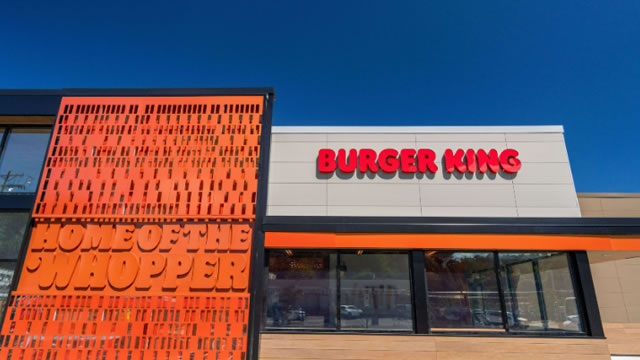
The core of this skepticism stems from specific brand-level challenges. Popeyes, for instance, saw its sales fall 3.2%, while Burger King US experienced a 2.9% drop in store count. These domestic headwinds are directly impacting the credibility of QSR's long-term vision, even as the company touts a successful refranchising strategy that exceeded 2025 guidance with over 100 units completed. Investors are keenly watching whether Popeyes can stabilize under new leadership and if Burger King's domestic revitalization, including a $550 million "Royal Reset" initiative, can reverse its declining footprint.
The company's latest earnings report for Q4 2025 showed system-wide sales growth of 5.8%, with international leading at 6.1%, and adjusted EPS of $0.96, beating expectations. Despite these headline numbers, the market is clearly looking beyond the immediate quarter, focusing on the structural issues within its key North American brands. The question isn't just about current performance, but about the sustainable path to the $10.1 billion revenue and $2.0 billion earnings projected for 2028.
What’s Fueling the Reddit Skepticism Around QSR's 2028 Growth Plan?
Reddit investors are largely unconvinced by Restaurant Brands International's 2028 growth plan, primarily due to the persistent underperformance of key domestic brands and the perceived disconnect between management's projections and on-the-ground realities. The tone on r/wallstreetbets is "cautiously skeptical," with users highlighting specific operational challenges that cast doubt on the company's ability to achieve its ambitious targets, such as 5%+ net restaurant growth and an "investment grade" credit rating by 2028.
Three critical business realities are shaping this skeptical view. First, Popeyes' domestic struggles are a major concern. Despite its past "chicken sandwich wars" success, Popeyes' sales fell 3.2% in Q4 2025, and its US comparable sales were down 4.9% for the full year. This persistent underperformance in a highly competitive segment raises questions about the brand's ability to contribute meaningfully to the overall growth algorithm. Investors are looking for concrete evidence that management's renewed emphasis on the banner's core menu, operations, and franchisee profitability will translate into sustained positive comparable sales.
Second, Burger King's domestic footprint is shrinking, with the US store count dropping 2.9%. While the company is investing $550 million in its "Royal Reset" initiative for remodels, relocations, and technology upgrades, the net decline in units is a red flag. The refranchising strategy, while exceeding 2025 guidance with over 100 units completed, needs to accelerate significantly to offset closures and drive the projected 5%+ net restaurant growth. The market wants to see a clear path to reversing this trend, especially as the company aims for a 99% franchised model by 2027.
Finally, the overall debt profile and the sustainability of capital returns are under scrutiny. QSR's debt-to-equity ratio stands at 4.84, and Net Debt/EBITDA is 6.87, indicating significant leverage. While management aims to reduce debt and achieve an investment-grade credit rating by 2028, and has announced a $500 million share repurchase program as part of a $1.6 billion capital return plan, the high dividend payout ratio of 141.8% (on a 3.49% yield) raises questions about its long-term sustainability if earnings don't improve dramatically. The market is demanding a "show-me story," as Morgan Stanley put it, where execution validates the financial engineering.
How Does Wall Street's Optimism Stack Up Against Retail Concerns?
Wall Street analysts largely maintain a "Buy" consensus for QSR, with an average price target of $81.57, significantly above the current trading price of $72.01. This optimism stems from several factors, including QSR's strong international growth, its strategic shift towards an asset-light, fully franchised model, and its commitment to returning capital to shareholders. Analysts see QSR as undervalued, with DCF models suggesting an intrinsic value near $83.00 per share, implying a 13–20% discount to its long-term cash flow potential.
The bullish case often highlights QSR's international prowess. While domestic brands face headwinds, the international segment is a consistent growth engine. Burger King Japan, for instance, saw sales rise 22%, and international Adjusted Operating Income (AOI) jumped 30.5% in Q4 2025. The joint venture with CPE to accelerate Burger King's growth in China, backed by $350 million in committed investment, is seen as a significant white-space opportunity. This global expansion, particularly through the franchise-led model in markets like China, India, and Brazil, is expected to drive double-digit unit and system-wide sales growth, supporting recurring, capital-light revenue streams.
Analysts also applaud QSR's strategic pivot towards a 99% franchised model by 2027, a year earlier than initially planned. This shift is expected to enhance capital efficiency, reduce capital expenditures (projected around $400 million for 2026), and generate predictable, high-margin royalty income. The company's commitment to a $2.60 per share annual dividend target (a 3.49% yield) and a $500 million share repurchase program in 2026 further reinforces the narrative of shareholder value creation. Stifel recently upgraded QSR from "Hold" to "Buy" with a $90.00 price target, citing these strategic developments as a path to "uninterrupted outperformance."
However, this optimism is tempered by the very concerns raised by retail investors. The "show-me story" aspect is crucial; analysts acknowledge that if management fails to execute on its plans, particularly in stabilizing Popeyes and reversing Burger King US declines, the premium valuation (TTM P/E of 30.99 vs. industry average around 21.7x) could quickly erode. Competitive pressures, such as value-driven price cuts by McDonald's, are also noted as potential challenges to traffic and margin outlook for QSR's burger brands. The gap between Wall Street's target and retail sentiment reflects this tension between strategic vision and operational reality.
What Are the Key Financial Metrics and Valuation Insights for QSR?
Restaurant Brands International's financial profile presents a mixed bag of robust returns and significant leverage, alongside a valuation that appears to be pricing in future growth. The company's market capitalization stands at $23.69 billion, with an Enterprise Value (EV) of $40.11 billion, reflecting its substantial debt load. While the TTM P/E ratio of 30.99 is above the hospitality industry average, analysts justify this premium by projecting 16% annual earnings growth.
Examining profitability, QSR demonstrates solid margins: a Gross Margin of 41.1%, Operating Margin of 23.7%, and a Net Margin of 8.2%. These figures, particularly the operating margin, highlight the efficiency of its largely franchised model. The company also boasts strong returns on equity (ROE) at 23.1%, well above the restaurant industry average, reflecting the operating leverage inherent in its asset-light strategy. However, Return on Assets (ROA) is a more modest 3.0%, and Return on Invested Capital (ROIC) is 6.9%, suggesting that while equity holders benefit, the overall capital deployed isn't generating exceptionally high returns relative to its cost.
Leverage remains a significant factor for QSR. The Debt-to-Equity (D/E) ratio is high at 4.84, and Net Debt/EBITDA is 6.87. While management is committed to reducing debt and achieving an investment-grade credit rating by 2028, this level of leverage introduces financial risk, especially in a rising interest rate environment. The current ratio of 0.98 indicates slightly less than ideal short-term liquidity, though this is common for asset-light franchise models with predictable cash flows.
From a growth perspective, FY2025 saw revenue growth of 12.2%, driven by system-wide sales growth of 5.3% for the full year. However, Net Income declined -24.0% and EPS fell -26.1%, which is a concerning trend that retail investors are keenly observing. Despite this, operating cash flow grew 14.0% and free cash flow (FCF) increased 11.3%. The TTM FCF Yield of 5.9% is attractive, and the P/FCF of 16.93 suggests a reasonable valuation based on its cash-generating ability. The quarterly dividend of $0.65 per share, yielding 3.49%, is a draw for income investors, but the 141.8% payout ratio indicates it's currently exceeding TTM earnings, relying on future earnings growth or other capital sources.
What Are the Key Risks and Opportunities for QSR Investors?
Investing in Restaurant Brands International comes with a distinct set of risks and opportunities, particularly as the company navigates its ambitious 2028 growth plan and shifts towards a nearly fully franchised model. Understanding these dynamics is crucial for any investor considering QSR.
On the opportunity front, QSR's international expansion and asset-light franchise model are significant tailwinds. The company's global footprint, with over 33,000 restaurants in 120+ countries, provides diversification and substantial white-space opportunities, especially in emerging markets like China and Brazil. The successful refranchising strategy, which aims for a 99% franchised model by 2027, is designed to generate predictable, high-margin royalty income with reduced capital expenditures. This capital-light approach, combined with a focus on digital transformation, loyalty programs, and AI-driven operational technologies, positions QSR to enhance order volume and boost per-store sales and EBITDA margins over time. Furthermore, the company's commitment to returning capital to shareholders through a $2.60 annual dividend and a $500 million share buyback in 2026 makes it attractive for income and total return-focused investors.
However, the risks are equally pronounced. The most immediate concern is the persistent underperformance of key domestic brands, specifically Popeyes and Burger King US. Popeyes' declining sales and Burger King US store closures directly challenge the credibility of the 2028 growth targets for 5%+ net restaurant growth. If these brands fail to stabilize and grow, the overall growth algorithm will be severely impacted. Macroeconomic pressures, including commodity inflation, rising labor costs, and shifts in middle-income consumer spending, could compress margins and reduce traffic, especially if competitive discounting intensifies.
Operational risks also loom large. Food safety issues, supply chain disruptions, and geopolitical events in QSR's vast international network could damage brand reputation and profitability. The highly leveraged balance sheet, with a D/E of 4.84 and Net Debt/EBITDA of 6.87, means the company is sensitive to interest rate fluctuations and needs flawless execution to achieve its investment-grade credit rating goal. Finally, the high dividend payout ratio of 141.8% is a warning sign; while management is confident in sustained cash generation, any significant earnings miss could put pressure on the dividend or the share repurchase program.
What Does This Mean for Investors Considering QSR?
For investors eyeing Restaurant Brands International, the current landscape demands a nuanced perspective. While the stock's 6.7% year-to-date gain and Wall Street's "Buy" consensus paint a positive picture, the underlying operational challenges, particularly with Popeyes and Burger King US, cannot be ignored. The market is clearly in a "show-me" phase, where management's ability to execute its 2028 growth plan will be the ultimate determinant of long-term shareholder value.
Here are three key things to watch:
- Popeyes' Turnaround: Monitor comparable sales and unit growth for Popeyes in North America. Any stabilization or return to positive growth will be a strong indicator that management's renewed focus is yielding results, validating a crucial part of the growth narrative.
- Burger King US Revitalization: Track the net store count and the impact of the $550 million "Royal Reset" initiative. A reversal of the declining unit trend and improved unit economics are essential to underpin the domestic segment's contribution to the 2028 targets.
- Debt Reduction & Capital Allocation: Keep an eye on QSR's progress towards reducing its debt and achieving an investment-grade credit rating. The sustainability of its $0.65 quarterly dividend and the $500 million share buyback program hinges on consistent free cash flow generation and prudent financial management.
QSR offers a compelling blend of income and potential growth, especially for investors who believe in the power of its international expansion and the long-term benefits of a capital-light franchise model. However, the skepticism from retail investors highlights real execution risks. Position sizing should reflect this risk profile; QSR could be a core, larger allocation for those confident in management's ability to deliver, or a smaller, higher-conviction satellite for those seeking exposure to the QSR sector with a watchful eye on its domestic brand performance.
Restaurant Brands International is a story of strategic ambition meeting operational reality. Its path to 2028 will be defined by how effectively it addresses its domestic brand challenges while leveraging its international strengths and capital-light model. Investors should remain vigilant, focusing on tangible improvements in brand performance and financial discipline to truly assess whether QSR can bridge the gap between its lofty targets and its current ground-level execution.
Want deeper research on any stock? Try Kavout Pro for AI-powered analysis, smart signals, and more. Already a member? Add credits to run more research.
Related Articles
Category
You may also like


1 Undervalued Stock That Could Rebound in 2026

Are You Looking for a High-Growth Dividend Stock?

Regions Financial Corporation (RF) Hit a 52 Week High, Can the Run Continue?
Breaking News
View All →Featured Articles
Top Headlines

Alibaba stock is falling as it spends heavily on AI. CEO Eddie Wu insists the tech will be its main growth driver
Apple's China iPhone Sales Are Up. Thank Memory Cost Increases.

S&P 500 Slides, Gold Crashes As $100 Oil Stokes Stagflation Fears: What's Moving Markets Thursday?

Alibaba: Enormous Price For A Tough Turnaround