MarketLens

Log in

Is Rockwell Automation Positioned for the Next Industrial Revolution

3 weeks ago
SHARE THIS ON:

Is Rockwell Automation Positioned for the Next Industrial Revolution

Key Takeaways

  • Rockwell Automation (ROK) is strategically pivoting towards high-margin software and services, leveraging AI, digital twins, and IIoT to drive recurring revenue streams.
  • Despite macroeconomic headwinds causing some project delays, strong demand in warehousing, life sciences, and energy sectors, coupled with robust Q1 FY2026 results, signals durable growth.
  • While ROK trades at a premium valuation, its strong cash flow, consistent dividend, and strategic investments in digital transformation position it as a long-term compounder in the evolving industrial landscape.

Is Rockwell Automation Positioned for the Next Industrial Revolution?

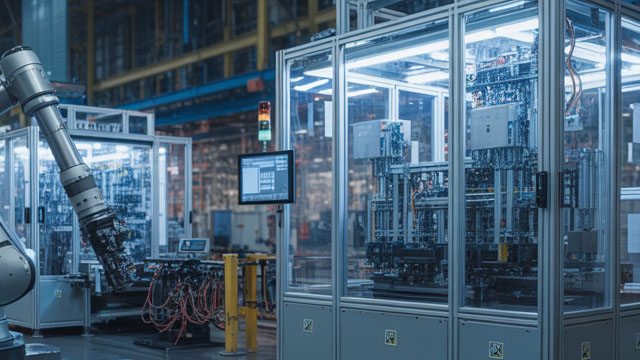
Rockwell Automation (NYSE: ROK) stands at the forefront of a profound shift in global manufacturing, transforming factories into intelligent, interconnected ecosystems. Trading at $407.45 as of February 27, 2026, the company is a pure-play leader in industrial automation and digital transformation, offering a comprehensive suite of hardware, software, and services. This integrated approach, particularly its focus on advanced software solutions, is critical as manufacturers worldwide grapple with rising operational costs, labor shortages, and the imperative for greater efficiency and resilience.

The broader industrial automation market is projected to grow at a robust 9.1% annually through 2035, a tailwind Rockwell is uniquely positioned to capture. Its core strength lies in enabling smart manufacturing plants through technologies like the Industrial Internet of Things (IIoT), artificial intelligence (AI), and digital twins. This isn't just about incremental improvements; it's about fundamentally rethinking production processes, moving from reactive maintenance to predictive optimization, and from manual controls to AI-driven automation.

Rockwell's strategy involves embedding intelligence at every layer of the industrial architecture, from shop floor devices to enterprise-level software. This allows customers to connect disparate devices and data sources, providing a single, secure view of operations. The company's market-leading hardware, software, and services are designed to help industrial firms navigate their digital transformation journeys, ensuring they remain competitive in an increasingly complex global supply chain environment.

The company's recent performance underscores this momentum. For fiscal Q1 2026, Rockwell reported a 12% increase in sales year-over-year, with organic sales up 10%. Adjusted EPS surged by 49% to $2.75, significantly beating expectations. These results reflect strong demand across core offerings and verticals, even as some customers continue to delay larger capital projects amidst global trade uncertainty.

How is Rockwell Leveraging AI and Software for Growth?

Rockwell Automation is making significant strides in integrating cutting-edge AI and software solutions, fundamentally reshaping its revenue profile towards higher-margin, recurring streams. The company's FactoryTalk Design Studio, enhanced with Microsoft's Azure OpenAI Service, exemplifies this shift. Engineers can now use natural language prompts with generative AI tools for tasks like product guidance, code generation, and troubleshooting, drastically accelerating design and deployment cycles. This isn't just a feature; it's a strategic move to embed AI directly into the industrial design process, making automation more accessible and efficient.

Beyond design, Rockwell's software portfolio, including FactoryTalk Analytics LogixAI and Plex, is empowering operational technology (OT) personnel with out-of-the-box AI for production optimization. Plex, a cloud-native platform, had its "strongest quarter yet" with significant customer wins, such as R.H. Sheppard adopting it for operational control and scalable expansion. This focus on cloud-native solutions and AI-enabled modules like demand planning highlights Rockwell's commitment to delivering tangible operational improvements for its clients.

The adoption of digital twin technology, particularly through Emulate3D software, is another key driver. Customers are increasingly using digital twins for simulation and optimization, reducing physical prototyping and accelerating time-to-market. The new Bologna Customer Experience Center in Italy, opened in February 2026, provides EMEA customers with hands-on access to these tools, fostering adoption of Rockwell’s higher-margin digital solutions and reinforcing the push toward more resilient, recurring revenue streams.

This strategic pivot is already yielding results. Rockwell reported annual recurring revenue growth of 7% in Q1 FY2026, driven by strong performance in recurring software across automotive, life sciences, and energy sectors. This shift towards software and services not only boosts margins but also creates a steadier, more predictable revenue stream, enhancing the company's financial resilience against cyclical hardware sales.

What are the Key Market Tailwinds Driving Rockwell's Expansion?

Rockwell Automation is benefiting from several powerful structural growth drivers that are reshaping global manufacturing. One significant tailwind is the surging demand in warehousing and eCommerce automation, where discrete sales grew by over 60%, primarily driven by North American customers. Investments in Manufacturing Execution Systems (MES), digital twins, and AI-enabled modernization tools are fueling this expansion, as companies seek to optimize logistics and fulfillment processes to meet evolving consumer demands.

The life sciences sector is also experiencing renewed investment, with pharmaceutical manufacturers accelerating reshoring efforts. This trend is supported by more than $350 million in planned U.S. capacity expansion, creating substantial demand for Rockwell’s advanced automation and control solutions. These modernization initiatives, focused on automation, digital twins, and advanced controls, are becoming essential for margin enhancement and regulatory compliance across industrial operations.

Furthermore, the energy sector is providing tailwinds, particularly as data center operators adopt microgrids and gas-fired power solutions to address grid constraints. Rockwell’s industrial controls are gaining traction in this area, offering critical infrastructure for reliable and efficient power management. The company's renewable energy solutions also enable efficient, sustainable energy production, aligning with global sustainability goals and expanding its addressable market.

Rockwell's strategic focus on these high-growth verticals, combined with its enterprise-wide integration of AI, is boosting supply chain efficiency and driving down operating expenses for its customers. The company is scaling U.S. production capacity to keep pace with strengthening demand for digital services, edge computing solutions, and cloud-native software. While large customers may still delay major capital expenditure projects due to global uncertainty, the imperative for modernization initiatives remains a durable growth catalyst, ensuring a steady pipeline of demand for Rockwell's offerings.

How Do Rockwell's Financials Stack Up Against Its Valuation?

Rockwell Automation's financial performance in Q1 FY2026 demonstrated significant strength, with reported sales up 12% to $2.11 billion and adjusted EPS soaring 49% to $2.75. This robust start to the fiscal year underscores the accelerating adoption of industrial automation. The company's total segment margin reached 20.7%, driven by higher volume, favorable mix, and productivity initiatives, reflecting disciplined cost management and operating leverage.

Looking ahead, management has reaffirmed its fiscal 2026 organic sales growth guidance of 2-6% and raised the EPS midpoint to $11.80, reflecting discrete tax benefits and continued momentum in recurring revenue and AI/digital twin adoption. Analysts largely concur, with a consensus price target of $436.56 and a median of $448.00, suggesting potential upside from the current $407.45 share price. However, the analyst consensus rating is a "Hold" from 39 analysts, with 23 recommending "Hold" and 13 "Buy," indicating a balanced view on its current valuation.

From a valuation perspective, Rockwell trades at a premium. Its TTM P/E ratio stands at 46.38, significantly higher than the S&P 500's average and even above many industrial peers. The P/S ratio is 5.35, and EV/EBITDA is 32.56. While these multiples appear steep, they reflect investor confidence in Rockwell's software and services-led growth strategy, which promises higher margins and more predictable revenue streams. The company's gross margin of 50.2% and operating margin of 18.2% (TTM) are strong, though the operating margin still lags its five-year average of 15.8%, suggesting room for improvement as higher-margin services scale.

Rockwell's financial health is further supported by its robust cash flow generation. Its TTM free cash flow (FCF) is $1.24 billion, translating to an FCF yield of 2.7%. The company has a history of disciplined capital allocation, including a consistent dividend, currently yielding 1.3% with a payout ratio of 60.4%. This commitment to shareholder returns, alongside a $500 million share repurchase program, provides a solid foundation for long-term investors, even amidst a high valuation.

What Are the Key Risks and Competitive Pressures for ROK?

Despite Rockwell Automation's strong market position and growth prospects, investors must consider several key risks and competitive pressures. The most significant is its macroeconomic sensitivity. Factory investment cycles, particularly in industries like automotive, energy, and semiconductors, tend to follow the broader economy. If global manufacturing cools off or if geopolitical uncertainties persist, customers may continue to delay major capital expenditure projects, shrinking Rockwell's order pipeline and impacting revenue growth. This was evident in the Lifecycle Services segment, which saw a -4% decline in Q1 FY2026 due to customer delays, though a robust 1.16x book-to-bill ratio signals strong forward demand.

Another critical concern is valuation vulnerability. With shares trading at a TTM P/E of 46.38 and a forward P/E around 45x, Rockwell carries a hefty premium compared to the S&P 500 and many industrial peers. This high valuation leaves very little room for error. Any slip-up in growth, a miss on guidance, or a shift in market sentiment towards pricey industrial stocks could lead to a significant correction in its share price. Investors are essentially betting on continued high growth and successful execution of its software and AI strategy.

The competitive landscape is also intensifying. Deep-pocketed rivals like Siemens, ABB, Schneider Electric, Honeywell, and Emerson are aggressively ramping up investments in software and AI. Siemens, for instance, demonstrated its low-code Insights Hub Copilot Studio and is integrating AI accelerators into industrial hardware. This fierce competition could put pressure on pricing, slow Rockwell’s market share gains, and necessitate continuous, heavy R&D investment to maintain its technological edge.

Finally, Rockwell's leverage and financial risk warrant attention. Its Net Debt/EBITDA ratio is 2.38, higher than the industrial sector's average. While manageable, this makes the company more sensitive to interest rate hikes and could limit its flexibility for strategic acquisitions or share repurchases in tougher market conditions. Supply chain disruptions and input cost inflation also remain potential headwinds that could squeeze margins and slow deliveries, despite the company's efforts in productivity and cost management.

What's Next for Rockwell Automation?

Rockwell Automation is clearly charting a course towards a more intelligent, connected, and sustainable industrial future. The company's strategic investments in AI, digital twins, and IIoT are not just buzzwords; they are foundational elements of its long-term growth strategy, aimed at driving higher-margin recurring revenue and expanding its competitive moat. The recent Q1 FY2026 performance, with double-digit sales growth and significant EPS expansion, provides a strong start to the fiscal year, reinforcing confidence in its strategic direction.

Looking ahead, Rockwell's focus on specific industrial applications for AI, rather than "large, nebulous models," is a pragmatic approach that delivers tangible value to customers. The expansion of its global footprint, exemplified by the new Bologna Customer Experience Center, will be crucial for accelerating the adoption of its advanced digital solutions in key markets. Furthermore, the planned dissolution of the Sensia joint venture will streamline Rockwell’s industrial automation offerings, allowing for greater focus and efficiency.

While the premium valuation and macroeconomic uncertainties present challenges, Rockwell's robust cash flow, consistent dividend, and strategic positioning in high-growth sectors like warehousing, life sciences, and energy provide a compelling long-term investment thesis. The company is not just selling products; it's selling productivity, resilience, and a pathway to digital transformation for manufacturers worldwide.

Rockwell Automation remains a core holding for investors seeking exposure to the secular growth trends in industrial automation and digital transformation. Its ability to execute on its software-first strategy and continue expanding margins will be key determinants of its future success and whether its premium valuation is truly justified.


Want deeper research on any stock? Try Kavout Pro for AI-powered analysis, smart signals, and more. Already a member? Add credits to run more research.

SHARE THIS ON:

Related Articles

Category

You may also like

Stock News3 weeks ago

This Industrial Stock Could Be a Hidden Gem (and Here's Why)

Eaton, an industrial stock, may benefit from the infrastructure supercycle driven by artificial intelligence adoption. The company supplies essential power and cooling solutions specifically for data ...
Stock News1 months ago

Is NuScale Power the Next Nuclear Millionaire Maker and Future Dividend Giant?

NuScale Power, a start-up focused on small modular reactors (SMRs), is attempting to bring its technology to the mainstream energy sector.
Stock News1 months ago

Unlocking Rockwell Automation (ROK) International Revenues: Trends, Surprises, and Prospects

Rockwell Automation's (ROK) international revenue performance is under review, which will influence financial analyst predictions on Wall Street and the stock's future prospects.
Stock News2 months ago

Is Comfort Systems Redefining Construction With Robots and AI?

Comfort Systems USA is capitalizing on the AI boom by heavily using automation and data-driven execution, aiming to become a technology-enabled construction leader.

Breaking News

View All →

Top Headlines

View More →
Stock News26 minutes ago

FedEx launches same-day delivery with OneRail as Amazon, Walmart boost their speeds

Stock News37 minutes ago

Nvidia CEO claims AGI has been achieved; Is NVDA stock about to soar?

Stock News1 hour ago

Is Nvidia Still Worth Buying After a 1,240% Run in 5 Years?

Stock News1 hour ago

Super Micro's Fate Lies in Nvidia's Hands

Stock News2 hours ago

Stock Market Today: Dow, S&P 500 Futures Fall As Iran Says 'No Negotiations' Took Place With US—Coherent, Apollo Global, GameStop In Focus