MarketLens

Log in

Is the Federal Reserve Losing Its Consensus? The Alarming Rise of Dissent

2 hours ago
SHARE THIS ON:

Is the Federal Reserve Losing Its Consensus? The Alarming Rise of Dissent

Key Takeaways

  • The Federal Reserve is facing unprecedented internal division, with the December 2025 FOMC meeting seeing three formal dissents on a 25 basis point rate cut, signaling deep uncertainty about future policy.
  • A fractured consensus, highlighted by both dovish and hawkish dissents and a wide-ranging dot plot, creates significant two-way risk and heightened volatility for interest-rate-sensitive assets like bonds and forex.
  • The upcoming March 2026 FOMC meeting and the anticipated change in Fed Chair in May 2026, alongside a rotation of hawkish voting members, will be critical junctures for market participants to gauge the Fed's evolving policy direction.

Is the Federal Reserve Losing Its Consensus? The Alarming Rise of Dissent

The Federal Reserve, long known for its carefully cultivated image of unity, is currently navigating an unusually fractured landscape. The December 2025 Federal Open Market Committee (FOMC) meeting starkly revealed this internal discord, with a 9-3 vote to cut the benchmark interest rate by 25 basis points to a target range of 3.5%-3.75%. This wasn't just a simple disagreement; it was a rare three-way split, featuring both dovish and hawkish dissents, a phenomenon not seen with such intensity in years. This level of internal strife signals a profound shift in the central bank's decision-making process, moving away from the consensus-driven approach that markets have come to expect.

The three formal dissents were particularly telling. Governor Stephen Miran, a recent Trump appointee, advocated for a more aggressive 50 basis point cut, reflecting a dovish stance driven by concerns over the labor market. On the hawkish side, Kansas City Fed President Jeffrey Schmid and Chicago Fed President Austan Goolsbee both preferred to hold rates steady, emphasizing persistent inflation risks. This simultaneous push for both larger cuts and no cuts at all underscores the deep philosophical chasm within the committee, making the Fed's future policy path significantly less predictable.

Such a divided FOMC is not merely an academic curiosity; it has tangible implications for financial markets. Historically, a unified Fed provides clear guidance, reducing uncertainty and allowing markets to price in future policy actions with reasonable confidence. When the committee is openly at odds, as it is now, it introduces a "two-way risk" for rate-sensitive positions. This means unexpected economic data releases or even subtle shifts in Fed communication can trigger rapid and unpredictable market movements, as investors struggle to discern the true direction of monetary policy. The current environment demands a more nuanced and agile investment strategy, as the traditional signals from the Fed become increasingly muddled.

What Do the December 2025 Dissents Really Mean for Policy Direction?

The December 2025 FOMC meeting was a watershed moment, not just for the number of dissents, but for their opposing nature. Governor Stephen Miran's call for a 50 basis point cut was a clear dovish signal, indicating a strong belief that the economy required more aggressive stimulus to support employment. This perspective often aligns with concerns that current monetary policy is too restrictive and risks stifling economic growth, potentially leading to a deeper slowdown or even recession. His consistent advocacy for larger cuts, evident in his dissents at the September, October, and December 2025 meetings, positions him as the committee's most dovish member.

Conversely, the hawkish dissents from Kansas City Fed President Jeffrey Schmid and Chicago Fed President Austan Goolsbee, who both argued for holding rates steady, highlight the persistent concerns about inflation. Despite the Fed's efforts, overall and core inflation remained elevated at 2.8% in September 2025, still above the central bank's 2% target. These officials likely believe that easing monetary policy prematurely could reignite inflationary pressures, undoing the progress made in stabilizing prices. Their stance suggests a preference for a "higher-for-longer" interest rate environment until there is undeniable evidence that inflation is firmly on a sustainable path back to target.

This stark divergence in opinion, with members advocating for both larger cuts and no cuts, creates a complex and uncertain outlook. It suggests that the committee is genuinely grappling with the Fed's dual mandate of maximum employment and price stability, with different members prioritizing one over the other based on their interpretation of incoming data. The return of the "extent and timing" language in the FOMC statement further underscores this pause in the rate reduction process, indicating that future decisions will be highly data-dependent and subject to ongoing internal debate. For investors, this means that the market's reaction to every new piece of economic data – be it inflation figures, employment reports, or GDP growth – will be amplified, as it could tip the balance between the dovish and hawkish camps.

How Divided is the Dot Plot, and What Does it Signal for 2026?

The Summary of Economic Projections (SEP), particularly the "dot plot," offers a crucial window into individual policymakers' expectations for the federal funds rate. The December 2025 dot plot painted a picture of profound disagreement regarding the path of interest rates in 2026, far beyond the formal dissents. While the median projection indicated only one 25 basis point cut for 2026, a significant seven officials projected no cuts at all, preferring to maintain the target range of 3.5%-3.75%. This hawkish bloc within the committee clearly believes that current economic conditions, particularly inflation, do not warrant further easing.

On the other end of the spectrum, the dot plot also revealed an outlier: one official projected a much more aggressive 150 basis points in cuts for 2026, widely believed to be Governor Stephen Miran. This wide dispersion of forecasts, from no cuts to substantial cuts, highlights the deep uncertainty surrounding the Fed's future policy trajectory. It's not just a matter of a few members disagreeing; it's a fundamental lack of consensus on the appropriate stance of monetary policy given the current economic environment. This makes it incredibly challenging for market participants to confidently price in future rate movements, leading to increased volatility and a constant re-evaluation of expectations.

The implications of such a divided dot plot are significant. It suggests that the market's current pricing of approximately one cut for 2026 might be an oversimplification, as the committee's internal dynamics are far more complex. If incoming economic data, such as the unemployment rate which edged up to 4.4% in September 2025, or the Q2 GDP growth of +3%, shifts the balance of power within the FOMC, the actual number and timing of cuts could deviate sharply from the median projection. This heightened uncertainty means investors must remain vigilant, understanding that the "dot plot" is a guide, not a guarantee, and that the individual dots, especially the outliers, reveal the true extent of the committee's internal struggle.

What Does the 2026 FOMC Rotation and New Leadership Mean for Monetary Policy?

The Federal Reserve's composition is not static; a rotating cast of regional Fed presidents gains voting rights each year, and 2026 brings a notable shift. The incoming voting members for 2026 include Beth Hammack (Cleveland Fed), Lorie Logan (Dallas Fed), and Neel Kashkari (Minneapolis Fed), all of whom are generally considered to have hawkish leanings. Their presence on the voting committee could significantly alter the balance of power, potentially strengthening the "higher-for-longer" camp and making further rate cuts more difficult to achieve. While Anna Paulson (Philadelphia Fed) is seen as more moderate to dovish, the overall tilt of the new voters appears to be towards a stricter monetary policy.

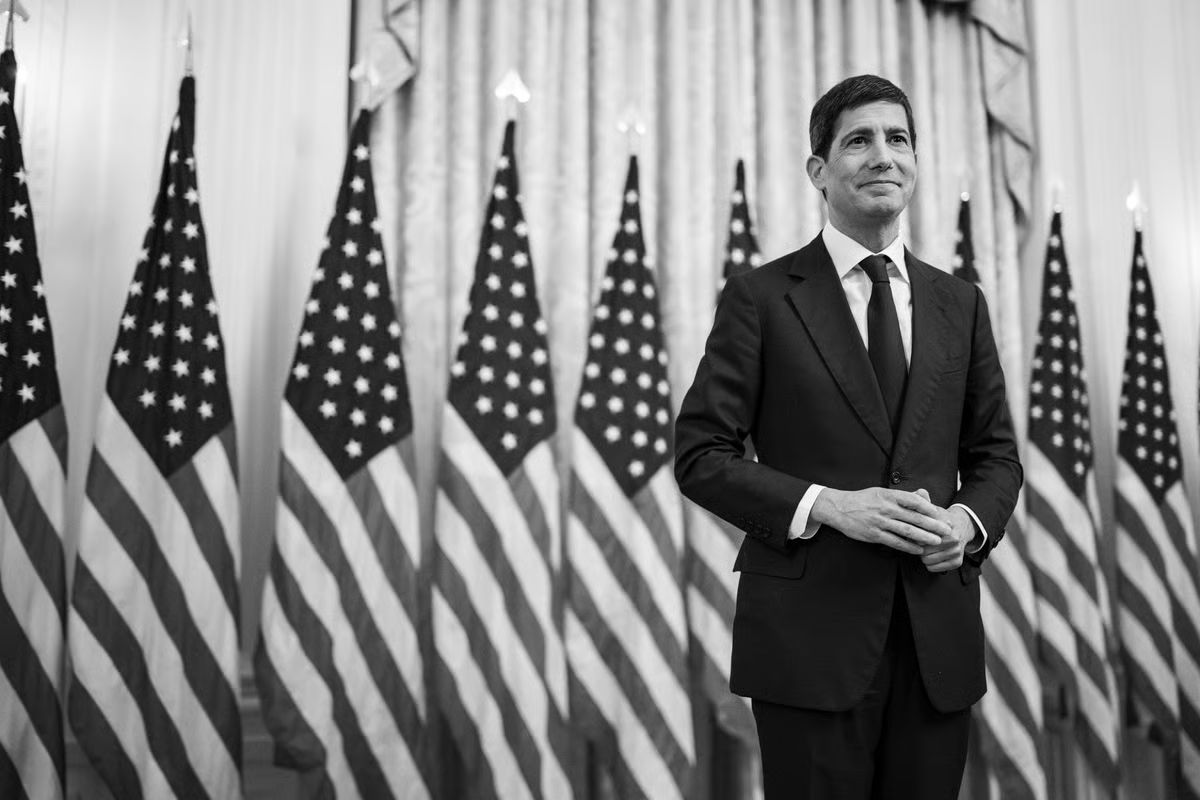
Beyond the rotating regional presidents, a more profound leadership change is on the horizon. Jerome Powell's term as Fed Chair expires in May 2026, and Kevin Warsh is widely tipped as his successor. Warsh is known to advocate for lower rates, and his appointment could usher in a period of more aggressive easing, especially if he is joined by other Trump appointees to the Board of Governors. This potential shift at the very top of the Fed's leadership structure, combined with the new voting members, introduces a layer of political uncertainty into monetary policy decisions. The market will be closely watching for any signals from the new Chair and the revamped Board, as their philosophy could dramatically reshape the Fed's approach to inflation and employment.

This combination of new voting members and a potential change in leadership creates a dynamic and unpredictable environment for monetary policy in 2026. The hawkish leanings of Logan, Hammack, and Kashkari could clash with a potentially dovish new Chair, leading to further internal friction and making consensus even harder to achieve. Such a scenario would only exacerbate the market uncertainty already evident from the December 2025 dissents and the divided dot plot. Investors should pay close attention to the rhetoric from these new and potential leaders, as their individual stances will be crucial in forecasting the Fed's direction, particularly as the central bank continues to grapple with inflation that remains above target and an unemployment rate that has seen recent increases.

How Should Investors Navigate This Era of Fed Uncertainty?

Navigating a Federal Reserve grappling with such deep internal divisions presents unique challenges and opportunities for investors. The immediate consequence of a fractured FOMC is heightened market volatility, particularly in interest-rate-sensitive assets. For instance, dovish dissents, like Governor Miran's call for a larger cut, have historically led to dollar weakness and rising bond prices, as markets anticipate easier monetary conditions. Conversely, hawkish dissents, such as those from Schmid and Goolsbee, tend to support the U.S. dollar and put pressure on bond markets, signaling a tighter policy outlook. This creates a "two-way risk" where unexpected data or Fed commentary can trigger sharp movements in either direction for forex pairs and fixed-income instruments.

Companies with high debt loads or those heavily reliant on consumer financing are particularly vulnerable in this uncertain environment. If the hawkish faction gains more influence, leading to a "higher-for-longer" interest rate scenario, borrowing costs will remain elevated. This could significantly impact real estate developers like D.R. Horton and Lennar Corporation, as higher mortgage rates dampen housing demand. Similarly, auto manufacturers such as General Motors and Ford Motor Company might see reduced sales as car loans become more expensive. Growth-oriented technology companies, which often depend on cheap capital for expansion, could also face headwinds. Investors should scrutinize balance sheets for debt levels and assess sensitivity to interest rate fluctuations.

Conversely, a more dovish tilt, perhaps under a new Fed Chair like Kevin Warsh, could lead to more aggressive rate cuts if the labor market shows clearer signs of weakness. This would benefit the aforementioned rate-sensitive sectors. However, a prolonged period of indecision, where the Fed continues to issue mixed signals, is perhaps the most challenging scenario. This "fog of monetary policy" could hinder long-term investment and economic planning, making a flexible and diversified investment approach paramount. Investors should prioritize companies with strong balance sheets, robust cash flows, and pricing power, which can better withstand periods of economic uncertainty and fluctuating interest rates.

The upcoming March 17-18, 2026 FOMC meeting, which will include an updated SEP and dot plot, will be a critical event. This meeting will provide the first opportunity to see how the new voting members influence the committee's projections and whether the internal divisions have deepened or narrowed. Beyond that, the change in Fed Chair in May 2026 will be a pivotal moment, potentially signaling a significant shift in the central bank's overall philosophy. Investors must remain agile, closely monitoring all economic indicators and Fed communications, and be prepared to adapt their portfolios to an evolving monetary policy landscape that is anything but predictable.

The Federal Reserve's internal rifts are a clear signal that the era of predictable monetary policy is over. Investors must brace for continued volatility and a nuanced approach to portfolio management, focusing on resilience and adaptability. The path ahead is shrouded in ambiguity, demanding vigilance and a deep understanding of the diverse forces shaping the Fed's decisions.


Want deeper research on any stock? Try Kavout Pro for AI-powered analysis, smart signals, and more. Already a member? Add credits to run more research.

SHARE THIS ON:

Related Articles

Category

You may also like

News3 hours ago

As many as three Federal Reserve governors are candidates to dissent at this week's meeting, an unusual break that offers a glimpse of the fracture Kevin Warsh stands to inherit

As many as three Federal Reserve governors may dissent at this week's meeting, signaling an unusual fracture within the board that incoming Governor Kevin Warsh will face.
News2 weeks ago

Fed's Bostic Says People Have Begun to Doubt Fed Independence

Atlanta Fed President Bostic issued a direct warning regarding the consequences of President Trump's aggressive stance toward the central bank. The warning focused on the potential erosion of the Fed'...
Stock News2 months ago

Will the Fed Cut Interest Rates in 2026? Don't Get Your Hopes Up, Some Experts Say

Experts are doubting the previous consensus that the Federal Reserve will cut interest rates in 2026, suggesting that lower borrowing costs are no longer a foregone conclusion for next year.
Crypto News2 months ago

Is Fed Crisis Setting Bitcoin up for Major Price Surge?

Mounting pressure on the Federal Reserve is intensifying fears regarding U.S. monetary stability, which is accelerating capital flows toward bitcoin as an alternative hedge.

Breaking News

View All →

Top Headlines

View More →
Stock News57 minutes ago

What Is One of the Best Artificial Intelligence (AI) Stocks to Buy Right Now?

Stock News2 hours ago

Nvidia Says Company Firing Up H200 Production for China

Stock News2 hours ago

Samsung Elec plans to produce Tesla chips starting late 2027

Stock News2 hours ago

LTM Named NVIDIA Partner Network ‘Rising Star Consulting Partner of the Year' at NVIDIA GTC 2026

Stock News2 hours ago

Nvidia Just Reported $68 Billion in Revenue. Here's Why It Matters.