Kavout

MarketLens

Log in

The Rise of Prediction Markets

Nov 27, 2025
SHARE THIS ON:

2025112701.jpg How Betting on the Future Became Wall Street's Newest Asset Class

Something remarkable happened in November 2025. The same platforms that college students use to bet on elections suddenly found themselves sharing boardroom conversations with Goldman Sachs and Susquehanna. Prediction markets—once dismissed as gambling sites with fancy algorithms—had officially arrived on Wall Street. And if you're an investor wondering where to put your money next, this shift deserves your attention.

The story of how we got here involves courtroom battles, blockchain technology, and a fundamental question about what constitutes "gambling" versus "investing." But more importantly for your portfolio, it's a story about infrastructure. When Robinhood announced its partnership with trading giant Susquehanna to acquire a derivatives exchange, it wasn't just news—it was a signal that prediction markets are becoming as essential to the financial ecosystem as futures contracts or options.

What Exactly Are Prediction Markets?

Let's strip away the jargon. A prediction market is simply a place where you can buy a contract that pays $1 if something happens and $0 if it doesn't. If you believe there's a 70% chance the Fed will cut rates in March, you might pay $0.65 for that contract. If you're right, you pocket $0.35 in profit. If you're wrong, you lose your $0.65.

What makes this interesting isn't the mechanics—it's the information. When thousands of people are putting real money behind their beliefs about future events, the resulting price becomes remarkably accurate. Studies of the Iowa Electronic Markets, an academic prediction platform running since 1988, showed that market prices consistently outperformed polling data in predicting presidential elections. Money, it turns out, concentrates the mind.

This concept isn't new. Wall Street ran election betting pools as far back as 1884. What's new is the infrastructure that makes it possible to trade these contracts efficiently, transparently, and—critically—legally.

The Legal Battles That Changed Everything

For years, prediction markets operated in a regulatory gray zone. The CFTC treated election contracts as "gaming"—essentially gambling—and blocked their expansion. Then came the Kalshi lawsuit.

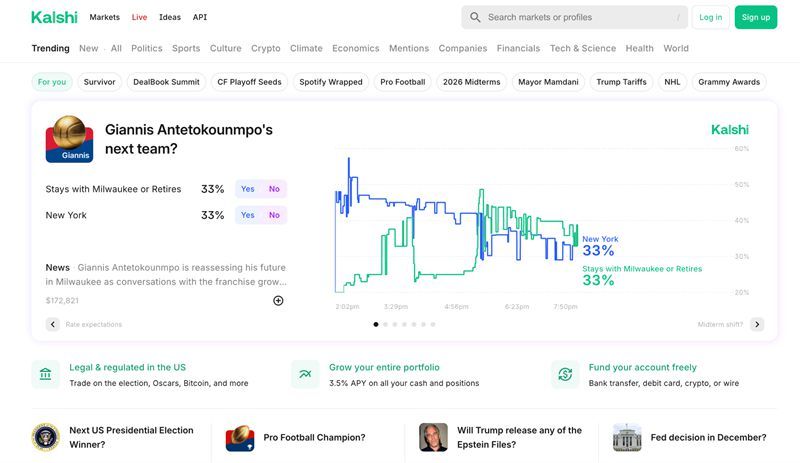
Kalshi, a CFTC-regulated exchange, sued the agency over its election contract ban. The company argued that elections aren't games of chance—they're processes of governance. In a ruling that stunned the industry, the D.C. District Court agreed. The judge found that for the CFTC to ban something as "gaming," the underlying event itself must involve gambling. Since elections clearly don't, the CFTC had overstepped.

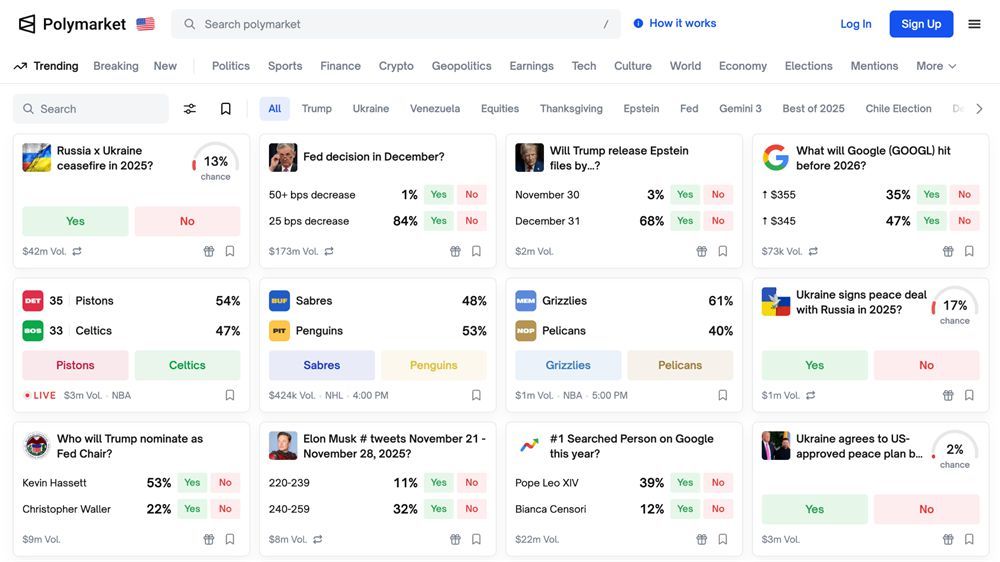
This opened the floodgates. In November 2025, Polymarket—the crypto-based platform that processed over $9 billion in trading volume during 2024—received CFTC approval to operate a regulated U.S. exchange. The catch? U.S. users can't trade directly on Polymarket anymore. Instead, they'll access these markets through traditional brokers like Robinhood or Schwab, just as they would any other derivative.

Think about what this means. A contract that lets you express a view on "Will CPI exceed 3% in December?" now sits alongside stock options and commodity futures in your brokerage account. The lines between speculation, investment, and risk management have officially blurred.

The Investment Landscape

So where should investors look? The prediction market boom creates opportunities across several categories, each with different risk-reward profiles.

The Aggressive Play: Robinhood

Robinhood's move to acquire the MIAX Derivatives Exchange through its Susquehanna partnership isn't just about adding another product. It's about owning the entire value chain. Instead of paying transaction fees to third-party exchanges, Robinhood will capture those fees itself. Instead of depending on external market makers for liquidity, Susquehanna—one of the world's largest trading firms—will provide it.

The numbers tell the story. Prediction markets are already Robinhood's fastest-growing product line, generating over $100 million in annualized revenue within the first year. Management believes this could reach $300 million quickly once they control the infrastructure. Analyst estimates for 2025 earnings have jumped 78% year-over-year, and the stock surged 11% on the acquisition news.

The demographic fit is perfect. Robinhood's 24 million users skew young, digitally native, and comfortable with gamified trading. Prediction markets feel like a natural extension of how this generation already thinks about financial markets.

The Value Play: Interactive Brokers

If Robinhood represents the high-beta bet, Interactive Brokers offers a steadier alternative. Through its ForecastEx platform, IBKR has carved out a niche focusing on economic indicators and climate data—contracts that appeal to sophisticated traders and institutions.

What makes ForecastEx different is its economics. Unlike competitors, it pays interest on the collateral posted for contracts. Since prediction contracts are fully funded upfront, traders holding positions continue earning yield on their capital. In a "higher-for-longer" rate environment, this creates meaningful value. IBKR has essentially turned prediction market collateral into a profitable float business.

The Infrastructure Play: Virtu and ICE

When a new market emerges, fragmentation follows. Today's prediction market landscape is scattered across Kalshi, Polymarket's U.S. entity, Robinhood's MIAX, and ForecastEx. This creates opportunities for companies that provide the plumbing.

Virtu Financial, a leading market maker, has the technological capability to provide liquidity across these disjointed venues. When volume and volatility increase—as they inevitably will during election cycles and major economic events—Virtu benefits directly.

Meanwhile, Intercontinental Exchange, owner of the NYSE, has made a strategic investment of up to $2 billion in Polymarket. This is a call option on the future of market infrastructure. If prediction markets scale to trillions in volume, ICE positions itself to provide the clearing and settlement rails that institutional money requires.

The Risks You Need to Understand

No investment thesis comes without caveats, and the prediction market story has several.

First, there's the federal-state conflict. While the CFTC has blessed these markets, state gaming commissions are pushing back. Nevada recently ruled against Kalshi, forcing it to stop offering sports contracts in the state. Massachusetts sued both Kalshi and Robinhood, alleging their football contracts are unlicensed sports wagers. This creates a patchwork regulatory landscape where federal approval doesn't guarantee state-level access.

Second, the sports betting giants aren't sitting still. DraftKings and FanDuel both resigned from the American Gaming Association in late 2025—a clear signal they're preparing to launch their own prediction market exchanges. DraftKings acquired Railbird, a prediction platform. FanDuel partnered with CME Group. These companies have millions of active users and deep expertise in event-based wagering. They won't cede this market without a fight.

Third, there's the resolution question. When a prediction contract settles, someone has to declare the outcome. Kalshi and ForecastEx use centralized data feeds—the Bureau of Labor Statistics for inflation, the National Weather Service for temperature. Polymarket's global platform uses a decentralized voting system that has faced accusations of manipulation by large token holders. The U.S. entity will likely implement safeguards, but this remains an area of technical and regulatory uncertainty.

Looking Forward

The prediction market sector is undergoing a fundamental rerating. Originally viewed as a subset of the $200 billion sports betting market, analysts now see it as a component of the global derivatives complex—a market measured in quadrillions of notional value.

The shift happens when corporations start using these contracts for hedging. Imagine an outdoor events company buying a binary contract that pays out if temperatures exceed 95 degrees on concert day. Or an agricultural business hedging against specific rainfall patterns. This transforms prediction markets from zero-sum speculation to positive-sum risk management—the same evolution that turned commodity futures from gambling into essential business tools.

The regulatory endgame will likely arrive by 2026. Either the Supreme Court will issue a definitive ruling on federal preemption, effectively nationalizing event contract regulation, or Congress will create new legislation that gives states taxation authority while preserving federal oversight of the exchanges themselves.

The Bottom Line

The convergence of prediction markets with traditional financial infrastructure isn't a trend—it's a structural evolution. The question for investors isn't whether this market will grow, but who will own the venues where that growth happens.

For those comfortable with volatility, Robinhood offers the highest beta to this thematic shift, with clear revenue drivers from its vertical integration strategy. For those seeking steadier returns, Interactive Brokers provides a profitable entry point through its interest-income model. And for those who prefer to bet on infrastructure rather than individual players, Virtu and ICE represent the inevitable beneficiaries of a market that's only going to get bigger and more complex.

The lines between investing, hedging, and betting have blurred. The winners of this cycle will be those who recognized it early—and positioned themselves accordingly.

Disclaimer: This article is for informational purposes only and does not constitute investment advice. Prediction markets and related securities involve substantial risk, including the possible loss of principal. Past performance does not guarantee future results. Consult a qualified financial advisor before making investment decisions.

SHARE THIS ON:

Related Articles

Category

You may also like

No related articles available

Breaking News

View All →

No topics available at the moment