Kavout

MarketLens

Log in

Prediction Markets Go Mainstream: Why Big Money Is Betting Billions On This Emerging Asset Class

Dec 04, 2025
SHARE THIS ON:

2025120402.jpg

The CNN partnership with Kalshi marks a turning point. Here's what investors need to know about the companies racing to dominate this fast-growing sector.

When we covered the rise of prediction markets just last week, the thesis was straightforward: betting platforms were crossing over from college dorm rooms to Wall Street boardrooms, and the infrastructure play was just getting started. What's happened since has only reinforced that view—and the pace of developments is accelerating faster than even bullish observers anticipated.

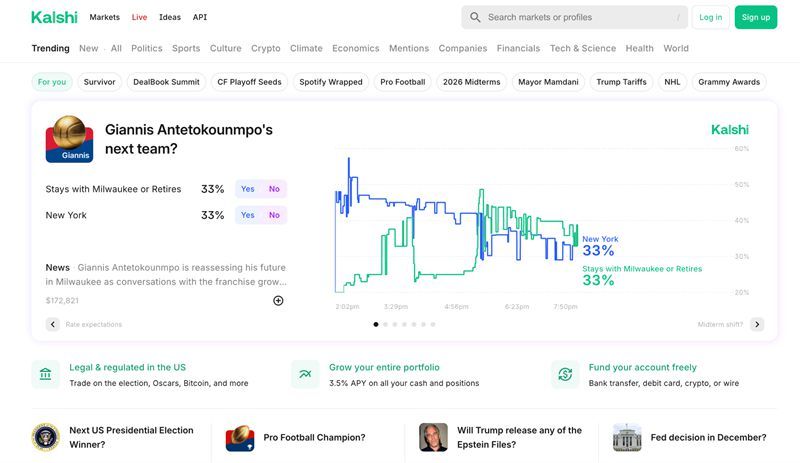
Something quietly shifted in how America consumes information earlier this year. CNN, the cable news giant, started running scrolling banners during its programming—not stock prices or sports scores, but real-time betting odds from Kalshi, a federally regulated prediction market exchange.

It might seem like a small change. But for anyone watching the financial markets, it signals something much bigger: Prediction markets have officially crossed from the fringes of fintech into the mainstream.

And the money pouring into this sector tells the story better than any headline could. Weekly trading volume across prediction market platforms recently topped $2.3 billion—a record that would have seemed impossible just two years ago. Major operators are commanding eye-popping valuations. Kalshi has reportedly fielded funding offers valuing it north of $10 billion. Polymarket, its crypto-native rival, is eyeing a valuation as high as $15 billion after securing investment from Intercontinental Exchange, the parent company of the New York Stock Exchange.

These aren't small bets from speculative venture funds. This is institutional capital making a calculated wager that prediction markets represent the next major evolution in financial data infrastructure.

The CNN Deal Changes Everything

To understand why the CNN partnership matters, you have to understand what prediction markets actually are—and why they've struggled for decades to break through.

At their core, these platforms let users trade contracts based on real-world outcomes. Will the Federal Reserve cut rates at its next meeting? Will a particular candidate win an election? Will inflation come in above expectations? Traders buy and sell contracts that pay out based on the answer, and the market price effectively represents the crowd's collective probability estimate.

The concept isn't new. Economists have studied prediction markets since the Iowa Electronic Markets launched in 1988. The theory was always compelling: When people put real money behind their beliefs, they tend to be more careful and accurate than when they're simply answering a pollster's questions. Skin in the game sharpens judgment.

But these markets never quite escaped academia and the betting-curious corners of the internet. Regulatory uncertainty kept institutional players away. Traditional media treated them as curiosities rather than serious data sources.

The CNN deal flips that script entirely.

Harry Enten, CNN's chief data analyst, has been explicit about the network's intentions. The goal isn't just to display prediction market odds as entertainment. It's to use them as a fact-checking mechanism—a way to verify and complement traditional reporting with market-implied probabilities.

Think about what that means. A major news organization is essentially saying that the collective wisdom of traders with money on the line produces more reliable forecasts than expert pundits or polling agencies. That's a remarkable admission, and it didn't happen in a vacuum.

Why Markets Beat Polls

The 2024 presidential election was a watershed moment for prediction market credibility. While traditional pollsters hedged and struggled to model the Electoral College's complexities, bettors on Polymarket consistently provided more accurate forecasts.

This wasn't a fluke. Academic research going back decades has shown that prediction markets generally outperform polls and expert forecasts across a wide range of outcomes. The mechanism is elegant: Traders who believe the market price is wrong have a financial incentive to bet against it, pushing prices toward the "true" probability as new information emerges.

Traditional polling suffers from structural problems that markets don't face. People can say whatever they want to a pollster without consequence. They can lie to avoid social stigma. They can simply not think very hard about the question. A prediction market, by contrast, financially punishes sloppy thinking. Get it wrong repeatedly, and you'll run out of money to bet with.

Microsoft Research economist David Rothschild has pointed out another key difference: While you can design a poll to mimic some aspects of market structure, prediction markets uniquely incentivize participants to return and update their positions as conditions change. Polls are snapshots. Markets are living, breathing systems that adjust in real time.

None of this means prediction markets are infallible. Researchers have identified biases that can skew prices—the "favorite-longshot bias," for instance, where unlikely outcomes tend to be overpriced. But as data sources go, they've earned their credibility the hard way.

Follow the Money

The investment thesis here isn't complicated. If prediction markets produce better forecasts than alternatives, and if that data becomes integrated into mainstream media, enterprise risk management, and financial decision-making, then the platforms providing that data are positioned to capture enormous value.

The smart money has clearly done this math.

Robinhood and Coinbase are both actively positioning to offer prediction market products to their massive user bases. DraftKings acquired Railbird, a predictions platform, while FanDuel has partnered with CME Group to launch its own offering. Even Trump Media & Technology Group has entered the space, partnering with Crypto.com to launch Truth Predict.

Google Finance and Yahoo Finance have announced plans to incorporate prediction market data, citing collaborations with both Kalshi and Polymarket. When the major financial data platforms start treating PM prices as essential information—on par with stock quotes and economic indicators—you know the sector has arrived.

The convergence is happening from multiple directions simultaneously. Traditional finance players like ICE are making strategic investments. Retail trading platforms see prediction markets as the next engagement driver. Sports betting giants recognize the overlap with their existing customer bases. Media companies need better forecasting tools to remain credible.

All of these forces are pushing toward the same outcome: prediction markets as ubiquitous infrastructure.

The Regulatory Wild Card

There's a catch, of course. There's always a catch.

Prediction markets operate in what industry observers politely call a "murky" regulatory space. The fundamental question is whether an event contract constitutes a regulated financial derivative—falling under the jurisdiction of the Commodity Futures Trading Commission—or an unregulated gambling product subject to state gaming laws.

The distinction matters enormously. If prediction markets are confirmed as derivatives, they can scale nationally with access to institutional capital and function as data providers for federally regulated entities. If they're classified as gambling, operators face a patchwork of state-by-state licensing requirements that would severely limit liquidity and growth.

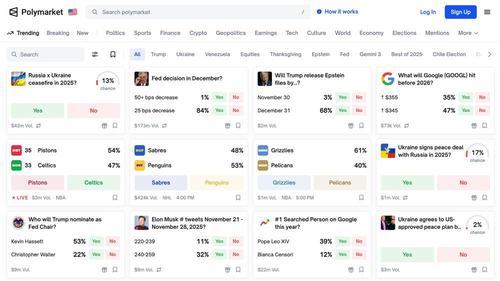
Kalshi has positioned itself as the first federally regulated prediction market exchange, operating as a Designated Contract Market under CFTC oversight. The company's legal strategy relies on the Supremacy Clause of the U.S. Constitution to preempt state gambling prohibitions. Polymarket took a different path, initially operating offshore before recently securing regulatory clearance to return to the U.S. market. But state authorities aren't backing down. New Jersey, Maryland, Massachusetts, Connecticut, and Illinois have all taken action against sports prediction market operators, issuing cease-and-desist orders or launching formal investigations. Their argument: these platforms are circumventing established sports betting regulations while offering a substantially equivalent product.

The conflict is fundamentally about money and jurisdiction. States that legalized sports betting after the 2018 PASPA repeal have built lucrative tax revenue streams around their licensing frameworks. Prediction markets that bypass those structures represent both a regulatory threat and a revenue leak.

Something will have to give. Either federal courts will definitively establish that CFTC-regulated event contracts preempt state gambling laws, or Congress will pass legislation clarifying the framework. The multi-billion dollar valuations currently assigned to major operators essentially represent a bet that federal classification will prevail.

The Integrity Imperative

As prediction markets scale into mainstream visibility, the integrity stakes rise dramatically.

These platforms are uniquely vulnerable to manipulation and insider trading because the commodity they trade is information itself. In conventional financial markets, insider trading laws prohibit using non-public information. But what counts as "non-public" when you're trading contracts on policy decisions, corporate announcements, or election outcomes?

The risk amplifies when participants who can influence outcomes—athletes, referees, election workers, data vendors—trade on privileged information. A high-profile scandal involving manipulation tied to an event covered by CNN would erode trust not just in the market mechanism but in the journalistic credibility of any media outlet using its data.

Operators recognize this existential threat. Surveillance systems, pre-trade controls, automated position limits, and restricted lists are all becoming standard infrastructure. The same AI-driven monitoring tools developed for futures and crypto markets are being adapted for prediction market compliance.

What Smart Investors Should Watch

The prediction market opportunity comes with genuine complexity. Here's how to think about it:

First, watch the regulatory battles closely. The outcome of state-level enforcement actions and any federal court decisions will determine whether the current valuations are justified or need significant revision. Companies with strong CFTC relationships and sophisticated legal teams have advantages here.

Second, recognize that prediction market data itself may become more valuable than the trading platforms. As hybrid forecasting models emerge—combining PM prices with traditional polling, economic indicators, and AI-driven sentiment analysis—the companies that can aggregate and calibrate this data will capture significant value. This isn't just about running an exchange; it's about becoming essential infrastructure for decision-making across industries.

Third, consider the enterprise applications. Prediction markets are evolving into tools for institutional risk management, offering ways to hedge against specific risks that traditional derivatives can't address. Probability estimates on regulatory decisions, geopolitical events, and policy outcomes have obvious value for corporate strategic planning.

Finally, keep an eye on the technology layer. Decentralized prediction markets rely on oracle systems to transmit real-world outcome data to smart contracts. Investments in projects like Opinion Labs and APRO signal where sophisticated crypto entrepreneurs see the next infrastructure bottleneck.

The Bottom Line

Prediction markets have spent decades as an academic curiosity and a niche hobby for political junkies. That era is ending.

The CNN partnership isn't just a media deal—it's institutional validation that changes the entire landscape. When a legacy news organization explicitly treats market-implied probabilities as equal or superior to expert punditry, it forces competitors to respond or look outdated.

The $2.3 billion in weekly trading volume, the $10-15 billion valuations, the parade of major financial institutions making strategic investments—these aren't signals of a speculative bubble. They're signals of an industry approaching an inflection point.

Regulatory uncertainty remains the key risk. But the capital already committed to resolving that uncertainty suggests the smart money believes the outcome favors federal classification and national scaling.

For investors, the prediction market sector represents something rare: an emerging asset class with proven underlying technology, clear demand drivers, and multiple potential winners still in early stages of growth. The question isn't whether prediction markets will become mainstream. It's how quickly—and which companies will capture the value when they do.

SHARE THIS ON:

Related Articles

Category

You may also like

No related articles available

Breaking News

View All →

No topics available at the moment