MarketLens
Is the Market Too "Exuberant"? Jamie Dimon's Latest Warning

Key Takeaways
- JPMorgan Chase CEO Jamie Dimon has issued stark warnings about "exuberant" markets, rising global debt, and potential bond and credit crises, suggesting investors may be underestimating systemic risks.
- Despite Dimon's macro caution, JPMorgan Chase (JPM) is strategically positioned as a resilient financial institution, benefiting from its diversified business model, strong balance sheet, and ability to navigate turbulent economic cycles.
- Investors should view JPM as a defensive core holding, balancing Dimon's long-term risk assessment with the bank's operational strength and attractive valuation metrics in the current environment.
Is the Market Too "Exuberant"? Jamie Dimon's Latest Warning
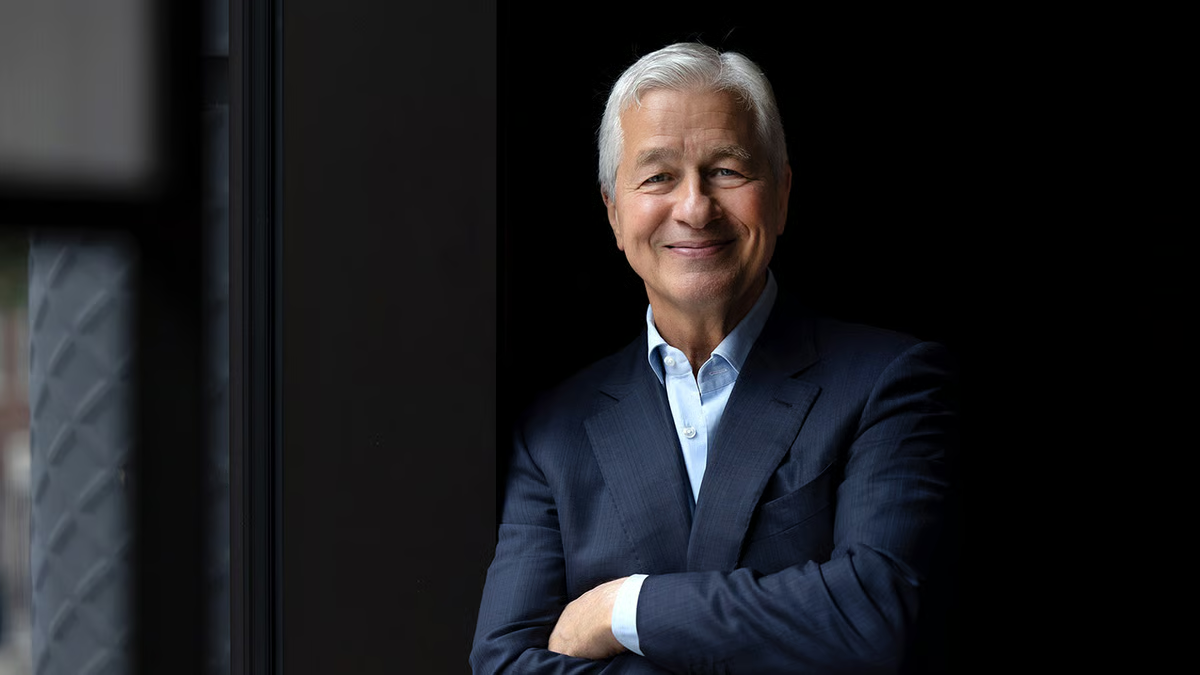
JPMorgan Chase CEO Jamie Dimon has once again captured Wall Street's attention, recently warning that the stock market is exhibiting "too much exuberance," a phrase that echoes Alan Greenspan's infamous 1996 caution about "irrational exuberance." Speaking in a Bloomberg TV interview on May 21, 2026, and days earlier at the Bernstein Strategic Decisions Conference, Dimon pointed to surging speculation and unusually tight credit spreads as clear signs of complacency among investors. He specifically drew comparisons to market peaks in 1972, 1986, 2000, and 2007, noting that the current "gung ho" sentiment among Wall Street clients does not give him comfort.
This sentiment is particularly resonant given the backdrop of rapidly advancing artificial intelligence (AI) technologies, which Dimon acknowledged as "real" in October 2025, but also cautioned that "some asset prices are high, in some form of bubble territory." The market's current pricing, he suggests, leans heavily towards a best-case AI scenario, potentially overlooking significant macroeconomic risks. Dimon's concern is that while earnings growth has supported the rally, the underlying speculative fervor, particularly around Big Tech and AI infrastructure, might be pushing valuations beyond sustainable fundamentals.
The tight credit spreads, which measure the yield gap between riskier corporate bonds and safer government debt, are a key indicator for Dimon. When these spreads are narrow, as they are now, investors are accepting less compensation for taking on additional risk. This dynamic can signal robust market appetite but also a dangerous level of complacency, where the market is not adequately pricing in potential defaults or economic downturns. Such conditions historically precede periods of market stress, making Dimon's warnings about exuberance a critical signal for investors to heed.
His economists at JPMorgan are also turning more cautious, having warned that the "Goldilocks scenario" of cooling inflation and steady growth is no longer achievable. They cite the Iran conflict and rising energy prices as factors that could push core inflation above 3%, derailing the hoped-for economic soft landing. This split-screen message from the head of America's largest bank — acknowledging current market strength while simultaneously highlighting flashing red lights — injects a necessary note of caution into a market that has been racing higher, prompting investors to question how much further this exuberance can run.
What are the Core Macro Risks Dimon is Flagging?
Beyond market exuberance, Jamie Dimon has repeatedly sounded alarms about a confluence of macroeconomic threats, most notably a looming "bond crisis" and the fragility of the U.S. economy. In late April 2026, speaking at an investment conference hosted by Norway’s sovereign wealth fund, Dimon warned that rising global government debt, including the U.S. national debt nearing $39 trillion, could lead to "some kind of bond crisis" if policymakers do not act proactively. He emphasized that the market will eventually force governments' hands if they fail to address their balance sheets, potentially triggering a sudden jump in yields and a breakdown in market liquidity.
Dimon pointed to a dangerous mix of factors contributing to this risk, including geopolitics, spiking oil prices, and widening government deficits. Conflicts in the Middle East and Ukraine have raised fears of sustained oil supply shocks, which could push core inflation higher and force the Federal Reserve to keep interest rates elevated. Indeed, the inflation rate stood at 2.39% as of May 28, 2026, with the Federal Funds Rate at 3.64% as of April 1, 2026. Higher energy prices, in turn, weigh heavily on mortgages, corporate loans, and the government’s own interest payments, creating a feedback loop that exacerbates fiscal pressures.
A bond crisis, as Dimon explained, typically erupts when investors lose faith in a government’s ability to manage its books, leading to a rush to sell and a scarcity of buyers. The 2022 U.K. gilt crisis, where yields on U.K. government bonds surged and the Bank of England had to intervene to stabilize the market, serves as a recent historical precedent for such instability. Dimon's concern is not that the U.S. won't be able to deal with such a crisis, but that "maturity should say you should deal with it, as opposed to let it happen," advocating for proactive policy measures rather than reactive interventions.
Furthermore, Dimon has expressed worry about stagflation risks, even as he shrugs off immediate inflation concerns. While the U.S. economy has shown resilience, he argues its foundation is brittle, with markets still pricing in a "soft landing" scenario that he believes has a much lower probability. The combination of high government debt, geopolitical instability, and the potential for persistent inflation creates a uniquely fragile global backdrop, making the "status quo" assumptions of moderate growth and stable debt markets "almost certainly wrong," according to fresh research from Deutsche Bank.
How Does the Looming Credit Cycle Impact Financials?
Jamie Dimon's warnings extend beyond sovereign debt to the private credit sector, a lightly regulated ecosystem that has surged in popularity over the last decade. This market, where non-bank entities like hedge funds and private equity firms lend directly to corporations, has grown to an estimated $1.7 trillion to $1.8 trillion. While Dimon doesn't believe private credit alone poses a systemic risk to the U.S. economy, he has repeatedly cautioned about the potential for a harsher-than-expected downturn across all lending categories when the next credit cycle inevitably arrives.
In his April 2026 annual letter to shareholders and a recent Bloomberg Television interview, Dimon highlighted vulnerabilities in leveraged corporate debt, noting that there is about $5 trillion to $6 trillion of leveraged loans outstanding. Many borrowers, he stated, did not hedge against higher interest rates, and will face significant challenges refinancing at current elevated yields. This "refinancing wall" could lead to considerably less equity value for these companies, potentially triggering defaults or forced asset sales, particularly for weaker credits. Private credit defaults have already hit record levels in some portfolios, signaling the early strains of this pressure.
Dimon criticized lax underwriting standards within the private credit space, warning of a harsh reality check for firms relying on high-risk debt when the economy eventually slows. He believes that "losses on all leveraged lending in general will be higher than expected" when a credit cycle occurs, and because it has been so long since the last major contraction, the next credit recession "will be worse than people think." This sentiment underscores the risk of a liquidity crunch, where sentiment can flip overnight, leading to a rush for cash and a breakdown in market functioning.
The broader impact of this credit cycle extends to government debt as well. The U.S. government must refinance enormous sums at higher costs, adding to fiscal pressures and deficits. Dimon pointed to $30 trillion of U.S. government debt with an average rate of 3.5%, plus another $2 trillion to refinance this year. For investors, the message is clear: "higher-for-longer" may not be the ceiling, and bond and credit markets could face more strain if inflation, deficits, and refinancing pressure continue to build. This environment favors major banks like JPMorgan, which possess deep experience managing credit cycles and workouts, often gaining market share during such periods of stress.
Is JPMorgan Chase a Defensive Play Amidst Dimon's Warnings?
Despite Jamie Dimon's cautious outlook on the broader market and economy, JPMorgan Chase (JPM) itself presents a compelling case as a defensive investment. Trading at $299.31 as of May 29, 2026, JPM's stock has demonstrated resilience, hovering within its 52-week range of $260.31 to $337.25. The bank's robust balance sheet, diversified revenue streams across consumer and community banking, corporate and investment banking, asset and wealth management, and commercial banking, position it well to weather the very storms Dimon warns about.
JPMorgan's ability to navigate past crises, from the 2008 financial meltdown to the pandemic, highlights its operational strength and risk management expertise. The bank's last earnings report on April 14, 2026, showed an EPS of $5.94, beating expectations, on revenue of $49.8 billion. This consistent performance underscores its capacity to generate strong results even in volatile environments. Furthermore, the consensus analyst rating for JPM is a Buy, with 61 analysts covering the stock (1 Strong Buy, 31 Buy, 27 Hold, 2 Sell). The average price target stands at $338.78, suggesting a potential upside of approximately 13.2% from the current price.
The bank's forward estimates also paint a picture of continued growth. Analysts project revenue of $204.9 billion for FY 2027 and $215.0 billion for FY 2028, with EPS estimates of $23.61 and $25.86 respectively. These projections reflect confidence in JPMorgan's long-term earnings power, even as macro uncertainties persist. A key factor in JPM's resilience is its role as a "flight-to-quality" asset during times of market stress. When investors seek safety, well-capitalized, systemically important banks like JPMorgan often benefit from increased deposits and market share gains as smaller, weaker institutions struggle.
Moreover, JPMorgan offers an attractive dividend yield of 2.00% with a next payment scheduled for July 31, 2026, providing income for shareholders even if capital appreciation is muted by market volatility. The bank's deep experience in managing credit cycles means it is often positioned to provide rescue capital or acquire distressed assets opportunistically, turning market dislocations into strategic advantages. While Dimon's warnings are serious, they also implicitly highlight the strength of institutions like JPM, which are built to endure and potentially thrive in challenging economic landscapes.
What Does This Mean for Investors in JPM?
For investors in JPMorgan Chase, Jamie Dimon's recent commentary serves as a crucial reminder of the interconnected risks in the global financial system, rather than an immediate sell signal for JPM itself. His warnings about market exuberance, global debt, and a looming credit cycle underscore the importance of holding high-quality, well-managed institutions. JPMorgan, with its $802.00 billion market capitalization and diversified operations, fits this description, acting as a financial fortress designed to withstand significant economic headwinds.
The current U.S. Treasury yield curve, with the 10-year yield at 4.45% and the 2s/10s spread at a normal +0.47%, indicates a healthy, albeit elevated, interest rate environment. This generally benefits banks like JPM, which can earn more on their lending activities. However, Dimon's concern about rates potentially rising "far above current levels" and the "refinancing crunch" for leveraged loans suggests that while higher rates can boost net interest income, they also increase credit risk. JPM's robust underwriting standards and diversified loan book are critical in mitigating these risks.
Investors should monitor key economic indicators closely, especially upcoming events like the Michigan Consumer Sentiment (Jun) on June 12, 2026, and the Producer Price Index MoM (May) on June 11, 2026. A significant deviation in these figures could either validate or alleviate some of Dimon's concerns. The Federal Reserve's stance, with the Federal Funds Rate at 3.64% and markets pricing in zero rate cuts for the rest of 2026, will also be pivotal. Dimon's warnings suggest the Fed may remain cautious or even restrictive to avoid fueling inflation, which could prolong the "higher-for-longer" rate environment.
Ultimately, JPM represents a long-term investment in financial stability and strategic resilience. While Dimon's macro outlook is undeniably cautious, it also implicitly highlights the value of being invested in a bank that is acutely aware of these risks and has a proven track record of navigating them. For investors seeking a blend of income, stability, and potential for opportunistic growth in a volatile world, JPM remains a compelling choice, offering a defensive posture against the very challenges its CEO so presciently articulates.
Jamie Dimon's warnings are a sober reminder that while markets may be exuberant, underlying risks are building. For JPMorgan Chase investors, the message is clear: maintain a long-term perspective, appreciate the bank's inherent strength, and recognize that a robust financial institution like JPM is often best positioned to weather the storms its visionary leader anticipates.
Want deeper research on any stock? Try Kavout Pro for AI-powered analysis, smart signals, and more. Already a member? Add credits to run more research.
Related Articles
What's Driving the Latest Market Volatility
Has the SaaS Sector's AI Reckoning Gone Too Far
Category
You may also like


The Fed Could Crush Trump's Bull Market — Here's the Warning Wall Street Is Missing
Market's Wild Wednesday Is Make or Break for the AI Boom

S&P 500 Is Overbought—But JPMorgan Says The Rally Isn't Done Yet
Breaking News
View All →Featured Articles
Why Did a Major Investor Trim ESTA
Are Analysts Shifting Gears on Tech and Consumer Staples
Top Headlines

Jensen Huang Used 1 Word to Describe AI Demand. It Could Be the Most Important of 2026.

Warren Buffett Successor Greg Abel Made 3 Big Purchases Last Quarter, and They're All Exceptional Performers

QQQ's Hidden Risk: Why the Fund's Top 5 Holdings Move Together

1 Overlooked Reason to Buy Amazon Stock Right Now