MarketLens
Is THOR Industries a Hidden Gem or a Value Trap

Key Takeaways
- THOR Industries (THO) presents a compelling valuation, trading at $96.13 with an implied 11.1% undervaluation by some models and a consensus price target of $108.67.
- Despite its market leadership and strategic initiatives, THO faces significant headwinds from elevated interest rates, cautious consumer sentiment, and declining long-term growth metrics.
- The upcoming Q2 earnings report on March 3, 2026, will be crucial in assessing whether recent operational adjustments can offset persistent macroeconomic pressures.
Is THOR Industries a Hidden Gem or a Value Trap?
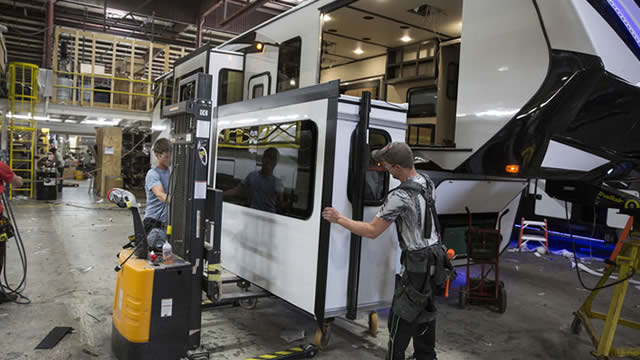
THOR Industries (THO), the world's largest manufacturer of recreational vehicles (RVs), finds itself at a critical juncture. The stock currently trades at $96.13, reflecting a notable 8.8% decline year-to-date and a 15.4% drop over the last seven days. This recent weakness has prompted investors to re-evaluate whether the company's seemingly attractive valuation truly discounts the significant industry headwinds it faces.
On one hand, analysts point to THO's market leadership and strategic moves as reasons for optimism. The company boasts an expansive portfolio of approximately 35 brands, including Airstream and Jayco, solidifying its dominant position in both North American and European markets. Management has also been proactive, recently announcing a strategic reorganization of its North American RV operations to enhance efficiency and collaboration.
However, the RV sector is inherently cyclical, highly sensitive to consumer discretionary spending and broader economic conditions. Elevated interest rates, persistent inflation, and a cautious consumer sentiment are all casting a long shadow over demand. With THO gearing up to report its Q2 fiscal 2026 earnings on March 3, 2026, investors are keenly watching if the company can navigate these turbulent waters.
The current analyst consensus rating for THO is a "Hold" from 41 analysts, with 13 "Buy" ratings and 26 "Hold" ratings, suggesting a mixed outlook. This article will delve into the core arguments for and against investing in THO, examining its valuation against the backdrop of its operational challenges and the broader economic landscape.
Is THO's Current Valuation Truly Attractive?
The "great valuation" narrative surrounding THOR Industries is certainly compelling at first glance. Trading at a current price of $96.13, the stock appears to offer a discount, with a discounted cash flow (DCF) analysis suggesting an intrinsic value of $108.19 per share, implying an 11.1% undervaluation. This is further supported by Wall Street's consensus price target of $108.67, with a median of $107.00 and a high of $133.00, indicating potential upside from current levels.
Looking at traditional valuation multiples, THO's trailing twelve-month (TTM) P/E ratio stands at 17.96x, which is slightly below its proprietary fair ratio of 18.65x. The company also trades at a TTM Price-to-Sales (P/S) of 0.52x and a Price-to-Book (P/B) of 1.18x, which are generally considered low for a market leader. Its Enterprise Value to EBITDA (EV/EBITDA) of 8.79x also suggests a reasonable valuation relative to its earnings before interest, taxes, depreciation, and amortization.
Furthermore, THO offers a quarterly dividend of $0.52 per share, translating to an attractive yield of 2.1% at the current stock price. The dividend payout ratio is a sustainable 28.5%, indicating ample room for future payments even amidst challenging market conditions. This consistent return to shareholders adds another layer of appeal for value-oriented investors.
However, valuation is not a static concept; it's deeply intertwined with future growth prospects and perceived risks. While current multiples and analyst targets suggest undervaluation, the market's skepticism, reflected in the stock's recent price performance, signals that these "attractive" numbers might be pricing in significant future challenges rather than overlooking a hidden bargain. The question remains whether the market has adequately discounted these risks.
What Macroeconomic Pressures Are Weighing on RV Demand?
The RV industry is notoriously cyclical, and THOR Industries is currently navigating a period of significant macroeconomic headwinds. High interest rates are a primary concern, directly impacting the affordability of RV purchases, which are often financed. The US Treasury yield curve, with the 10-year yield at 3.97% and the 30-year at 4.64%, reflects a higher cost of borrowing that deters potential buyers. This translates into reduced consumer demand and cautious ordering patterns from dealers, who are wary of holding excess inventory in a softening market.
Consumer sentiment, a key driver for discretionary purchases like RVs, remains subdued. The latest Consumer Sentiment reading of 56.40 (as of January 2026) indicates a lack of confidence among consumers, making them less likely to commit to large, non-essential expenditures. This cautious behavior is further exacerbated by persistent inflationary pressures, which erode purchasing power and prioritize essential spending over leisure items.
The impact of these pressures is evident in THO's operational outlook. For the upcoming Q2 fiscal 2026, analysts forecast a 1.9% year-over-year decline in overall revenues. More specifically, North American Towables revenues are projected to see a substantial 13.2% year-over-year decline, with unit sales down 21.8% in the prior quarter. European revenues are also expected to dip by 2.1%.
These figures underscore the challenging demand environment. While THO's market leadership and diversified product portfolio offer some resilience, even the largest player cannot escape the gravitational pull of a contracting market. The company's ability to manage inventory, control costs, and maintain pricing power in this environment will be critical for its near-term performance.
Are THO's Long-Term Growth Prospects Stalling?
While THO's valuation might appear attractive, a deeper dive into its long-term growth trajectory reveals some concerning trends. Over the last five years, THOR Industries' sales grew at a sluggish 2.8% compounded annual growth rate, which some analysts deem below par for an enduring business. This indicates that despite its market dominance, the company has struggled to generate robust top-line expansion over a sustained period.
Even more troubling is the stagnation in earnings per share (EPS) growth. Over the same five-year period, THO's EPS has remained largely flat, failing to keep pace with its modest revenue growth. This suggests a decline in profitability on a per-share basis as the company expanded, raising questions about operational efficiency and margin pressures. The TTM net margin of 2.9% and operating margin of 4.2% further highlight these challenges.
A critical metric for assessing a company's capital allocation is Return on Invested Capital (ROIC). For THO, the ROIC has unfortunately decreased significantly over the last few years, currently standing at 6.4% TTM. A declining ROIC suggests that new investments are failing to generate sufficient operating profit relative to the capital raised, potentially signaling fewer profitable growth opportunities or inefficient deployment of capital.
These long-term trends present a stark contrast to the short-term valuation appeal. While the company has shown resilience in beating EPS estimates in three of the last four quarters, the underlying structural issues in growth and profitability cannot be ignored. Investors must weigh the potential for a cyclical recovery against the evidence of stalled long-term performance, which could limit the stock's upside even if market conditions improve.
Can Strategic Initiatives Offset Industry Headwinds?
Despite the challenging macroeconomic backdrop and historical growth concerns, THOR Industries is not standing still. The company has been actively pursuing strategic initiatives to bolster its market position and diversify revenue streams. Its status as the world's largest RV manufacturer, owning multiple operating companies, provides significant scale and market influence.
A key strategic move was the recent reorganization of its North American RV operations into two new operating groups. This restructuring, announced on February 23, 2026, aims to strengthen competitiveness, accelerate collaboration, and unlock substantial synergies across its diverse brand portfolio. Such internal alignment could lead to improved cost control and more efficient product development, which are crucial during periods of soft demand.
Furthermore, THO has expanded its revenue streams beyond core RV sales through initiatives like RV Partfinder and its North American parts strategy. RV Partfinder is designed to enhance customer and dealer experience by reducing repair cycle times and improving service efficiency, fostering loyalty and repeat business. These efforts aim to create more stable, recurring revenue streams, mitigating some of the volatility inherent in new vehicle sales.
The company also maintains a strong focus on innovation, having introduced the world's first Range Extended Electric Class A Motorhome and winning an award for its Hybrid Class A Motorhome. These advancements, alongside the expansion of its Global Connected Vehicle Platform to North America, position THO at the forefront of technological shifts in the RV industry. While the immediate impact of these initiatives may be overshadowed by macro factors, they lay the groundwork for future growth and market differentiation.
What Does This Mean for Investors?
THOR Industries presents a classic dilemma: an attractive valuation in the face of significant operational and macroeconomic risks. The stock's current price of $96.13 and its low valuation multiples suggest a potential bargain, especially when considering the analyst consensus price target of $108.67. However, the market's "Hold" rating and recent price weakness underscore deep-seated concerns about the cyclical nature of RV demand, elevated interest rates, and the company's own stalled long-term growth.
The upcoming Q2 earnings report on March 3, 2026, will be a pivotal moment. While analysts expect a modest EPS of $0.03 on revenues of $1.98 billion, any deviation, particularly in guidance or commentary on consumer sentiment and dealer inventory, could significantly sway investor perception. A strong beat or a more optimistic outlook on the back of strategic reorganizations could ignite a rally, but continued weakness or cautious guidance might validate the market's current skepticism.
For investors, THO is not a straightforward "buy the dip" opportunity. Its market leadership and strategic initiatives offer a strong foundation, but the pervasive industry headwinds and the company's historical struggles with profitable growth cannot be overlooked. A patient approach, closely monitoring the Q2 results and subsequent market commentary, seems prudent before making a definitive move.
THOR Industries remains a dominant force in the RV market, but its path forward is fraught with challenges. While the valuation metrics whisper "buy," the broader economic environment and the company's own growth trajectory scream "caution." Investors should carefully weigh the potential for a cyclical rebound against the persistent risks, understanding that the road ahead for THO may be bumpy.
Want deeper research on any stock? Try Kavout Pro for AI-powered analysis, smart signals, and more. Already a member? Add credits to run more research.
Related Articles
Category
You may also like


CGAU vs. AEM: Which Stock Should Value Investors Buy Now?

Payoneer: A Risky Bet or a Hidden Gem in Payments?

XRP Price Prediction: Rebound in Sight or Another Bull Trap?
Breaking News
View All →Featured Articles
Top Headlines

Prediction: Nvidia (NVDA) Will Be Worth More Than Alphabet, Apple, Amazon, Tesla, Meta, and Microsoft Combined by 2030

Meta Creates New AI Unit to Accelerate Model Development

Nvidia Expands Telecom Push With AI-Native 6G Initiative

Nvidia, Amazon temporarily close Dubai offices, Google employees stranded amid U.S.-Iran war