Kavout

MarketLens

Log in

The Big Picture: Why Wall Street's Bitcoin Bet Is More Than Just Speculation

Nov 26, 2025
SHARE THIS ON:

2025112602.jpg

November 2025 — A market shakeout, institutional conviction, and what it means for your portfolio

If you've been watching the crypto markets lately, you've probably felt the whiplash. Bitcoin hit an all-time high above $126,000 in October, only to crash below $85,000 by late November—erasing roughly $1 trillion in market value in just a few weeks. Headlines screamed about panic selling, leveraged positions getting liquidated, and retail investors heading for the exits.

But here's what most of those headlines missed: while everyday traders were hitting the sell button, institutional investors were doing something different. They were buying.

This divergence tells us something profound about where crypto stands today—and where it's heading. The asset class has quietly crossed a threshold. What was once dismissed as digital speculation has become a permanent fixture in the portfolios of pension funds, hedge funds, and Fortune 500 treasuries.

Let's unpack what's really happening.

The November Crash: Context Matters

First, let's acknowledge the elephant in the room. Bitcoin's November 2025 plunge was brutal. The price dropped from its peak above $126,000 to around $80,000 at its lowest point—a decline of roughly 35%. For anyone who bought near the top, that's a painful lesson in volatility.

But zoom out, and the picture changes dramatically.

Bitcoin started 2025 trading around $93,000. Even after the November bloodbath, it's currently hovering near $88,000—still above where the year began. More importantly, the underlying drivers of this bull cycle remain intact: ETF inflows continue to grow, institutional adoption is accelerating, and regulatory clarity has improved substantially.

The recent crash wasn't a rejection of Bitcoin's thesis. It was a shakeout of excessive leverage. When prices started falling, over-leveraged derivatives positions got liquidated in a cascading waterfall effect—the same pattern we've seen in previous crypto cycles. Deutsche Bank analysts have called this the "Tinkerbell effect," where Bitcoin's value depends heavily on collective belief. When confidence wavers, prices can move violently.

But here's the key insight: the institutions didn't panic. They accumulated.

MicroStrategy: The Canary in the Coal Mine

No discussion of institutional Bitcoin is complete without talking about MicroStrategy—or as it's now officially called, Strategy Inc.

The company holds a staggering 649,870 Bitcoin, making it the largest corporate holder in the world. That's 3.26% of every Bitcoin that will ever exist. Total cost: approximately $48.37 billion, at an average price of around $74,430 per coin.

Michael Saylor, the company's executive chairman, has become the face of corporate Bitcoin conviction. His stance hasn't wavered despite the recent volatility. "I won't back down," he's repeatedly stated, framing the company's strategy as a long-term bet on Bitcoin as digital gold.

But MicroStrategy's position isn't without risks—and investors should understand them.

The company's stock has been hammered in 2025, down roughly 41% year-to-date and 55% from its highs. Part of this reflects Bitcoin's own volatility, but there's a structural issue emerging. MSCI is consulting on whether companies with more than half their assets in digital currencies should remain in its indices. If MicroStrategy gets excluded—a decision expected by January 15, 2026—JPMorgan estimates it could trigger $2.8 billion in passive selling from index funds alone. If other index providers follow, total outflows could reach $8-11 billion.

This doesn't mean MicroStrategy is going bankrupt. The company's debt is structured as convertible notes maturing between 2027 and 2032, so there's no immediate liquidity crisis. The company survived far worse in 2022 when Bitcoin dropped to $20,000. But it does mean the stock may face significant headwinds in the near term.

For traders, MicroStrategy has become a leveraged play on Bitcoin—but with added corporate and index-related risks that pure Bitcoin or ETF exposure doesn't carry.

The ETF Revolution: $21 Billion and Counting

If MicroStrategy represents the high-risk, high-conviction corporate approach, Bitcoin ETFs represent the safer, more standardized path to institutional adoption.

And the numbers here are remarkable.

As of late 2025, spot Bitcoin ETFs have attracted over $21.5 billion in inflows year-to-date. BlackRock's iShares Bitcoin Trust (IBIT) alone has accumulated more than $86 billion in assets under management, making it one of the most successful ETF launches in history. To put this in perspective: IBIT reached $50 billion in AUM faster than any ETF ever.

Why does this matter? Because ETFs are how traditional finance allocates capital at scale.

When a pension fund or endowment wants Bitcoin exposure, they don't set up a Coinbase account. They buy IBIT. When a family office wants to hedge against inflation, they add a few percentage points of FBTC to their portfolio. These regulated vehicles have removed the operational complexity that previously kept institutions on the sidelines.

The impact on market dynamics is significant. ETFs are now purchasing far more Bitcoin than miners produce daily. This structural supply-demand imbalance has helped put a floor under prices even during periods of retail panic.

Harvard University's endowment recently tripled its Bitcoin ETF holdings to $443 million through IBIT. Goldman Sachs has become one of the largest institutional holders of BlackRock's fund. These aren't speculators chasing memes—they're sophisticated allocators making strategic decisions about portfolio construction.

How Institutions Are Playing This Differently

Here's something that doesn't get enough attention: institutional investors are using Bitcoin very differently than retail traders.

Survey data shows that 58% of traditional hedge funds now use crypto derivatives rather than simple spot purchases. Over-the-counter options volume surged 412% in the first half of 2025. This isn't buy-and-hope speculation—it's sophisticated risk management using puts, calls, and structured products to generate yield and hedge exposure.

The strategic allocation has also matured. Approximately 59% of institutional investors now allocate at least 10% of their portfolios to digital assets, up dramatically from just a few years ago. And they're concentrated in major assets: institutions keep about 67% of their crypto allocation in Bitcoin and Ethereum, avoiding the volatile altcoin and memecoin sectors that dominate retail activity.

This divergence is crucial for understanding market dynamics. When Bitcoin drops 20%, retail traders panic-sell and flood into memecoins looking for quick recovery plays. Institutional investors rebalance, harvest tax losses, and add to positions at better prices.

The result? A more mature market structure where volatility is slowly decreasing compared to previous cycles.

Real World Assets: The Quiet Revolution

While Bitcoin ETFs grab headlines, a potentially more significant transformation is happening in tokenized real-world assets (RWAs).

The RWA market has grown to nearly $34 billion in 2025, up 70% year-over-year. The fastest-growing segment? Tokenized U.S. Treasury securities, which have expanded 251% to $8.8 billion. BlackRock's BUIDL fund leads this market with approximately $2.8 billion in tokenized Treasury holdings.

Why would anyone tokenize Treasury bills?

Because it fundamentally improves how financial plumbing works. Traditional securities settlement takes days. Tokenized assets settle in minutes. This reduces counterparty risk, frees up capital that would otherwise be locked in clearing processes, and enables 24/7 global trading.

For institutional investors, this is arguably more important than Bitcoin price appreciation. It represents the adoption of blockchain technology for operational efficiency—completely decoupled from cryptocurrency speculation.

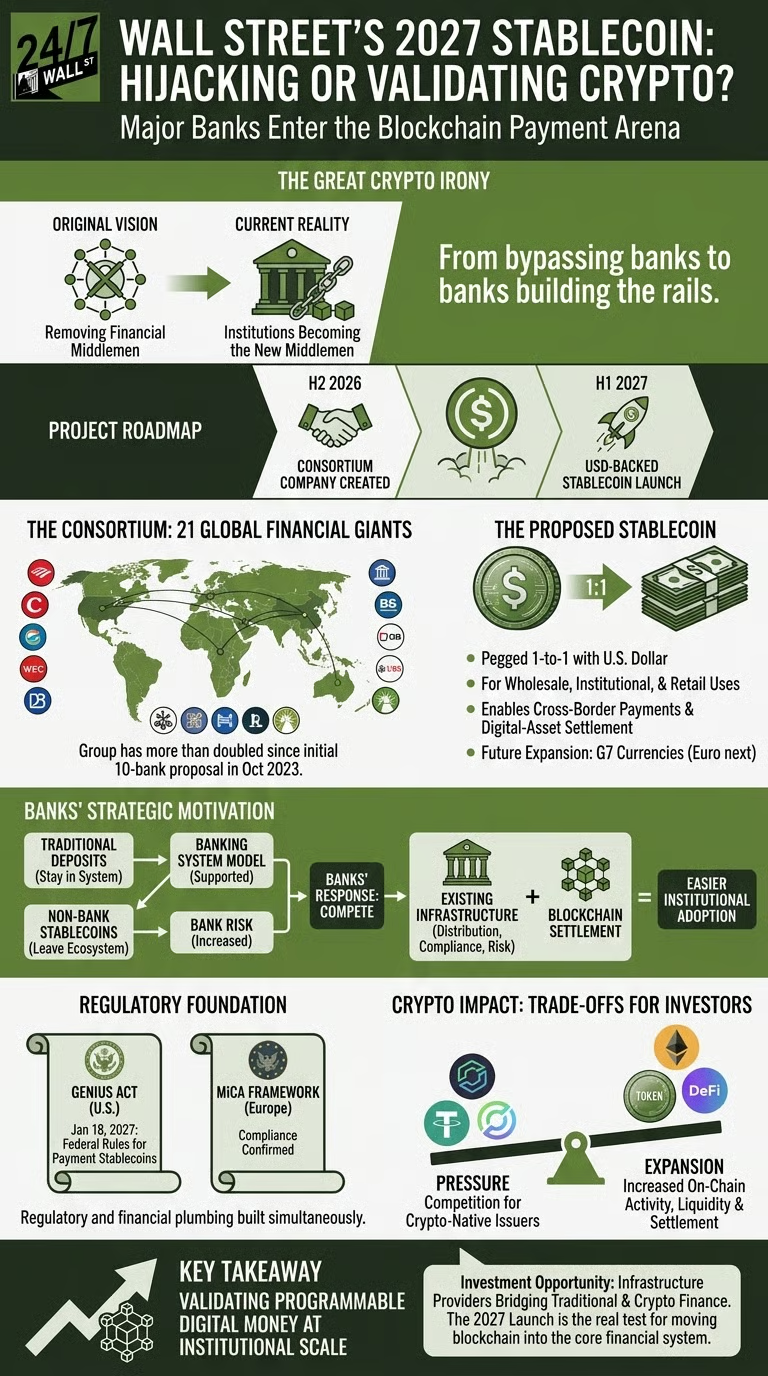
Private credit is the largest tokenized category at around $17 billion, reflecting demand for more efficient fund distribution and short-duration financing. Major financial institutions are exploring stablecoin ventures that could eventually replace slow, expensive correspondent banking networks.

This is the bridge being built between traditional finance and blockchain infrastructure. And unlike Bitcoin's price, it doesn't depend on market sentiment or speculative enthusiasm.

Regulatory Tailwinds

One of the most underappreciated factors driving institutional adoption is regulatory clarity.

The SEC's Crypto Task Force has been working to distinguish between securities and non-securities, create tailored disclosure frameworks, and establish realistic registration paths for crypto businesses. The approval timeline for new ETF products has shortened dramatically—from 270 days to approximately 75 days under streamlined standards.

In Europe, MiCA (Markets in Crypto-Assets Regulation) provides a uniform legal framework across EU member states, with grandfathering provisions allowing existing crypto businesses to continue operations until mid-2026.

This matters because compliance is the primary barrier to institutional participation. When pension fund managers or bank executives evaluate Bitcoin exposure, their first question isn't about upside potential—it's about regulatory risk. Clear rules enable clear decisions.

The U.S. policy stance has also shifted notably, with prohibitions on Federal Reserve CBDC development while enabling regulated stablecoin growth. This positions dollar-denominated digital assets as the likely standard for global crypto liquidity.

What's Ahead for 2026

Analyst consensus points to continued price appreciation, with median Bitcoin forecasts clustering around $200,000 for 2026. The drivers: sustained ETF inflows projected to push total assets under management above $150 billion, continued corporate adoption, and the development of sophisticated financial products using Bitcoin as collateral.

More importantly, analysts expect the traditional four-year boom-bust cycle to moderate. As institutional participation increases, volatility decreases. Bitcoin may become less exciting for traders but more attractive for long-term allocators—evolving from a speculative asset into a genuine portfolio diversifier.

The convergence of artificial intelligence and digital assets is another trend to watch. AI tools are already being deployed for trading optimization, custody security, and tokenization workflows. The intersection of these technologies could drive the next phase of infrastructure development.

What This Means for Your Portfolio

If you're an investor or trader navigating these markets, here are the key takeaways:

For long-term investors: The institutional thesis remains intact despite November's volatility. Bitcoin ETFs offer a straightforward way to add exposure without the complexity of direct custody. A modest allocation (1-5%) to Bitcoin and potentially tokenized RWA products can provide portfolio diversification with managed risk.

For active traders: MicroStrategy offers leveraged Bitcoin exposure but carries corporate-specific risks including potential index exclusion. The derivatives market has matured significantly—consider options strategies for hedging and yield generation rather than purely directional bets.

For everyone: Understand that crypto is now a two-track market. Institutions focus on major assets with sophisticated risk management. Retail focuses on altcoins and memecoins with speculative positioning. These markets behave very differently under stress.

The November crash wasn't the end of the institutional adoption story. If anything, it was a stress test that proved the ecosystem's resilience. The largest corporate holder didn't sell. The biggest ETFs saw inflows rather than outflows. The regulatory framework continued improving.

The "Wild West" narrative has been retired. What's replacing it is something that looks increasingly like traditional asset management—just built on fundamentally different technological rails.

Whether that excites you or disappoints you probably says something about why you got into crypto in the first place. But either way, it's the reality of where we are.

Disclaimer: This article is for informational purposes only and does not constitute investment advice. Cryptocurrency investments carry significant risk, including the potential loss of principal. Always conduct your own research and consult with financial advisors before making investment decisions.

SHARE THIS ON:

Related Articles

Category

You may also like

No related articles available

Breaking News

View All →

No topics available at the moment