MarketLens
Why Did Sphere Entertainment (SPHR) Stock Jump Today

Key Takeaways
- Sphere Entertainment (SPHR) shares surged over 3% today, continuing a strong upward trend fueled by the Las Vegas Sphere's exceptional financial performance and ambitious global expansion plans.
- The company's Q4 2025 results showcased robust growth in its Sphere segment, with revenue up 60% year-over-year, driven by the blockbuster success of "The Wizard of Oz at Sphere" and strong advertising partnerships.
- Despite the impressive growth, SPHR faces challenges from its declining MSG Networks segment and the substantial capital expenditure required for future Sphere venues, necessitating a "capital-light" expansion strategy.
Why Did Sphere Entertainment (SPHR) Stock Jump Today?
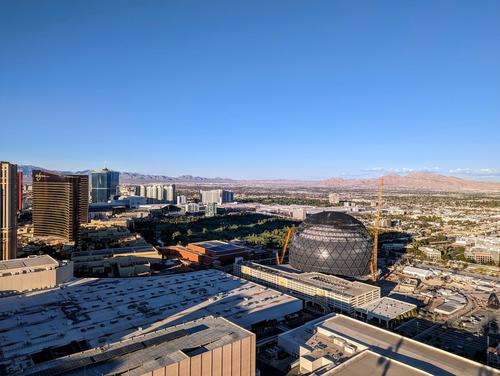
Sphere Entertainment Co. (SPHR) shares climbed +3.26% today to $114.82, extending a remarkable run that has seen the stock surge over 365% from its 52-week low of $23.89. This latest uptick reflects continued investor confidence in the company's innovative Sphere venue in Las Vegas and its promising growth trajectory, particularly following its stellar Q4 2025 earnings report. The market is increasingly recognizing the unique value proposition of the Sphere, moving past initial skepticism about its massive construction costs.
The primary catalyst for this sustained positive sentiment stems from the company's Q4 2025 earnings, released on February 12, 2026, which significantly exceeded analyst expectations. Sphere Entertainment reported total company revenue of $394.3 million for the December quarter, a 28% increase year-over-year and well above the $378 million forecast. More importantly, the Sphere segment itself delivered a staggering $274.2 million in revenue, marking a 60% jump compared to the prior year, and swung to an adjusted operating income of $89.4 million from a loss in the previous period.
This financial outperformance is largely attributed to the immense success of "The Wizard of Oz at Sphere," which has sold over 2.2 million tickets and generated approximately $290 million in sales since its August launch. The immersive experience, coupled with high-profile concert residencies and growing advertising revenue from the Exosphere, has transformed the Las Vegas venue into a significant cash generator. Investors are now betting on the replicability of this success as the company outlines plans for global expansion, including new venues in Abu Dhabi and National Harbor, Maryland.
The positive momentum is also bolstered by a generally bullish analyst consensus. While the average 1-year price target sits around $127.50, some analysts, like Guggenheim's Curry Baker, have set targets as high as $150.00, representing a potential 34.9% upside from the previous day's close. This optimistic outlook, combined with the company's strategic refinancing of its Las Vegas credit facility, has created a compelling narrative for SPHR, driving its stock price to near its 52-week high of $121.93.
What's Driving the Sphere's Unprecedented Success?
The Sphere in Las Vegas isn't just a venue; it's an experience, and that unique selling proposition is the core driver of its financial success. The company's Q4 2025 earnings call highlighted several key factors contributing to its record Sphere segment growth. Foremost among these is the phenomenal audience reception for proprietary content like "The Wizard of Oz at Sphere," which has proven to be both a critical and commercial triumph. This show alone accounted for a significant portion of the $109 million increase in Sphere Experience revenues from 245 showings.
Beyond proprietary content, the Sphere has become a magnet for top-tier musical acts, with residencies from artists like U2, Dead & Company, and the Eagles selling out quickly. Executive Chairman and CEO James Dolan confirmed that the venue is nearly fully booked through 2027, focusing on long weekends to maximize visitor traffic in Las Vegas. This robust booking pipeline ensures consistent revenue streams from ticket sales, which averaged around $132 per ticket for "The Wizard of Oz."
The venue's exterior, the Exosphere, also represents a high-margin revenue stream through dynamic advertising. Major brands such as Google and Delta have already capitalized on this unique platform, which can deliver an estimated 4.7 million daily impressions. Sponsorship and advertising revenue ticked up $4.2 million in Q4, demonstrating the growing appeal of the Sphere as an innovative marketing channel. These diversified revenue streams, from immersive shows and concerts to advertising and potential naming rights, underpin the Sphere's strong financial performance.
Furthermore, Sphere Entertainment is actively investing in enhancing its immersive technology and content. Plans include releasing an enhanced version of "The Wizard of Oz" with new scenes and 4D effects, as well as a new theater experience titled "From The Edge" later this year. This continuous innovation ensures the Sphere remains a cutting-edge attraction, drawing repeat visitors and maintaining its competitive edge in the entertainment landscape. The company's ability to create and monetize such unique, high-demand experiences is a testament to its innovative business model.
What Are the Expansion Plans and Their Financial Implications?
Sphere Entertainment's long-term vision extends far beyond Las Vegas, with ambitious plans to replicate its successful model globally. The company has already announced two major expansion projects: a full-scale Sphere in Abu Dhabi, in partnership with the Department of Culture and Tourism, and a smaller-scale Sphere at National Harbor in Maryland, near Washington D.C. These initiatives signal a clear strategy to leverage the brand and technology developed in Las Vegas, but with a crucial shift in financial approach.
The National Harbor project, for instance, is slated to be a 6,000-seat venue, significantly smaller than the 17,600-seat Las Vegas original, and is supported by approximately $200 million in state, local, and private incentives. This move towards a "capital-light" expansion strategy is critical, as the Las Vegas Sphere cost a staggering $2.3 billion to build, far exceeding initial projections. By focusing on partnerships and licensing the Sphere concept, rather than solely committing its own capital, the company aims to mitigate the substantial financial burden associated with constructing these technologically advanced venues.
While the capital-light approach is designed to reduce direct financial risk, it introduces new complexities. The company will need to attract partners willing to invest heavily in these projects, and the operational management and financing structures for these new venues, particularly National Harbor, are still being ironed out. James Dolan, Executive Chairman and CEO, indicated that they are exploring multiple financing options, including standalone project financing, due to lender confidence in the Sphere model. He also noted ongoing discussions with IP holders and potential partners, who are enthusiastic about adapting their content for the Sphere's unique medium.
The economic impact of these expansions is projected to be substantial. The National Harbor Sphere, for example, is expected to generate over $1 billion annually for Maryland and create thousands of jobs. However, elevated construction costs remain a concern, as noted by Dolan, though he believes the business model can still support the investment. The success of these expansion projects will hinge on Sphere Entertainment's ability to secure favorable financing, attract strong local partners, and maintain the high-margin revenue streams seen in Las Vegas.
What Are the Key Risks and Headwinds for SPHR?
Despite the dazzling success of the Las Vegas Sphere, Sphere Entertainment (SPHR) is not without its challenges and risks. The most significant headwind comes from its legacy MSG Networks segment, which continues to face structural declines. In Q4 2025, MSG Networks revenue decreased by 14% to $120.1 million, primarily driven by a 14.5% decrease in subscribers and lower affiliate rates. This ongoing erosion in its traditional media business acts as a drag on the company's overall financial performance, offsetting some of the Sphere segment's impressive growth.
Another substantial concern revolves around the high direct operating expenses associated with the Sphere experience. While the venue generates significant revenue, the costs of running such a technologically complex operation are considerable. The company reported higher direct operating expenses due to increased costs for performances and a higher number of shows. Although the Sphere segment achieved an adjusted operating income of $89.4 million in Q4, it still posted a $6.5 million operating loss when accounting for substantial depreciation and amortization costs of $82 million. This highlights the capital-intensive nature of the business and the long road to full profitability on a GAAP basis.
Future expansion plans, while exciting, also present financial risks. The Las Vegas Sphere's $2.3 billion construction cost far surpassed initial projections, raising questions about the economic scalability of new venues. While the company aims for a "capital-light" strategy for future Spheres, relying on partnerships and licensing, securing adequate financing and managing construction costs for projects like National Harbor and Abu Dhabi will be crucial. There's also uncertainty regarding potential operating partners for these new venues, which could impact their financial viability and speed of development.
Finally, the company's SG&A expenses were higher in Q4, partly due to executive transition costs and share-based awards. While these might be one-off events, they underscore the challenges of managing a rapidly evolving and high-growth enterprise. The market will be closely watching SPHR's ability to effectively manage these costs, mitigate the decline in MSG Networks, and execute its ambitious global expansion without incurring excessive debt or diluting shareholder value.
Is SPHR a "Buy" for Long-Term Investors?
For long-term investors, Sphere Entertainment (SPHR) presents a compelling, albeit high-risk, high-reward, proposition. The company is clearly at the forefront of redefining live entertainment, and the Las Vegas Sphere has proven its ability to generate significant revenue and adjusted operating income. The market's reaction to the Q4 2025 earnings, pushing the stock up over 3% today and more than 365% from its 52-week low, signals strong belief in its innovative business model and future potential.
The bull case rests on several pillars. First, the proven demand for the Sphere experience, exemplified by "The Wizard of Oz" selling 2.2 million tickets and generating $290 million, suggests a powerful, repeatable revenue stream. Second, the strong booking pipeline for concert residencies through 2027 provides revenue visibility. Third, the high-margin advertising revenue from the Exosphere offers a diversified income source. Finally, the strategic shift to a "capital-light" expansion model, leveraging partnerships and incentives for new venues in Abu Dhabi and National Harbor, could unlock global growth without overburdening the balance sheet.
However, investors must weigh these positives against significant risks. The declining MSG Networks segment remains a drag, and the substantial depreciation and amortization costs mean the Sphere segment still reports an operating loss on a GAAP basis. The execution of global expansion, particularly managing construction costs and securing favorable financing and operating partners, will be paramount. While the company has successfully refinanced its Las Vegas credit facility, future projects will require careful financial stewardship.
Ultimately, SPHR is a speculative play on the future of immersive entertainment. Its current market capitalization of $4.14 billion reflects considerable growth expectations. Analysts generally hold a "Moderate Buy" consensus, with a median price target of $127.50, suggesting further upside. For investors with a high-risk tolerance and a belief in the long-term potential of cutting-edge experiential entertainment, SPHR could be an attractive opportunity, but it demands careful monitoring of its expansion execution and cost management.
Sphere Entertainment is carving out a unique niche in the entertainment industry, demonstrating impressive early success with its flagship Las Vegas venue. While challenges remain, particularly with its legacy media business and the capital intensity of its projects, the company's innovative approach and strategic expansion plans offer considerable upside. Investors should closely watch the progress of its new venues and its ability to consistently deliver high-quality, high-demand content to sustain this momentum.
Want deeper research on any stock? Try Kavout Pro for AI-powered analysis, smart signals, and more. Already a member? Add credits to run more research.
Related Articles
Why Did Petco (WOOF) Stock Skyrocket Today
Category
You may also like


Planet Labs Stock Is Surging Today: What's Driving The Action?

Sphere Entertainment (SPHR) is a Great Momentum Stock: Should You Buy?

Trump stock just spiked 25%; Here's why DJT is soaring today
Breaking News
View All →Featured Articles
Top Headlines

Is It Too Late to Buy Walmart?

Got $5,000? 2 Stocks the Fed's Rate Decision Just Made More Attractive

Nvidia Is Credit Personified While The Fed Is A Pointless Distraction

Nvidia Just Announced Hardware for AI Data Centers in Space. Here Are the Very Real Implications.