MarketLens
BYD vs Tesla: The High-Stakes Investment Battle Reshaping the EV Market

The electric vehicle revolution has entered a brutal new phase. Gone are the days of easy profits and unchallenged growth—today's EV market is a gladiatorial arena where only the strongest survive. In this high-stakes environment, two titans stand apart: China's BYD and America's Tesla. But as we dive into the numbers and strategies, a surprising narrative emerges that challenges conventional wisdom about which company represents the better investment opportunity.
The Great EV Shakeout Has Begun
The global electric vehicle market is experiencing its most dramatic transformation yet. In China alone, car prices have plummeted 19% over the past two years, triggering an industry-wide price war that's forcing a massive consolidation. Industry analysts predict that of the 129 EV brands currently operating, only 15 will survive until 2030. This isn't just competition—it's corporate Darwinism at its most ruthless.
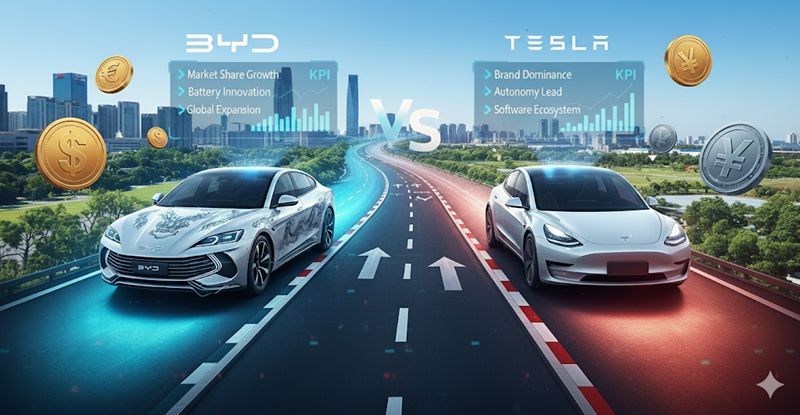
At the center of this storm, BYD and Tesla represent two fundamentally different philosophies. BYD has embraced a volume-driven, manufacturing-focused strategy, while Tesla increasingly pins its hopes on futuristic technologies like autonomous driving and humanoid robots. The question for investors isn't just which company will win, but which strategy makes more sense in today's hyper-competitive landscape.
The Financial Reality Check
The numbers tell a compelling story. In the first half of 2025, BYD's revenue surged 23.3% to 371.3 billion yuan ($51.9 billion), surpassing Tesla's $41.8 billion for the first time in history. Yet BYD's second-quarter profit plummeted 30% year-on-year—its first quarterly decline in three years. This apparent contradiction reveals the heart of BYD's strategy: deliberately sacrificing short-term profits to capture long-term market dominance.
| H1 2025 Financial Snapshot | BYD | Tesla |
|---|---|---|
| Revenue | $51.9B | $41.8B |
| Q2 Net Profit Change | -30% | -16% |
| Vehicle Sales | 2.15M units | ~0.78M units |
| Cash Reserves | $21.8B | $36.8B |
| Operating Cash Flow | +125% YoY | -31% YoY |
BYD's profit decline directly results from its aggressive pricing strategy—cutting prices by up to 34% across 20 models. This pushed its Q2 gross margin to 16.3%, the lowest in three years. But here's what most analysts miss: BYD's operating cash flow surged 125% year-on-year to 31.8 billion yuan, and its cash reserves remain robust at 156.1 billion yuan. The company is essentially using its financial fortress to fund a market share land grab.
Tesla's challenges run deeper. Beyond the 16% profit decline, the company faces a systematic erosion of market share. In Europe, Tesla's sales dropped 40% in July 2025—the seventh consecutive monthly decline—even as the overall European EV market grew strongly. In China, Tesla's market share has collapsed from 16% in 2020 to just 3.2% today. Most alarmingly, Tesla is losing ground in its home market, with California sales slipping below 50% for the first time. Tesla's operating cash flow fell to $2.5 billion in Q2 2025 from $3.6 billion a year earlier, while free cash flow plummeted to just $146 million from $1.3 billion in the prior year—an 89% decline that raises questions about sustainability.
The Moat That Matters: Vertical Integration vs. Vision
BYD's competitive advantage lies in its extraordinary vertical integration. The company doesn't just assemble cars—it manufactures its own batteries (including the proprietary Blade Battery), semiconductors, electric motors, and power electronics. It even operates its own shipping fleet for international deliveries. This integration provides unmatched cost control and supply chain resilience that competitors simply cannot replicate.
Tesla's moat is more ethereal but potentially more valuable—if it materializes. The company's investment thesis increasingly rests on three pillars: Full Self-Driving (FSD) technology, humanoid robotics (Optimus), and its energy storage business. The energy division has emerged as a surprise star performer, with gross margins exceeding 30% in Q2 2025, contributing 23% of Tesla's total profit despite representing only 13% of revenue.
| Strategic Advantages | BYD | Tesla |
|---|---|---|
| Vertical Integration | Complete: batteries to shipping | Partial: Gigafactories |
| R&D Investment (H1 2025) | $4.3B (53% YoY increase) | Focus on FSD/AI |
| Business Diversification | Auto (80%), electronics, energy, rail | Auto, energy storage, AI/robotics |
| Product Strategy | Multi-brand (mass to luxury) | Limited premium lineup |
The Global Expansion Story
BYD's international expansion is nothing short of remarkable. The company's overseas wholesale volumes more than doubled year-on-year in Q2 2025. In Europe, BYD's July 2025 sales tripled to 13,503 units, surpassing Tesla's volume for the first time. The company has established factories in multiple continents and built extensive dealer networks to reduce tariff exposure and adapt to local preferences.
Tesla's global narrative is less encouraging. The company faces a seven-month streak of declining European sales and has seen its U.S. market share drop from 75% in 2022 to approximately 43% in 2025. While competitors like Geely and XPeng surge, Tesla struggles with an aging product lineup and unique reputational challenges tied to CEO Elon Musk's public behavior.
Navigating the Risk Landscape
Both companies face significant risks, but their nature and magnitude differ substantially.
BYD's risks are tactical and manageable:
- The price war it initiated impacts profits but plays to its strengths
- EU tariffs (17.4%) and geopolitical tensions are offset by local manufacturing
- Its diversified business model provides buffers against sector-specific downturns
Tesla's risks are existential and complex:
- Vulnerable to potential rollback of U.S. EV subsidies and emissions standards
- Carbon credit revenue—historically crucial to profitability—faces elimination
- CEO reputational risk has measurably impacted sales in key markets
- Execution risk on unproven technologies (Robotaxi, Optimus) underpins valuation
The Investment Verdict
The investment case crystallizes around a fundamental question: Do you bet on proven execution or visionary potential?
BYD represents the pragmatic choice. It's a manufacturing colossus with demonstrated operational excellence, wielding its cost advantages like a strategic weapon. The company's willingness to sacrifice short-term profits for long-term dominance, backed by robust financials and successful global expansion, presents a compelling narrative of sustainable growth. Its recent profit decline isn't a weakness—it's a feature of a strategy designed to emerge as one of the few survivors in a consolidating industry.
Tesla offers a higher-risk, higher-reward proposition. Its valuation increasingly depends on successfully commercializing technologies that remain unproven at scale. While the energy business provides a bright spot, the core automotive segment faces systemic challenges that show no signs of abating. Investing in Tesla means believing the company can transform into a technology and services giant before its traditional car business erodes beyond recovery.
The Bottom Line for Investors
In the ruthless new world of electric vehicles, BYD has emerged as a serious contender that demands investor attention. While Tesla maintains its status as a visionary company, vision alone may not justify its premium when the core business is contracting in an expanding market. BYD's combination of operational excellence, strategic positioning, and financial strength positions it as a formidable competitor that could potentially reshape the global EV landscape.
The recent profit drop that spooked some investors should be viewed as BYD flexing its muscles, demonstrating it can absorb pain that would cripple competitors. For investors seeking exposure to the EV revolution with a margin of safety, BYD's industrial might and proven execution make it an increasingly attractive alternative to Tesla's higher-risk proposition. In a market where 90% of brands won't survive the decade, betting on the company with the strongest fundamentals isn't just prudent—it's essential.
The electric vehicle game has evolved from a technology race to a war of attrition. In this new paradigm, BYD's manufacturing fortress looks increasingly capable of challenging Tesla's long-held dominance. Whether it ultimately prevails remains to be seen, but one thing is clear: the era of Tesla's unchallenged supremacy in the EV investment landscape is over.
Ready to dive deeper into complex investment analysis like this? Discover how Kaout Pro's financial research agents can automate sophisticated market comparisons, company valuations, and strategic assessments. Our AI-powered platform transforms hours of manual research into comprehensive, data-driven insights in minutes. Subscribe to Kaout Pro today and elevate your investment research with the power of automated financial intelligence.
Related Articles
Category
You may also like
No related articles available
Breaking News
View All →No topics available at the moment