MarketLens
Has Sharplink's Ethereum Pivot Created a High-Stakes Bet for Investors

Sharplink Gaming Ltd. (NASDAQ: SBET) has emerged as one of the market's most perplexing tickers, sporting a "Strong Sell" quant rating of 1.17 while simultaneously garnering a "Buy" consensus from Wall Street analysts. This stark divergence signals a company at a critical juncture, having pivoted dramatically from its iGaming roots to an institutional-grade Ethereum treasury platform. Investors are left to decipher whether SBET represents a high-convulsion opportunity or a value trap laden with significant risks.
Key Takeaways
- Sharplink's pivot to an Ethereum treasury model introduces extreme volatility and significant accounting losses, overshadowing its legacy iGaming business.
- Despite a "Buy" analyst consensus, fundamental metrics reveal deep profitability issues, negative returns, and a highly speculative valuation.
- Massive share dilution and a highly competitive, capital-intensive market for its original business add layers of risk to its crypto-centric strategy.
Has Sharplink's Ethereum Pivot Created a High-Stakes Bet for Investors?
Sharplink Gaming Ltd. (SBET) has undergone a radical transformation, shifting its core identity from an iGaming solutions provider to a prominent institutional-grade Ethereum treasury management platform. This strategic pivot, heavily influenced by the company's chairman, Ethereum co-founder Joseph Lubin, has seen SBET accumulate a substantial 867,798 ETH, valued at approximately $1.72 billion as of February 15, 2026. This move positions Sharplink as a direct play on Ethereum's fortunes, attracting significant institutional ownership, which now stands at around 46%.
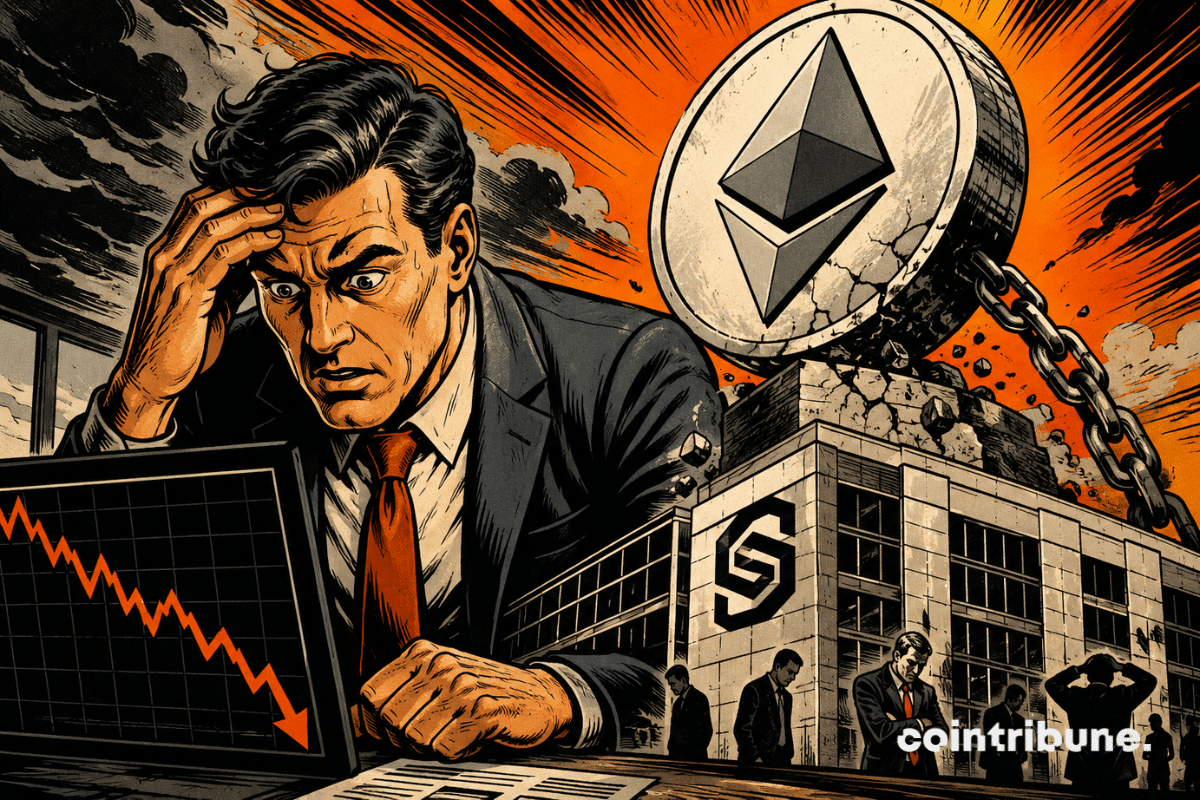
However, this bold strategy comes with an inherent and profound risk: extreme exposure to cryptocurrency volatility. The company's stock performance is now inextricably linked to the unpredictable fluctuations and sentiment within the broader crypto market. This was starkly evident in its full-year 2025 results, where a reported $734.59 million net loss was largely driven by $616.2 million in unrealized losses and a $140.2 million impairment tied to its substantial Ethereum holdings. While the company generated $55.2 million in net realized gains from its crypto activities in 2025, the sheer scale of unrealized losses underscores the double-edged nature of its treasury strategy.
The company's high beta of 11.40 further highlights its extreme sensitivity to market movements, making it a highly speculative investment. For context, a beta of 11.40 suggests that if the broader market moves 1%, SBET could theoretically move 11.40% in the same direction. This level of volatility means that even minor shifts in crypto sentiment or ETH price can lead to outsized swings in SBET's stock, creating both immense potential for gains and equally significant downside risk. Investors are essentially making a leveraged bet on Ethereum, albeit through a publicly traded equity.
This pivot has fundamentally altered Sharplink's investment narrative. While the bullish argument centers on the accumulation of ETH and the potential for its Net Asset Value (NAV) to "explode upwards" if Ethereum returns to all-time highs, the bearish case points to the risks of leverage and liquidation. A sustained bear market in crypto could shrink the company's assets relative to its liabilities, with the $2,000 support level for ETH being a critical watchpoint. If ETH falls below this, the pressure on SBET's balance sheet could become unsustainable, turning paper losses into a liquidity crisis.
What Do Sharplink's Financials Reveal About Its Profitability and Valuation?
A deep dive into Sharplink's trailing twelve-month (TTM) financial fundamentals paints a concerning picture, starkly contrasting with any notion of a stable, profitable enterprise. Despite a reported revenue surge of 666.0% year-over-year for FY2025, reaching $28.06 million, the company's profitability metrics are in disarray. Sharplink posted an astounding TTM net margin of -2618.4% and an operating margin of -116.7%. This indicates that not only is the company failing to generate profit from its operations, but its expenses are vastly outstripping its revenue.
The TTM Earnings Per Share (EPS) stands at a deeply negative -$3.73, reflecting the massive $734.59 million net loss reported for full-year 2025. This loss, primarily driven by unrealized losses on its Ethereum holdings, highlights the accounting challenges and volatility inherent in its crypto treasury strategy. While gross margin appears robust at 93.2%, this figure is largely misleading in the context of the company's overall financial health, as it's quickly eroded by massive operating and non-operating expenses, including a significant increase in SG&A expenses to $42.3 million in 2025, up from $5.7 million in 2024.
Valuation multiples further underscore the speculative nature of SBET. The company trades at a TTM Price-to-Sales (P/S) ratio of 40.01, which is exceptionally high for a company with such severe profitability issues. Its Price-to-Earnings (P/E) ratio is a negative -2.02, and its EV/EBITDA is an alarming -101.50, all pointing to a company that is far from generating sustainable earnings or positive cash flow. Returns on equity (ROE) and assets (ROA) are deeply negative at -49.5% and -30.2% respectively, indicating inefficient use of shareholder capital and assets.
The company's cash on hand was a mere $28.5 million as of December 31, 2025, alongside $1.9 million in USDC holdings. While Sharplink successfully raised $2.1 billion in equity in 2025, this capital was primarily used to acquire its substantial ETH treasury. The ongoing operational losses and the inherent volatility of its primary asset raise serious questions about its long-term liquidity and ability to fund operations without further dilutive capital raises, especially if the crypto market faces a prolonged downturn.
Why Are Analysts Divided on Sharplink, and What Does This Mean for Investors?
The analyst landscape for Sharplink (SBET) presents a perplexing dichotomy, with a "Buy" consensus from a small group of analysts clashing sharply with the company's dire financial fundamentals and a "Strong Sell" quant rating. While MarketBeat reports a "Moderate Buy" consensus from eight firms (one Strong Buy, five Buys, one Hold, one Sell) with an average 1-year price target of $27.43, the real-time API data shows a more constrained "Buy" consensus from just two analysts, with a consensus target of $18.75. This discrepancy in reporting highlights the rapidly evolving and often conflicting views on this highly volatile stock.
What's clear is a pattern of significant downward revisions in price targets. B. Riley Financial, for instance, drastically cut its price objective from $32.00 to $19.00 in November 2025, and then further to $10.00 by February 22, 2026. Other firms like Weiss Ratings and Wall Street Zen issued or reissued "sell" ratings in January and February 2026, respectively. The average price target across analysts was revised downward by a substantial 26.56% in the three months leading up to March 6, 2026. This trend suggests a growing skepticism, even among those maintaining "Buy" ratings, as the company's crypto-centric strategy unfolds.
The disconnect between analyst optimism and the underlying financial reality is a critical red flag for investors. While analysts might be focusing on the "potential" of Sharplink's Ethereum treasury and the long-term vision of its leadership, the TTM financials scream distress. The Q3 2025 earnings miss, where EPS of $0.62 fell 17.33% below estimates and revenue of $10.84 million missed expectations by an astonishing 98.47%, triggered a 5.0% stock decline the day after the announcement, followed by a 38.1% drop over the subsequent 103 days. This shows that market participants are indeed reacting negatively to poor operational performance, regardless of the crypto narrative.
Furthermore, shareholders have experienced substantial dilution, with total shares outstanding growing by a staggering 37611% over the past year. This massive increase in share count significantly impacts per-share value and puts downward pressure on the stock price, especially if the capital raised doesn't translate into commensurate shareholder value. While institutional investors like Alyeska Investment Group, Invesco, and Voloridge have increased their stakes, this could be a bet on the underlying ETH holdings rather than the operational viability of Sharplink's original business or its ability to manage crypto volatility.
What Are Sharplink's Competitive Pressures and Operational Vulnerabilities?
Sharplink's operational landscape is bifurcated, encompassing both its legacy B2B gambling technology and services, and its new, dominant Ethereum treasury management. In the iGaming sector, Sharplink is a "minnow swimming among sharks," as described by competitive analyses. It operates in a highly competitive market where scale, robust technology, and strong relationships with gaming operators are paramount. Larger, more established, and vastly better-capitalized firms like Gambling.com Group (GAMB), Better Collective A/S, and Sportradar Group AG dominate this space.
These competitors boast profitable business models, strong balance sheets, and significant network effects that are incredibly difficult for a small player like SBET to overcome. For instance, Sportradar generates over €150 million in annual EBITDA, a stark contrast to Sharplink's deep operating losses. Sharplink's core offering, focused on affiliate marketing and player conversion technology, lacks a scalable product and a viable revenue model in this crowded field. Its weaknesses are fundamental, with the primary risk being its ability to continue as a going concern in its original business segment.
The pivot to Ethereum treasury management introduces a different set of operational vulnerabilities. While the company has assembled an in-house team with expertise in capital markets and digital asset operations, managing a multi-billion dollar crypto treasury is inherently complex and risky. Sharplink itself warns that ETH volatility and evolving regulatory risks could strain liquidity and working capital. The company's ETH holdings trade in a market marked by high volatility, evolving regulation, and operational vulnerabilities at exchanges, which can restrict timely conversion to cash.
In periods of market stress, Sharplink may be unable to sell ETH at acceptable prices, use ETH as collateral, or rely on protections comparable to FDIC or SIPC coverage. This lack of traditional financial safeguards directly pressures working capital and can severely harm its financial condition. The company's reliance on "generating yield above native staking rates through partnerships and innovation" for its treasury management strategy also implies a level of active management and risk-taking beyond simple HODLing, which could expose it to further operational and counterparty risks.
Is Sharplink a Speculative Bet or a Value Trap for Investors?
Sharplink Gaming (SBET) presents a classic high-risk, high-reward scenario, but with significant red flags that lean heavily towards the "speculative bet" side of the ledger, bordering on a value trap. The company's current stock price of $7.53, while significantly off its 52-week high of $124.12, still represents a market capitalization of $1.12 billion. This valuation appears stretched when juxtaposed against its TTM revenue of just $0.14 per share and a staggering net loss of $734.59 million in 2025.
The core of Sharplink's investment thesis now rests almost entirely on the price appreciation of Ethereum. With 867,798 ETH on its balance sheet, the company has indeed become a proxy for institutional exposure to the cryptocurrency. The bullish argument, championed by some analysts, hinges on the idea that if ETH returns to its all-time highs, Sharplink's Net Asset Value (NAV) would surge. However, this is a highly concentrated bet on a single, volatile asset, subject to market whims, regulatory shifts, and technological developments beyond Sharplink's control.
For investors considering SBET, it's crucial to distinguish between a company with a strong underlying business that happens to hold crypto, and a company whose primary business is holding crypto, with the associated accounting and operational challenges. Sharplink's legacy iGaming business is struggling, lacking scale and a viable revenue model against formidable competitors. The massive share dilution, negative profitability metrics, and extreme stock volatility (beta of 11.40) further compound the risk profile.
Ultimately, Sharplink is not an investment for the faint of heart or those seeking fundamental value. It is a highly speculative vehicle for gaining exposure to Ethereum, albeit with significant operational, accounting, and market-specific risks. The "Strong Sell" quant rating reflects the dire financial health and operational challenges, while the "Buy" analyst consensus appears to be a bet on the crypto market's future rather than Sharplink's intrinsic business strength. Investors should approach SBET with extreme caution, understanding that any investment is a direct, leveraged wager on ETH, fraught with the potential for substantial capital loss.
Sharplink Gaming remains a high-stakes gamble, driven by the volatile tides of the cryptocurrency market rather than robust operational performance. The significant financial red flags and competitive pressures demand extreme caution, making it a highly speculative play best suited for investors with a very high-risk tolerance and a strong conviction in Ethereum's long-term trajectory.
Want deeper research on any stock? Try Kavout Pro for AI-powered analysis, smart signals, and more. Already a member? Add credits to run more research.
Related Articles
Category
You may also like


Bitcoin OG moves $543 mln in ETH – Is a major Ethereum sell-off about to begin?

Here's How Ethereum Staking Transforms Into A Multi-Billion-Dollar Bet For Bitmine Immersion

Ethereum Leverage Ratio Hits Record High as Traders Pile Into Risky Bets
Breaking News
View All →Featured Articles
Top Headlines

Nebius Teams With NVIDIA to Build Cloud for Robotics and Physical AI

CMR Surgical Advances Physical AI to Support the Future of Robotic Surgery with NVIDIA

Compal Introduces High-Density NVIDIA HGX™ Rubin NVL8 Integrated Solution at GTC 2026

Tecan to create Data-Driven Labs with NVIDIA