MarketLens

Log in

Is Dutch Bros' Ambitious 2029 Expansion Goal Achievable

2 weeks ago
SHARE THIS ON:

Is Dutch Bros' Ambitious 2029 Expansion Goal Achievable

Key Takeaways

  • Dutch Bros is aggressively pursuing a target of 2,029 shops by 2029, nearly doubling its current footprint, fueled by strong Q4 2025 results and strategic operational shifts.
  • The company's focus on capital efficiency through build-to-suit models and strategic acquisitions, alongside menu innovation and digital engagement, underpins its ambitious expansion.
  • Despite a premium valuation, BROS's robust growth trajectory, positive free cash flow, and significant addressable market potential present a compelling long-term investment case, though execution risks remain.

Is Dutch Bros' Ambitious 2029 Expansion Goal Achievable?

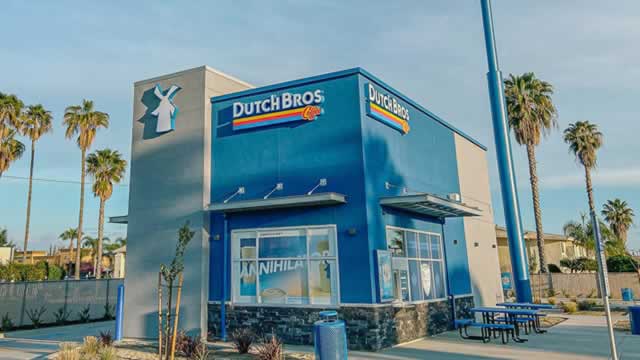
Dutch Bros (NYSE: BROS) recently delivered a strong Q4 2025 performance, reporting revenue growth of 29.4% to $443.6 million and a remarkable 143% surge in adjusted EPS to $0.17. This robust showing has reignited investor confidence, particularly as the company reaffirmed its bold target: 2,029 shops by 2029. This isn't just incremental growth; it implies nearly doubling its current footprint of 1,136 locations in just four years, averaging over 200 new shops annually.

The company's confidence stems from several operational successes. System-wide average unit volumes (AUVs) hit a record $2.1 million in 2025, surpassing even Starbucks' reported AUVs from 2024. This strong unit-level economics, coupled with a burgeoning regional operator pipeline of approximately 475 candidates (nearly double 2022 levels), provides the human capital necessary to scale. Dutch Bros isn't just growing; it's growing profitably, with adjusted EBITDA for FY 2025 climbing 31% to $303 million, outpacing revenue growth.

This aggressive expansion is not without precedent for the brand. Dutch Bros has already more than doubled its system shop count since 2022, expanding into seven contiguous states in 2025 alone, bringing its total presence to 25 states. The company plans to open at least 181 new locations in 2026, with capital expenditures projected between $270 million and $290 million. This systematic approach, combined with a proven ability to enter new markets successfully, suggests that while challenging, the 2029 goal is within reach if current momentum is sustained.

However, achieving such rapid growth demands flawless execution. The company's ability to consistently identify prime real estate, train new "broistas," and maintain its distinct brand culture across a rapidly expanding network will be critical. The restaurant industry is notoriously competitive, and while Dutch Bros has carved out a unique niche, sustaining its growth rate will require continuous innovation and operational excellence. The market will be watching closely to see if Dutch Bros can maintain its impressive unit economics as it scales.

How is Dutch Bros Fueling its Rapid Store Expansion?

Dutch Bros isn't just opening new stores; it's strategically optimizing its development engine to fuel rapid, capital-efficient expansion. A key shift has been towards a "build-to-suit" development model, where development partners fund upfront construction in exchange for higher rent. This strategy has significantly reduced the average capital expenditure per shop, dropping from $1.8 million in Q4 2024 to $1.3 million in Q4 2025, with a long-term target of $1.25 million. This capital efficiency is crucial for funding the planned 181+ new locations in 2026 and beyond.

Beyond ground-up builds, Dutch Bros is also leveraging strategic acquisitions and conversions. A prime example is the recent acquisition of 20 Clutch Coffee Bar locations in North and South Carolina for $19.8 million, funded with cash on hand. This move allows Dutch Bros to rapidly enter new markets and gain immediate scale in a capital-efficient manner, converting existing real estate rather than starting from scratch. CEO Christine Barone emphasized that the company will continue to evaluate such conversion opportunities when they make strategic sense, highlighting a flexible and opportunistic real estate strategy.

The company is also experimenting with new store formats to penetrate urban-dense corridors where traditional drive-thrus are challenging. Its first walk-up-only shop in Downtown Los Angeles, opened in late 2025, quickly became the chain's top-performing shop, demonstrating the potential for diversified formats. This location also saw an order-ahead mix more than three times the system average, showcasing the synergy between physical expansion and digital engagement.

Furthermore, Dutch Bros is strengthening its operational foundation. The company has refined its labor deployment and rolled out a new training model for field teams, enabling continued transaction growth while protecting customer and employee experience. The appointment of Jennifer Somers, former CAVA COO, as Chief Shops Officer underscores the commitment to operational excellence and scalability. These initiatives collectively aim to enhance throughput, provide greater convenience, and drive market share, ensuring that new shops are not just opened, but are also high-performing and profitable.

What Operational Drivers Are Boosting Same-Store Sales and Profitability?

Beyond sheer unit growth, Dutch Bros is actively implementing several initiatives to drive same-store sales (SSS) and enhance profitability, which are critical for sustainable long-term performance. In Q4 2025, comparable store sales increased by a robust 7.7%, supported by a 5.4% rise in customer visits. For the full year 2025, systemwide SSS grew 5.6%, with company-operated comps increasing an even stronger 7.4%.

A significant driver is the expansion of its food program. Currently piloted in 300 shops across 11 states, the program is expected to roll out nationwide by the end of 2026. Early results are promising, with management suggesting an approximate 4% comp lift in participating shops. While food currently accounts for less than 2% of sales, the potential to inch closer to industry averages (where food can be 25% of sales for leading coffee chains) represents a substantial opportunity to boost average ticket sizes and attract new occasions.

Digital engagement and loyalty are also playing a crucial role. The Dutch Rewards loyalty program surpassed 15 million members by the end of 2025, with about 72% of system transactions attributed to the program – a four-point increase over 2024. The Order Ahead program, ending 2025 with roughly a 14% mix in Q4, has not only driven Dutch Rewards penetration but also activated walk-up windows, which now represent about 18% of the channel mix. These digital channels improve throughput and customer convenience, driving repeat visits.

Efficiency gains are also contributing to profitability. The company-operated contribution margin reached 28.9% in 2025, representing more than 400 basis points of expansion since 2022. This improvement is partly due to the shift towards build-to-suit development, which lowers capital expenditures, and refined labor deployment. While elevated coffee costs are expected to create approximately 200 basis points of COGS pressure in Q1 2026, management anticipates offsetting this through operational efficiencies and strategic pricing, guiding for 2026 adjusted EBITDA between $355 million and $365 million.

What Are the Key Risks and Competitive Headwinds for BROS?

While Dutch Bros' growth story is compelling, investors must consider the inherent risks and competitive headwinds in the quick-service beverage industry. The company's aggressive expansion target of 2,029 shops by 2029 requires sustained operational excellence, and any missteps in real estate selection, new market penetration, or franchisee support could impede progress. Rapid growth can strain supply chains, quality control, and brand consistency, especially as Dutch Bros enters new, unfamiliar territories.

Competition remains fierce. Dutch Bros operates in a crowded market, vying for market share against established giants like Starbucks (SBUX) and rapidly expanding rivals such as 7 Brew, which finished 2025 with over 600 locations. These competitors are also innovating with menu items, digital platforms, and store formats. While Dutch Bros has cultivated a strong "cult following" and differentiates itself with its unique culture and focus on energy drinks, maintaining this edge will be crucial as it expands into more saturated markets.

Valuation is another significant consideration. BROS currently trades at a premium, with a P/E ratio of 83.30 and a P/S ratio of 7.53. While high growth companies often command higher multiples, this valuation leaves little room for error. Any slowdown in growth, margin compression, or failure to meet ambitious targets could lead to a significant re-rating of the stock. The company's beta of 2.55 also indicates higher volatility compared to the broader market, making it a more speculative investment.

Furthermore, external factors like elevated coffee costs pose a threat to margins. Management expects approximately 200 basis points of COGS pressure in Q1 2026 due to these costs. While Dutch Bros aims to mitigate this through pricing and efficiency, sustained commodity price increases could erode profitability. The success of new initiatives like the food program and walk-up shops is also not guaranteed, and if these fail to deliver expected comp lifts, the growth narrative could falter.

Is Dutch Bros Stock a Buy for Long-Term Investors?

For long-term investors, Dutch Bros presents an intriguing, albeit high-growth, opportunity. The company's recent Q4 2025 results and ambitious 2029 expansion goal underscore a clear growth trajectory. With a current price of $52.35, the stock sits well below its 52-week high of $86.88, potentially offering an attractive entry point for those bullish on its long-term vision. Wall Street analysts largely agree, with a consensus "Buy" rating from 20 analysts and an average price target of $76.10, suggesting substantial upside.

The core of the bull case rests on Dutch Bros' ability to execute its aggressive unit expansion while maintaining strong unit economics. The company's shift to a build-to-suit model, strategic acquisitions, and diversified store formats demonstrate a thoughtful approach to capital-efficient growth. The long-term addressable market of over 7,000 potential locations in the US, significantly higher than its current 1,136 shops, indicates ample room for sustained growth well beyond 2029.

Moreover, the company's focus on transaction-driving initiatives, such as the expanding food program and robust Dutch Rewards loyalty program, promises to boost same-store sales and customer engagement. The positive free cash flow generation, despite heavy capital expenditures for growth, is a critical indicator of financial health and self-funded expansion. This allows Dutch Bros to grow without relying on debt or shareholder dilution, a significant advantage for long-term value creation.

However, investors must acknowledge the premium valuation and the inherent risks associated with rapid expansion in a competitive industry. The high P/E ratio of 83.30 demands continued exceptional performance. While the growth story is compelling, potential investors should weigh the significant upside potential against the execution risks and market volatility. For those with a high-risk tolerance and a long-term horizon, Dutch Bros could be a rewarding addition to a diversified portfolio, betting on its unique brand, operational prowess, and vast untapped market.

Dutch Bros has laid out a clear, ambitious roadmap for growth, backed by strong operational performance and strategic initiatives. The company's ability to execute on its 2,029 shop target by 2029 will be the ultimate determinant of its long-term stock performance. Investors should monitor new store openings, same-store sales trends, and margin expansion closely as BROS navigates its next chapter of accelerated expansion.


Want deeper research on any stock? Try Kavout Pro for AI-powered analysis, smart signals, and more. Already a member? Add credits to run more research.

SHARE THIS ON:

Related Articles

Category

You may also like

Stock News1 week ago

Can CRS's Brownfield Expansion Project Fuel Long-Term Growth?

Carpenter Technology advances a $400M Athens brownfield expansion, targeting a 7% lift in melt capacity upon commissioning in fiscal 2028.
Stock News1 week ago

Is Nebius the Next Amazon?

Nebius projects substantial growth by 2026, though its current custom chip business remains smaller than Amazon's established operations.
Stock News2 months ago

Is Plug Power's $700M Revenue Target for 2025 Within Reach?

Plug Power's $700M revenue target for 2025 is contingent upon robust electrolyzer demand, despite current softness in legacy product sales impacting growth trajectory.
Stock News2 months ago

Can Dutch Bros Maintain Its Growth Edge as Store Openings Accelerate?

Dutch Bros shows steady transaction growth and strong digital engagement while accelerating store openings toward its 2029 expansion target. The key factor will be maintaining this unit-level performa...

Breaking News

View All →

Top Headlines

View More →
Stock News1 hour ago

AAPL Not Running AI Race Paying Off? iPhone & Google Gemini Add Tech Muscle

Stock News1 hour ago

Why Some Experts Think 'Defensive' Investors Could Lift Costco Stock Back Toward Records

Stock News1 hour ago

Forget Lucid and Rivian: This 1 EV Leader Is Still the Monster Long-Term Winner

Stock News2 hours ago

Is Costco Too Expensive? 3 Red Flags That Could Send Shares Sliding

Stock News2 hours ago

U.S.-Iran war exposes big market concentration risk. It isn't in S&P 500 stocks