MarketLens

Log in

Is the Prediction Market Boom a Game-Changer for Robinhood and Coinbase

5 hours ago
SHARE THIS ON:

Is the Prediction Market Boom a Game-Changer for Robinhood and Coinbase

Key Takeaways

  • Cantor Fitzgerald identifies Robinhood (HOOD) and Coinbase (COIN) as prime public-market beneficiaries of the exploding prediction market sector, projecting $1 trillion in volumes by 2030.
  • Robinhood appears to have a near-term edge, with its users funding prediction market activity with fresh capital and the company already reporting billions of contracts traded and rapid revenue growth.
  • Coinbase is strategically building out its own prediction market infrastructure, but faces potential cannibalization risks as users may fund trades by selling existing crypto holdings.

Is the Prediction Market Boom a Game-Changer for Robinhood and Coinbase?

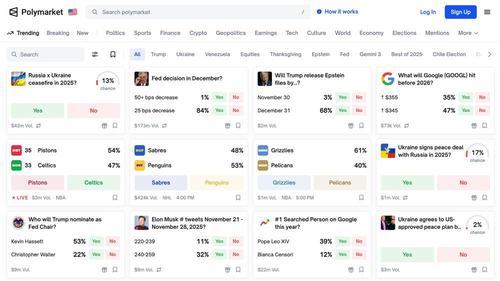
The financial landscape is undergoing a subtle yet profound transformation, driven by the rapid emergence of prediction markets. These platforms, where users trade contracts on real-world outcomes from elections to economic data, are no longer a niche curiosity. Cantor Fitzgerald recently highlighted Robinhood (HOOD) and Coinbase (COIN) as the public companies best positioned to capitalize on this burgeoning sector, which Bernstein forecasts could reach $1 trillion in volumes by 2030. This isn't just about a new product offering; it's about a fundamental shift in how information is valued and traded, creating a powerful new revenue stream for platforms with existing scale and infrastructure.

Cantor Fitzgerald's thesis centers on the idea that prediction markets, often misunderstood as mere gambling, are evolving into sophisticated financial forecasting tools. They generate fee revenue from trading activity, much like traditional equities or crypto exchanges, rather than taking the opposite side of user bets. This model makes them a natural fit for platforms like Robinhood and Coinbase, which already boast massive retail audiences and robust trading systems. The ability to integrate these event-based contracts seamlessly into existing user experiences gives these incumbents a significant competitive advantage over smaller, pure-play prediction market platforms.

The appeal for these platforms is clear: diversify revenue, increase user engagement, and capture a slice of a rapidly expanding market. Robinhood, for instance, has already seen its prediction markets hub become one of its fastest-growing business lines by revenue, with users trading billions of contracts since its post-2024 election launch. Coinbase, while earlier in its rollout, is also integrating prediction market offerings, powered by infrastructure from regulated entities like Kalshi. This strategic move positions both companies at the forefront of what could become a foundational asset class for the modern investor, reshaping how retail finance operates.

Robinhood's Strategic Edge: Fresh Capital and Retail Dominance

Robinhood Markets, Inc. (HOOD) appears to be carving out a significant early lead in the prediction market space, leveraging its established retail user base and a distinct funding dynamic. The company's prediction markets hub, launched after the 2024 U.S. election, has already facilitated over 9 billion contracts traded within a year, quickly becoming its fastest-growing segment by revenue. This impressive traction underscores Robinhood's ability to rapidly onboard users into new product categories, a testament to its intuitive platform design and broad appeal among younger investors.

A key differentiator for Robinhood, according to a Mizuho survey, is how its users fund these new ventures. Approximately 50% of Robinhood respondents indicated they expect to use fresh money to trade prediction markets, rather than reallocating funds from existing traditional portfolios or crypto holdings. This influx of new capital suggests a net additive effect on Robinhood's revenue, minimizing the risk of cannibalizing existing trading volumes. It positions prediction markets as a genuine expansion of the total addressable market for Robinhood, attracting users who might not otherwise engage with traditional financial products.

Robinhood's strategy also emphasizes working with regulated U.S. platforms like Kalshi and ForecastEx, focusing on lower-risk event contracts. This approach aims to mitigate regulatory and reputational concerns, aligning user access to alternative contracts with existing compliance expectations. CEO Vlad Tenev has openly identified prediction markets as a potentially meaningful new revenue source within alternative assets, further signaling the company's commitment. With plans to launch its own prediction markets and integrate tokenized stocks and ETFs, Robinhood is aggressively expanding its product suite to capture diverse user segments and solidify its position as an "everything app" for retail finance.

Coinbase's Vertical Integration and the Cannibalization Question

Coinbase Global, Inc. (COIN) is approaching the prediction market opportunity with a strategy focused on vertical integration and building out its own comprehensive infrastructure. While Robinhood has leveraged partnerships with regulated exchanges like Kalshi, Coinbase has taken a more insular route, acquiring "The Clearing Company" in late December 2025 to bring on-chain clearing and settlement of event contracts under its own roof. This move, aimed at securing specialized talent and achieving Derivatives Clearing Organization (DCO) status, reflects Coinbase's ambition to create an "Everything Exchange" where prediction markets seamlessly integrate with its broader crypto ecosystem.

Coinbase's prediction platform, offered through Coinbase Financial Markets (a registered futures commission merchant), spans a wide array of categories including sports, crypto, politics, economics, and company-related outcomes. This integration within its existing ecosystem of spot trading, derivatives, and on-chain products creates a powerful synergy, allowing users to hedge against inflation or predict economic outcomes within the same app where they manage their crypto holdings. The company's December 2025 System Update further underscored this ambition, announcing commission-free stock and ETF trading with 24/5 availability and native Kalshi integration, directly challenging Robinhood's breadth.

However, Coinbase's strategy faces a notable challenge: the potential for cannibalization. The same Mizuho survey that highlighted Robinhood's fresh capital inflow revealed a different picture for Coinbase users. Approximately 37% of Coinbase respondents cited selling existing crypto holdings as their primary source of funds for prediction market trades, matching the 37% who planned to add new money. This raises concerns that prediction market activity could, in part, divert revenue from Coinbase's core crypto trading business, rather than solely generating incremental growth. While Coinbase's technical competence and crypto credibility are undisputed, the funding mix suggests a more complex revenue impact compared to Robinhood's seemingly additive model.

The burgeoning prediction market sector, despite its rapid growth and innovative potential, operates within a complex and often ambiguous regulatory environment. This "messy" landscape, as described by Cantor Fitzgerald, presents both opportunities and significant risks for companies like Robinhood and Coinbase. The core issue revolves around whether prediction markets are classified as derivatives, falling under the Commodity Futures Trading Commission (CFTC), or as a form of gambling, which would subject them to state-level gaming laws. This regulatory uncertainty is the single largest variable influencing the trajectory of these platforms.

In early 2026, states like Michigan and Tennessee attempted to classify prediction markets as illegal sports betting, triggering a high-stakes legal counter-offensive. Coinbase, in particular, has been at the forefront of this battle, filing lawsuits against state regulators in December 2025, arguing that event contracts are federal commodities subject only to CFTC jurisdiction. This conflict led to the formation of the "Coalition for Prediction Markets," an industry alliance featuring Robinhood, Coinbase, and Kalshi, which is actively lobbying for the "Safe Harbor Act" in Congress to provide permanent legal clarity. The outcome of these legal and legislative efforts will profoundly shape the operational framework and growth potential for both companies.

Both Robinhood and Coinbase are attempting to de-risk their prediction market offerings by partnering with or building on CFTC-regulated infrastructure. Robinhood works with Kalshi and ForecastEx, while Coinbase is pursuing DCO status for its own clearing house. This focus on regulatory compliance aims to legitimize the sector and differentiate their offerings from unregulated offshore platforms. However, any shift in how prediction contracts are treated could still impact growth, product design, or compliance costs. The success of their prediction markets, particularly Coinbase's, could also accelerate calls for a unified regulatory framework for digital assets, as the lines between traditional finance and crypto continue to blur within a single app.

Valuation and Investor Outlook for HOOD and COIN

The rapid expansion into prediction markets adds a compelling new dimension to the investment thesis for both Robinhood (HOOD) and Coinbase (COIN), but their current valuations reflect high growth expectations. Robinhood, trading at $79.09, boasts a market cap of $71.21 billion. Its TTM P/E ratio stands at 37.71, with a P/S of 15.92. While these multiples are substantial, they are underpinned by impressive growth: TTM revenue growth of 51.6% and net income growth of 33.5%. Analysts have a consensus "Buy" rating for HOOD, with a median price target of $123.00, suggesting significant upside from current levels, potentially reaching $191.14 by 2030 according to some forecasts.

Coinbase, currently priced at $184.41 with a market cap of $49.73 billion, trades at a TTM P/E of 39.25 and a P/S of 7.73. Its TTM revenue growth of 9.4% is more modest than Robinhood's, and it reported a TTM net income decline of -51.1%. Despite this, Coinbase also holds a "Buy" consensus rating from analysts, with a median price target of $264.00. However, recent analyst actions, like Barclays downgrading COIN to "Underweight" in April 2026, highlight concerns about its near-term performance and the potential for prediction markets to cannibalize existing crypto revenue. Mizuho, for instance, trimmed Coinbase's price target to $280 from $320 due to these concerns and weaker Q4 trends.

For investors, the choice between HOOD and COIN in this new prediction market era hinges on their risk appetite and conviction in each company's strategy. Robinhood's ability to attract fresh capital and its strong revenue growth momentum make a compelling bull case, especially if its international expansion and tokenization initiatives bear fruit. Coinbase, with its deeper crypto infrastructure and vertical integration play, offers a more direct bet on the maturation of the digital asset ecosystem, but faces higher execution risk and the challenge of proving prediction markets are truly additive. Both companies are trading at premium valuations, meaning any slowdown in growth or adverse regulatory developments could trigger significant multiple compression.

What Does This Mean for Investors?

For investors, the emergence of prediction markets as a significant revenue driver for Robinhood and Coinbase presents a fascinating, albeit complex, opportunity. These platforms are no longer just about trading stocks or crypto; they are evolving into comprehensive financial ecosystems that capture a broader spectrum of human economic behavior and opinion. The ability to monetize this "real-time, incentivized map of human expectations" could unlock substantial long-term value.

However, the journey will not be without turbulence. Regulatory clarity remains the most critical factor, with ongoing legal battles and legislative efforts shaping the operational landscape. Investors should closely monitor these developments, alongside each company's ability to execute on their ambitious expansion plans and maintain robust user engagement in a highly competitive and rapidly evolving fintech environment.

The contrasting funding dynamics observed in Robinhood and Coinbase users also warrant close attention. Robinhood's apparent success in attracting fresh capital for prediction markets suggests a more direct and additive revenue impact, while Coinbase must demonstrate that its integrated approach can overcome potential cannibalization risks. Ultimately, both companies are making bold bets on the future of retail finance, and their success in prediction markets will be a key determinant of their long-term growth trajectories.


Want deeper research on any stock? Try Kavout Pro for AI-powered analysis, smart signals, and more. Already a member? Add credits to run more research.

SHARE THIS ON:

Related Articles

Category

You may also like

Crypto News•2 weeks ago

Can BNB price stay above $600 support as Binance unveils prediction market feature in its wallet?

BNB is trading near the $600 psychological support level as Binance introduces a prediction market feature to its wallet. The new utility could influence token demand if adoption of the prediction too...
Stock News•3 weeks ago

Robinhood vs. Coinbase: Which Trading Platform Stock Will Dominate 2026?

Robinhood's Prediction Markets unit recorded over 12 billion event contracts traded in 2025, while Coinbase expands offerings beyond crypto into traditional investing.
Stock News•1 months ago

Are Prediction Markets Mirroring Crypto's Boom?

Prediction markets are mirroring the crypto boom's growth, driven by a shared speculative "get-rich-quick" mentality. This alignment suggests increased retail participation and potential volatility as...
Crypto News•1 months ago

Truth Social files for Bitcoin ETF – Risky gamble or a game-changer?

Truth Social filed for a Bitcoin ETF, potentially introducing a new investment vehicle amid current market pressures. This move could impact Bitcoin's market dynamics.

Breaking News

View All →

Top Headlines

View More →
Stock News•19 minutes ago

Best Growth Stocks to Buy for April 15th

Stock News•56 minutes ago

Amazon Just Revealed a Hidden $50 Billion Business -- Is This the Buy Signal Investors Needed?

Stock News•1 hour ago

Nvidia Has 74% of Its Portfolio Invested in 2 Artificial Intelligence (AI) Stocks

Stock News•3 hours ago

Amazon: Zoox Enters The Robo Taxi Race, Jassy On Growth And Anthropic Mythos

Stock News•3 hours ago

FPT Advances Chugoku Electric Power Group's Digital Transformation Through Microsoft 365 Deployment