MarketLens
The AI Momentum Paradox: Navigating 2026's Concentrated Market Rally

Key Takeaways
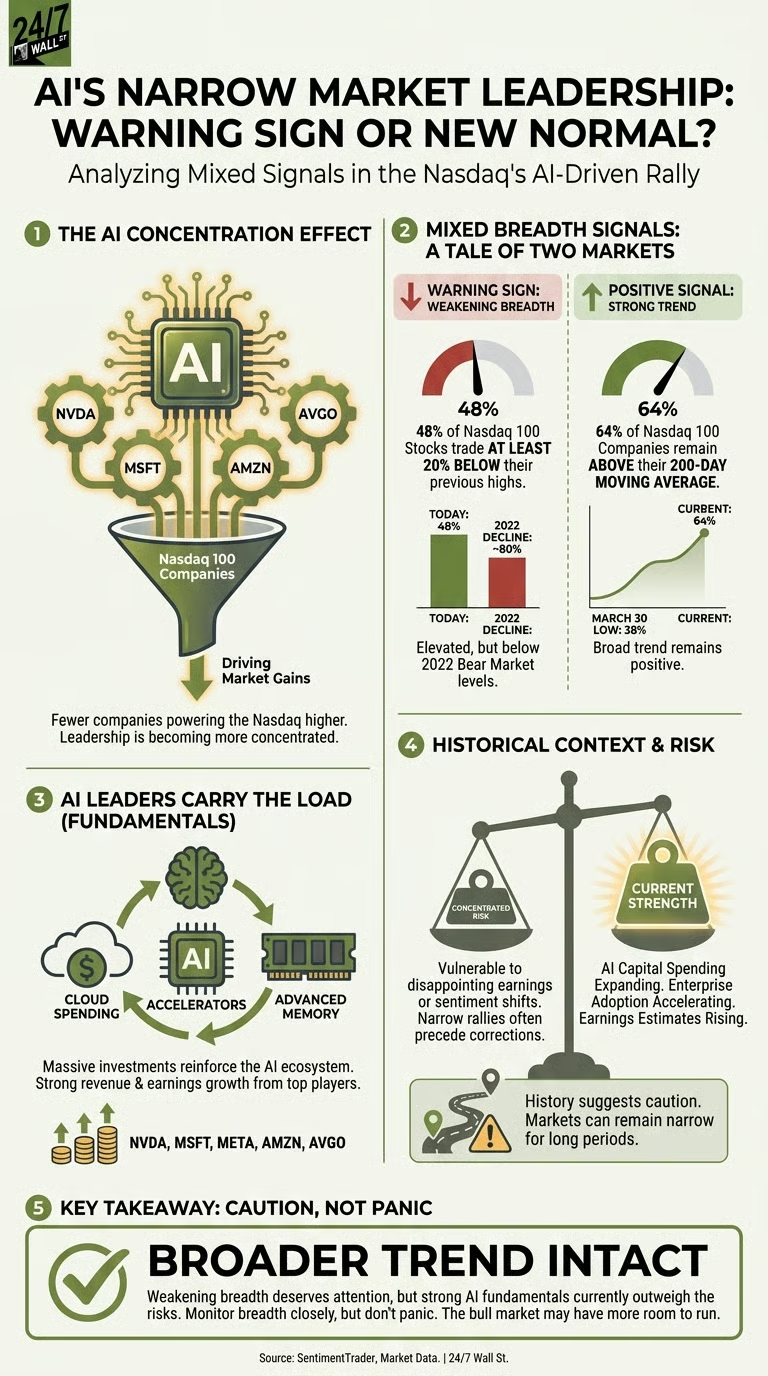
- Despite robust Q2 2026 earnings projections for the S&P 500, the market's ascent to near all-time highs is largely driven by a narrow, AI-centric momentum trade.
- Investors are heavily favoring companies providing "scarcity" in the AI buildout, such as semiconductor equipment and power infrastructure, often at the expense of other tech sub-sectors.
- This concentrated rally introduces significant polarization and elevated valuations, requiring investors to carefully assess underlying business fundamentals rather than chasing price action alone.
The U.S. stock market in 2026 presents a compelling paradox: broad economic resilience and strong corporate earnings are propelling indices to near all-time highs, yet beneath the surface, the rally is increasingly narrow and concentrated. As of July 2026, the dominant force shaping market dynamics is an intense, AI-driven momentum trade. This phenomenon, characterized by significant capital flows into companies enabling the artificial intelligence buildout, has created a highly polarized environment where specific winners thrive while other segments, even within technology, struggle to keep pace. Navigating this landscape requires a keen understanding of where true value lies versus where speculative fervor has pushed valuations to unsustainable levels.
The Market's Uneven Ascent
The macro backdrop for Q3 2026, as observed by MAI Capital Management on July 17, 2026, points to "resilience through a volatile quarter," with equities near all-time highs despite earlier geopolitical tensions and an oil shock. This strength is largely underpinned by continued AI spending and anchored inflation expectations. JPMorgan Global Research, in its December 2025 outlook for 2026, anticipated double-digit gains across both developed and emerging markets, even while forecasting a 35% probability of a U.S. and global recession.
The latest earnings season further illustrates this robust, yet uneven, performance. Wall Street analysts expect Q2 2026 S&P 500 profit growth of a staggering 23.6% year-over-year, marking the index's seventh consecutive quarter of double-digit earnings expansion. This impressive bottom-line growth is projected to be supported by a robust 12.3% year-over-year increase in revenues. Energy and Technology sectors are leading this charge, while Healthcare is currently the sole laggard, with EPS expected to decline 9.0% from Q2 2025. This strong headline performance, however, masks a deeper story of market concentration, where a select few themes are capturing the lion's share of investor attention and capital.
Momentum's Reign: A New AI Era
Momentum investing, a strategy focused on buying assets that have performed well recently in anticipation of continued upward trends, has proven to be a winning play in 2026. As Jennifer Sor noted for Yahoo Finance on May 12, 2026, funds employing this strategy have consistently beaten the S&P 500 year-to-date. This trend is not merely a cyclical phenomenon; it is fundamentally driven by the "relentless expansion of AI," as Mislav Matejka of J.P. Morgan Global Research highlighted in December 2025.
The current momentum trade is "all about artificial intelligence," according to Kriti Gupta, Executive Director and Global Investment Strategist at J.P. Morgan Private Bank, speaking on June 5, 2026. She emphasized that investors are not just buying adopters of the technology but are "leaning into scarcity around its buildout." This includes critical components like graphics processing units (GPUs), memory, networking equipment, power generation, grid infrastructure, cooling solutions, transformers, copper, gas turbines, and data center capacity. This targeted investment comes at the direct expense of sectors the market perceives AI will disrupt, such as enterprise software and commercial services.
The impact of this AI-driven momentum is evident in the performance of key enablers. For instance, as of July 16, 2026, specialty materials manufacturer Corning (GLW) has seen its stock price surge 81% year-to-date, reaching a market capitalization of $136 billion. Even more dramatically, semiconductor equipment manufacturer Applied Materials (AMAT), a direct beneficiary of the wafer fab spending cycle driven by AI chipmaker capacity investments, has posted an astounding 124% year-to-date performance, pushing its market cap to $456 billion. These figures underscore the market's willingness to reward companies at the core of the AI infrastructure buildout.
| Company | Ticker | YTD Performance (as of 2026-07-16) | Market Cap |
|---|---|---|---|
| Corning | GLW | 81% | $136 billion |
| Applied Materials | AMAT | 124% | $456 billion |
A Polarized Landscape
Despite the overall market's resilience, the first half of 2026 witnessed a notable divergence: large-cap technology stocks, as a group, actually lagged the overall S&P 500. This "unusual" split between market winners and losers, as observed by SocGen, highlights the extreme polarization within the market. While the AI infrastructure plays soar, other prominent tech names have faced headwinds. Oracle, for example, has seen its shares struggle due to its aggressive AI-centric spending plans, while Adobe has contended with downbeat sentiment tied to the long-term impact of AI on its core business.
This concentration of gains in a few momentum plays echoes historical patterns. Past momentum trades have seen valuations for leading stocks reach nearly double that of the S&P 500 on a price-to-earnings basis, according to data compiled by Jeremy Siegel and Bloomberg Finance L.P. as of June 3, 2026. Such elevated valuations inherently carry greater risk, as any shift in future expectations can be magnified, leading to severe drawdowns. Investors are essentially paying a premium for future potential, making these stocks highly sensitive to changes in sentiment or fundamental performance. BlackRock's Spring 2026 Investment Directions noted that while technology earnings growth is driven by AI adoption, they see large-cap companies as better suited to weather higher interest rates, suggesting a cautious approach even within the favored sector.
The Bear Case: Cracks in the AI Foundation
While the AI momentum trade has been undeniably powerful, it is not without significant risks. The inherent volatility of momentum stocks is a primary concern. As The Motley Fool cautioned on July 16, 2026, these stocks tend to exhibit price swings "significantly greater than that of the typical S&P 500 company." This means investors must be prepared for potentially severe drawdowns, especially if the underlying business performance doesn't ultimately justify the rapid price appreciation. Focusing solely on stock price momentum without a deep understanding of the business fundamentals is a common pitfall.
Beyond stock-specific volatility, broader macroeconomic and geopolitical factors could introduce significant headwinds. JPMorgan Global Research's 2026 outlook, published December 9, 2025, highlighted "uneven monetary policy, relentless AI expansion and intensifying market polarization" as key forces. Empower's Q3 2026 outlook, published June 2026, noted that while the Fed is expected to keep rates steady in Q3, "tight credit spreads" serve as a warning to avoid excessive risk-taking. Geopolitical uncertainties, such as the Iran conflict that intensified in Q2 2026 and briefly shut down the Strait of Hormuz, can quickly upend market stability, as MAI Capital Management observed on July 17, 2026. Although tensions eased, the potential for such disruptions remains. Furthermore, the persistent theme of "sticky inflation" and the 35% probability of a recession in 2026, as forecasted by JPMorgan, could dampen overall market sentiment and challenge even the most robust growth narratives.
Analyst Consensus: Bullish, But With Divergence
Wall Street analysts generally maintain a constructive outlook on many of the companies benefiting from the AI buildout, though with varying degrees of optimism. MarketBeat, on July 23, 2026, characterized Alphabet (GOOG) as a "moderate buy" based on a consensus from 17 analysts. Tickflow's data from July 2026 provides a snapshot of analyst sentiment for several key tech and growth stocks:
| Company | Ticker | Price | Target | Implied Upside | Analysts | Rating | Sector |
|---|---|---|---|---|---|---|---|
| Alphabet Inc. | GOOGL | $321.00 | $419.14 | +21.5% | 91 | Buy | Communication Services |
| CrowdStrike Holdings, Inc. | CRWD | $183.89 | $178.40 | -11.9% | 90 | Buy | Technology |
| Amazon.com, Inc. | AMZN | $232.74 | $308.70 | +24.9% | 80 | Buy | Consumer Cyclical |
| Micron Technology, Inc. | MU | $928.40 | $1575.91 | +83.1% | 78 | Buy | Technology |
| Snowflake Inc. | SNOW | $270.01 | $283.54 | +5.8% | 78 | Buy | Technology |
| Advanced Micro Devices, Inc. | AMD | $531.04 | $513.42 | +3.8% | 75 | Buy | Technology |
| ServiceNow, Inc. | NOW | $97.88 | $140.82 | +36.5% | 75 | Buy | Technology |
Analyst data as of July 2026, from Tickflow.io
This table highlights a broad "Buy" consensus across these names, but with a wide range of implied upsides. Micron Technology (MU) stands out with an impressive +83.1% implied upside, reflecting strong conviction in the memory sector's role in the AI buildout. ServiceNow (NOW) also shows a robust +36.5% upside. Conversely, CrowdStrike (CRWD) and Advanced Micro Devices (AMD) show negative or minimal implied upsides despite their "Buy" ratings, suggesting that current prices may already reflect much of their near-term potential. This divergence underscores the need for investors to look beyond a simple "Buy" label and delve into the specific price targets and the rationale behind them.
The Verdict: Navigating a Concentrated Rally
The 2026 market is defined by a powerful, yet precarious, AI-driven momentum trade. While the S&P 500's robust Q2 earnings and overall economic resilience paint a picture of strength, the underlying reality is one of extreme polarization. Capital is flowing disproportionately into a select group of companies providing the "scarcity" required for the AI buildout, pushing their valuations to elevated levels. This leaves other market segments, even within the broader tech sector, struggling for attention and capital.
For investors, the key is to recognize this concentrated dynamic and avoid blindly chasing momentum. Focus on companies with strong underlying business fundamentals that genuinely benefit from the AI trend, rather than those whose price action is purely speculative. Due to the lack of a specific ticker's product launch data, a general market-level recommendation for navigating this AI momentum trade is prudent.
Entry Zone: For investors seeking exposure to the AI momentum theme, consider entry points during periods of market consolidation or sector-specific pullbacks, particularly when the S&P 500 (currently around 7,400 as of May 2026) experiences a 5-7% correction. This allows for a more favorable risk-reward profile, mitigating some of the current valuation risk.
12-Month Target: Given the strong earnings growth projections and continued AI investment, the S&P 500 could reasonably target a range of 7,800-8,000 over the next 12 months, representing a modest upside from current levels, largely driven by continued earnings expansion in the AI-centric sectors.
Invalidation Level: A sustained breach below the S&P 500's 200-day moving average, or a drop below 6,900, would invalidate the thesis of a resilient, AI-driven market, signaling a broader market correction or a significant shift away from the current momentum trade.
The AI momentum trade is real and powerful, but its narrow focus demands a disciplined approach to avoid the pitfalls of overvaluation and market polarization.
Want deeper research on any stock? Try Kavout Pro for AI-powered analysis, smart signals, and more. Already a member? Add credits to run more research.
Related Articles
Category
You may also like


Week-In-Review: Market Moves, AI Momentum, And What's Next

Navigating the AI-led stock market

The S&P 500 Rally Looks Broad: It Isn't
Breaking News
View All →Featured Articles
Top Headlines
Good News For Meta Stock Fans

Oracle Just Hit a New 52-Week Low. Wall Street's Average Target Is Still More Than Double the Stock.

Intel Stock Jumps as Earnings Blow Past Expectations Amid Booming AI Demand

Stock Market Today, July 24: Intel Reverses Gains on Foundry and AI Spending Concerns