MarketLens

Log in

What is Warren Buffett Signaling to Wall Street

2 hours ago
SHARE THIS ON:

What is Warren Buffett Signaling to Wall Street

Key Takeaways

  • Warren Buffett's unprecedented $373 billion cash hoard at Berkshire Hathaway signals deep concerns about current market overvaluation and potential volatility in 2026.
  • The "Buffett Indicator" (market cap to GDP) at 220-225% is flashing red, suggesting the market is significantly overstretched, reminiscent of the dot-com bubble.
  • Investors should adopt a defensive yet opportunistic stance: selectively trim winners, build a cash reserve, and focus on high-quality, fairly priced companies for long-term growth.

What is Warren Buffett Signaling to Wall Street?

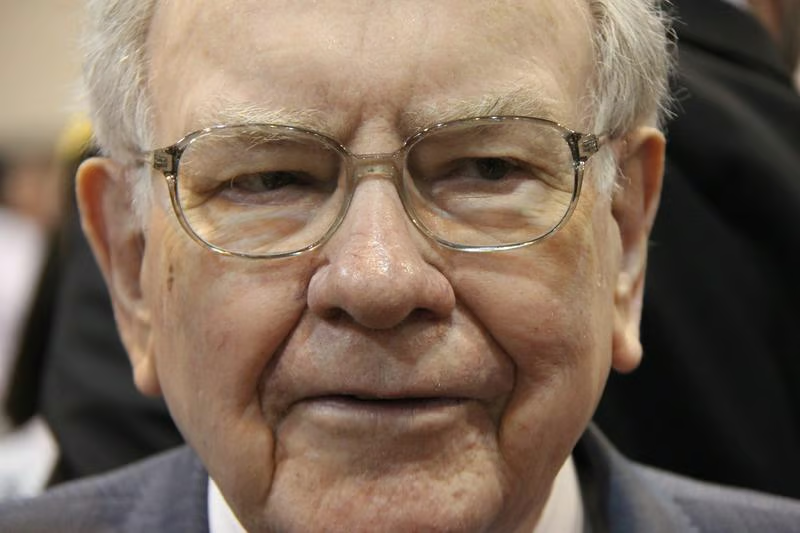
Warren Buffett, the legendary "Oracle of Omaha," has always been a master of adjusting Berkshire Hathaway's portfolio based on his economic outlook. His recent actions, particularly as he stepped down as CEO at the end of 2025, are sending a clear, unprecedented warning to Wall Street and individual investors alike. This isn't just a subtle shift; it's a profound signal that the market may be entering a period of significant turbulence.

The most striking evidence of Buffett's caution is Berkshire Hathaway's colossal cash position. The company ended 2025 with an astounding $373 billion in cash and Treasury bills on its balance sheet. This figure is not only a record high but more than double the previous peak of nearly $150 billion held during the COVID-19 pandemic lockdowns. Such a massive cash hoard, accumulated through a sustained period of net selling, speaks volumes about Buffett's view on current market valuations.

For 13 consecutive quarters, Buffett was a net seller of stocks, a streak unmatched in Berkshire's history under his leadership. While he didn't "panic-sell" everything, evidenced by Berkshire's still substantial $267.2 billion in stock holdings, this consistent reduction in equity exposure underscores a deliberate, long-term strategy. It suggests a profound difficulty in finding attractive investment opportunities at current prices, leading him to prioritize liquidity and capital preservation.

Buffett’s actions are a direct reflection of his belief that the market is overvalued. He has famously used the "Buffett Indicator," which compares the total market capitalization of the U.S. stock market to the country's Gross Domestic Product (GDP), as a key valuation tool. This indicator currently sits at an "alarmingly high" 220.1% to 225%, a level only surpassed during the peak of the dot-com bubble in 1999-2000. This metric screams caution, suggesting that stocks are significantly detached from underlying economic reality.

Why is Buffett Hoarding Cash Now?

Buffett's decision to accumulate such an enormous cash pile isn't merely about being conservative; it's a strategic move born from a deep-seated conviction that current market conditions offer limited value and heightened risk. He views cash as "oxygen" for a portfolio—necessary for survival and crucial for seizing opportunities when they inevitably arise. This isn't a declaration of doom, but a preparation for a potential market correction or even a "major stock market drop in 2026."

The primary driver behind this cash accumulation is the perceived overvaluation of the broader market. When the "Buffett Indicator" hits levels like 220-225%, it suggests that investors are attaching an exceptionally high value to future cash flows of businesses. This significantly increases the risk of short-term volatility, especially if corporate earnings fail to meet lofty expectations. Buffett's philosophy dictates that it's "far better to buy a wonderful company at a fair price than a fair company at a wonderful price," and right now, wonderful companies at fair prices are scarce.

Furthermore, the current interest rate environment makes holding cash more attractive than it has been in years. While Buffett generally prefers productive investments that grow above inflation, he acknowledged that "under current conditions [in 2024], building the cash position" was "quite attractive" given the alternatives available in the equity markets. This means the opportunity cost of holding cash has decreased, making it a more prudent temporary haven for capital.

Buffett's cash position also serves as "dry powder" for future acquisitions. He's not predicting the exact timing of a market downturn, but he's ensuring Berkshire is ready to act decisively when "it rains gold." This readiness allows him to deploy capital into high-quality businesses that become attractively priced during a market correction, aligning with his long-term value investing principles. It's a testament to his "Noah rule": "Predicting rain doesn’t count; building arks does."

What Does This Mean for the Broader Market?

Buffett's actions, particularly his unprecedented cash accumulation and net selling streak, carry significant implications for the broader market. When the "Oracle of Omaha" signals such caution, it's not just a personal investment decision; it's a bellwether for institutional and retail investors alike. The market's current state, characterized by high valuations and potential froth, is clearly a concern for even the most optimistic long-term investors.

The "Buffett Indicator" at over 220% suggests that the U.S. stock market's total value is more than double the country's annual economic output. Historically, such elevated levels have preceded significant market corrections. For instance, the only time it was higher was during the dot-com bubble, which was followed by a sharp downturn. This doesn't guarantee a crash, but it certainly raises the probability of a substantial pullback, especially if economic growth slows or corporate earnings disappoint.

Several institutional investors and economic analysts echo Buffett's concerns. Capital Economics and Goldman Sachs, for example, have explicitly warned of potential double-digit declines in the S&P 500 if earnings fail to keep pace with expectations. This consensus among market watchers, combined with Buffett's tangible actions, paints a picture of a market teetering on the edge of a correction, where short-term volatility is a significant risk.

Despite the warnings, the market has seen a remarkable run, with the S&P 500 rising by nearly 16% over the past 12 months and 77% over the past three years. This sustained bull market, fueled in part by richly priced tech stocks, has led to a concentration of wealth and potentially inflated valuations across various sectors. Buffett's move suggests that this upward trajectory may be unsustainable without a fundamental re-evaluation of asset prices.

How Should Retail Investors Respond to Buffett's Warning?

Buffett's warning isn't a call for panic, but rather a guide for prudent action. His approach emphasizes preparedness and long-term thinking, even in the face of potential market turbulence. Retail investors can adapt his strategy in three key ways to protect their portfolios and position themselves for future opportunities.

First, don't panic-sell everything. While Buffett has been a net seller, he hasn't dumped his entire portfolio. Berkshire Hathaway still holds over 40 stocks valued at more than $300 billion, including stalwarts like American Express and Coca-Cola. His measured selling, often trimming partial positions in companies like Apple (reducing by 41.8 million shares but still holding $60.7 billion worth), demonstrates a conviction in quality businesses for the long term. Timing the market is notoriously difficult, and selling everything risks missing out on unexpected future gains or a market rebound. Instead, focus on retaining high-conviction holdings and liquidating positions in companies where your confidence has waned or valuations have become truly stretched.

Second, build a substantial cash reserve. Buffett's record cash hoard is his "dry powder," and individual investors should emulate this by increasing their own liquidity. Financial advisors typically recommend an emergency fund of three to six months' worth of expenses. In an overvalued market, having even more cash on hand provides a crucial safety net against unforeseen personal emergencies and, more importantly, positions you to capitalize on market dips. When "it rains gold," as Buffett says, you want to "put out the bucket, not the thimble." This cash can then be deployed into quality assets when prices become more attractive.

Third, focus on quality companies at fair prices. Even with the market appearing overvalued, Buffett is still buying selectively. In the most recent quarter, Berkshire bought over $5 billion in various stocks, including Alphabet, Chubb, and Domino's Pizza. This reinforces his mantra of buying "wonderful companies" at "fair prices." Investors should look for businesses with strong fundamentals, durable competitive advantages, consistent cash flows, and reasonable valuations. This often means looking beyond the high-flying growth stocks and seeking out value opportunities that may be overlooked by the broader market.

What Specific Actions Can Investors Take Now?

Given Buffett's clear signals, retail investors should implement actionable steps to fortify their portfolios against potential headwinds while remaining poised for future growth. This involves a blend of risk mitigation, strategic positioning, and a disciplined approach to investing.

One crucial step is to rebalance your portfolio and consider trimming some winners. The S&P 500's significant gains over the past three years mean that some stocks or sectors may have grown to outsize portions of your portfolio, increasing concentration risk. It's never a bad idea to take some profit on investments that have grown substantially, especially in a short period. This doesn't mean selling out entirely, but rather bringing your asset allocation back in line with your long-term risk tolerance. For instance, if a tech stock has surged and now represents an excessive percentage of your holdings, consider reducing its weight to a more balanced level.

Another vital action is to seek out "diamonds in the rough" and maintain a long-term perspective. While the overall market may be expensive, individual opportunities still exist. This requires diligent research to identify high-quality businesses that are currently trading at reasonable valuations, or those that have experienced a temporary setback unrelated to their long-term prospects. Buffett himself continues to buy stocks in quality businesses, demonstrating that even in a frothy market, selective opportunities can be found. Remember, investing is a marathon, not a sprint; focus on the intrinsic value of a company rather than short-term price fluctuations.

Finally, prioritize debt reduction, especially high-interest credit card debt. Buffett famously advised a friend to pay off credit card debt before investing, highlighting the "crazy-high interest rates" that erode wealth. Eliminating high-interest debt provides a guaranteed return that often outperforms market returns, frees up cash flow, and reduces financial stress. This foundational step strengthens your personal balance sheet, making you more resilient to economic downturns and better prepared to invest when opportunities arise. It's a practical, unglamorous move that aligns perfectly with Buffett's emphasis on financial prudence.

Looking Ahead: Navigating Market Uncertainty

As we move further into 2026, the market landscape appears fraught with uncertainty, yet also ripe with potential for those who are prepared. Warren Buffett's final warnings and strategic moves at Berkshire Hathaway provide a timeless blueprint for navigating these complex conditions. His emphasis on patience, preparedness, and a relentless focus on intrinsic value remains as relevant as ever.

Investors who heed these signals by judiciously managing their portfolios, building cash reserves, and maintaining a disciplined approach to identifying quality investments will be best positioned to weather any storms and capitalize on future opportunities. The goal isn't to predict the next market move, but to build an ark that can withstand the inevitable downpours. By embracing Buffett's wisdom, individual investors can transform potential market turbulence into a pathway for long-term wealth creation.


Want deeper research on any stock? Try Kavout Pro for AI-powered analysis, smart signals, and more. Already a member? Add credits to run more research.

SHARE THIS ON:

Related Articles

Category

You may also like

Stock News20 hours ago

Before Retiring, Warren Buffett Left Investors With a $373 Billion Warning. Here's What History Says the Stock Market Will Do Next.

Warren Buffett was a net seller of stocks for 13 consecutive quarters before stepping down as CEO, signaling a potential market caution. History suggests the stock market's next move is uncertain base...
Stock News2 days ago

New CEO Greg Abel Just Gave Wall Street an Undeniable Signal About Berkshire Hathaway Stock. It Couldn't Be Any Clearer.

Berkshire Hathaway CEO Greg Abel sent a clear signal to shareholders in March regarding the company's stock. This action follows Warren Buffett's announcement last year that he would step down as CEO.
Stock News2 months ago

Wall Street Bulls Look Optimistic About Palo Alto (PANW): Should You Buy?

Wall Street analyst recommendations for Palo Alto Networks (PANW) are noted by investors before making trading decisions. The significance of these sell-side rating changes on stock price movement is ...
Stock News2 months ago

Warren Buffett Added a Big Chunk of This Tech Stock. Should You Add It Too?

Berkshire Hathaway CEO Warren Buffett, a noted stock picker, recently increased a position in an unnamed technology stock. Investors are evaluating whether this move signals future gains for the asset...

Breaking News

View All →

Top Headlines

View More →
Stock News1 hour ago

Amazon Gets Its Biggest Hit Movie Ever With ‘Project Hail Mary'

Stock News2 hours ago

Elon Musk unveils chip manufacturing plans for SpaceX and Tesla

Stock News2 hours ago

The Era of AI Agents Has Arrived. 2 Stocks on Track to Win.

Stock News2 hours ago

Tesla, SpaceX Plan to Build New Chip Factory in Texas

Stock News3 hours ago

Netflix's Ad Revenue Surges to $1.5 Billion: Is the Stock a No-Brainer Buy Today With $2,000?