MarketLens
What's Driving Classover's Radical AI & Robotics Pivot

Key Takeaways
- Classover Holdings (KIDZ) is undergoing a high-stakes pivot from traditional online tutoring to AI-native intelligent robotics education, marked by declining legacy revenue but a strengthened balance sheet.
- The company's new embodied AI robotics platform and strategic partnerships aim to capture a rapidly growing market, but execution risks and the speculative nature of its current valuation remain significant.
- While the retirement of convertible debt and a substantial digital asset treasury provide financial flexibility, KIDZ faces an uphill battle to prove the commercial viability and scalability of its ambitious new direction.
What's Driving Classover's Radical AI & Robotics Pivot?
Classover Holdings (KIDZ) is in the midst of a dramatic strategic overhaul, shifting its entire focus from traditional online tutoring to an ambitious vision centered on AI-native intelligent robotics ecosystems and next-generation education platforms. This pivot, highlighted in the company's Q1 2026 results, comes as its legacy service revenue continues to shrink, underscoring the urgency of this transformation. Management views the retirement of all previously outstanding convertible notes, which have now been fully converted to equity, as a major strategic inflection point, significantly simplifying the balance sheet and enhancing long-term financing flexibility for this new direction.
The company's Q1 2026 service revenue stood at approximately $0.52 million, a notable decline from $0.82 million in the prior-year quarter. This revenue contraction reflects the ongoing operational transition away from its traditional model, which has seen its profitability margins deeply negative, with a trailing twelve-month (TTM) net margin of -356.2%. Classover is betting that the future of education lies in AI-powered personalization, robotics-assisted interaction, and AI-native digital environments, a market segment projected to grow at a robust 34.52% CAGR for AI in education and 22.0% CAGR for educational robots through 2034.
This strategic reorientation is not merely an incremental product update; it represents a fundamental methodological shift from passive, screen-based learning to active, construction-based experiences. Classover aims to build the foundational infrastructure for an exponential adoption curve in embodied artificial intelligence education, moving beyond demonstrations to create scalable, hands-on learning experiences for K-12 students. The company believes its evolving capabilities, strategic ecosystem relationships, and strengthened capital structure position it to capture the next wave of educational technology innovation.
How Does Classover's Embodied AI Platform Work, and What Are Its Partnerships?
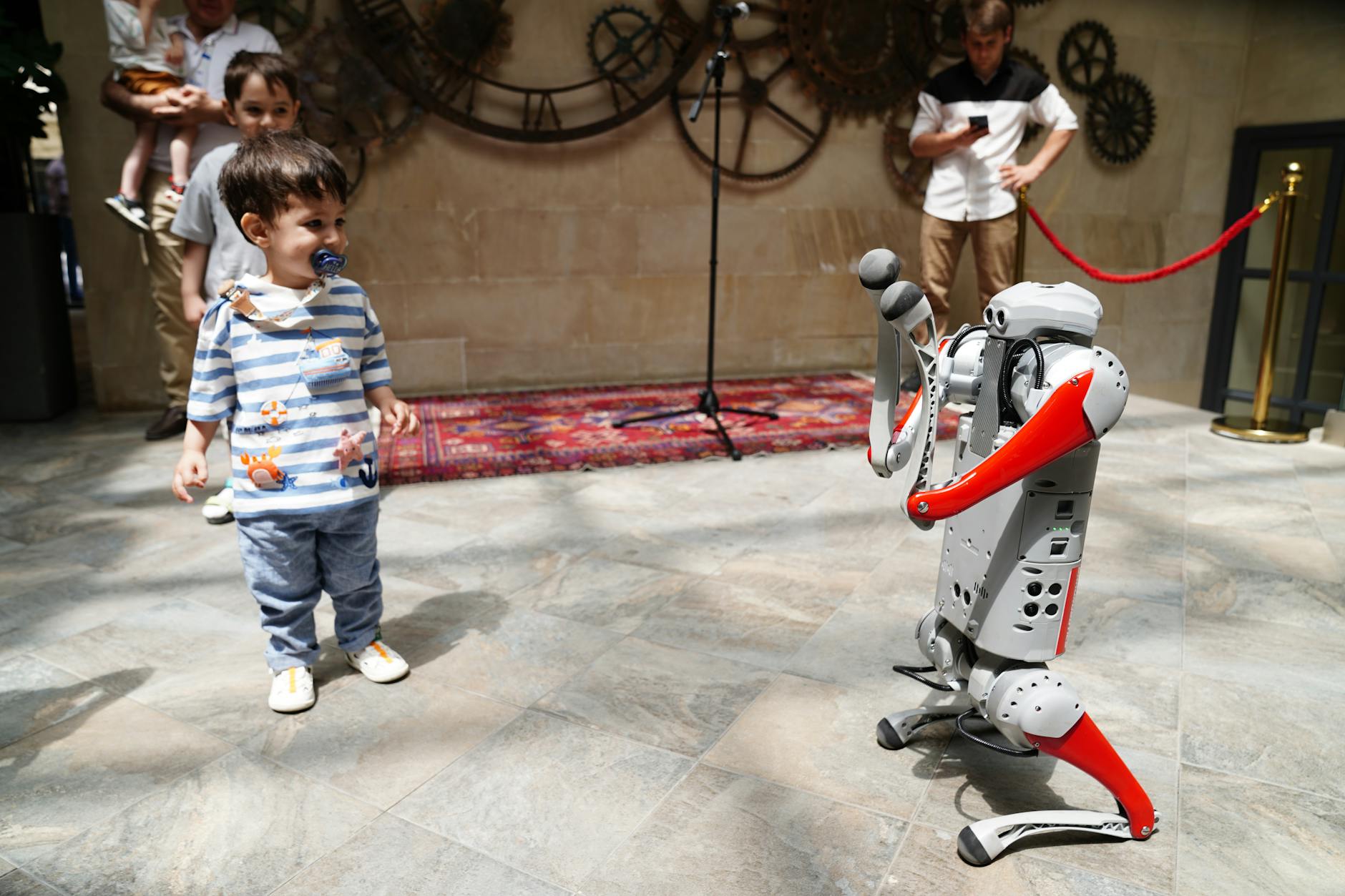
Classover's new embodied AI robotics education platform is designed to immerse K-12 students in hands-on learning with advanced robotics, moving beyond theoretical concepts to practical application. The platform integrates humanoid robots and robotic dog systems from Unitree Robotics, a key partner, directly into instructional environments. This allows students to interact with, program, and operate these systems within classroom settings, fostering a deeper understanding of AI and robotics through direct engagement. The curriculum is comprehensive, covering topics from an introduction to AI and robotics to Python and Scratch programming for robotics applications, AI agents, and real-time robotics control.
Beyond Unitree Robotics, Classover has forged several other strategic collaborations to bolster its new ecosystem. A partnership with Vensin Computer Technology focuses on advancing AI robotics education and infrastructure, exploring cooperation across humanoid robotics technologies, including robot controllers and edge computing solutions. This collaboration aims to facilitate technical exchange, product demonstrations, and real-world deployment opportunities, particularly in human-AI interaction within classrooms.
Another significant alliance is with ICreate Education Technology, a leading AI education robotics company serving over one million users globally. This non-binding strategic collaboration, announced in April 2026, aims to co-develop hands-on AI and robotics learning environments across North America. Classover plans to leverage its North American education footprint, including offline deployment capabilities and institutional partnerships, while ICreate contributes its AI robotics systems and technical expertise. The goal is to create immersive, multi-modal environments where robots act as co-teachers, making abstract STEM concepts tangible and engaging.
What Do the Q1 2026 Financials Reveal About This Transition?
Classover's Q1 2026 financial results offer a mixed picture, reflecting the company's ongoing transition and the significant investment required for its AI and robotics pivot. As previously noted, service revenue declined to approximately $0.52 million from $0.82 million year-over-year, indicating that the legacy business is shrinking as resources are reallocated. Despite this revenue drop, the gross margin remained around 50%, suggesting that the core educational services, while smaller, retain some profitability at the direct cost level.
A crucial financial highlight is the complete conversion of all previously outstanding convertible notes into equity. This move eliminates debt obligations, simplifying Classover's balance sheet and providing greater long-term financing flexibility. For a company embarking on a capital-intensive strategic shift, removing this overhang is a significant positive, reducing potential dilution from future debt conversions and strengthening the capital structure. This is particularly important given the company's TTM net loss of $7.04 million in fiscal year 2025 and an operating margin of -106%, indicating a substantial operational burn.
The company also reported a robust digital treasury strategy, holding approximately $2.12 million in cash and $4.94 million in SOL-related digital assets as of March 31, 2026. This totals roughly $7.06 million in combined liquidity and digital treasury holdings, which generated approximately $84,680 in staking rewards in Q1 2026. This evolving digital asset strategy provides additional balance sheet flexibility and strategic options, supporting investments in AI-native educational platforms and intelligent robotics learning ecosystems. However, it also introduces exposure to the volatile cryptocurrency market, a risk explicitly acknowledged by the company.
What Are the Key Risks and Opportunities for KIDZ Investors?
Investing in Classover (KIDZ) at this juncture is a high-risk, high-reward proposition, fundamentally a speculative bet on the company's ability to execute a paradigm shift in education. The primary opportunity lies in Classover's early mover advantage in building the foundational infrastructure for embodied AI education. If the hands-on robotics learning environments prove effective in accelerating student outcomes and gain widespread adoption, Classover could become a standard component of K-12 STEM curricula. The global educational robots market is projected to reach $10.50 billion by 2034, growing at a 22.0% CAGR, presenting a massive addressable market if Classover can capture significant share.
However, the risks are substantial. The collaboration with ICreate Education Technology, while promising, is explicitly non-binding and lacks definitive commercial terms such as pricing, exclusivity, or distribution arrangements. This means pilot programs could serve only as costly proofs-of-concept without a clear path to commercial scalability and revenue generation. The company's current financial health, characterized by a TTM market capitalization of just $169,587 and a stock price of $0.47 (down -14.75% today), reflects extreme investor skepticism and significant dilution from its 1:50 stock split in March 2026. Its 52-week range from $0.42 to $309.00 highlights immense volatility and value destruction.
Moreover, the educational robotics market faces challenges like high initial costs (often exceeding $500 per unit), teacher training requirements, and curriculum integration difficulties. Classover must demonstrate measurable educational outcomes and student engagement to justify premium pricing for its hardware-curriculum bundles. Without hard metrics proving improved STEM proficiency or increased interest in robotics careers, schools may opt for cheaper, proven alternatives. The company's operational efficiency, especially its ability to convert its existing capital base into physical infrastructure and generate revenue quickly enough to offset its current burn, will be the single most important indicator of success.
Is KIDZ a Buy, Hold, or Sell Amidst This Transformation?
Given Classover's current financial state and the highly speculative nature of its pivot, KIDZ is a high-risk, high-reward proposition that leans towards a speculative "Hold" for existing investors with a high-risk tolerance, and a "Sell" or "Avoid" for new investors seeking stability or clear profitability. The company is attempting a paradigm shift on a shoestring, with a market cap of just $169,587 and a TTM EPS of -$20.92. Its P/S ratio of 0.06 and P/B of 0.07 might appear cheap, but these metrics are distorted by the massive losses and the company's tiny scale relative to its ambitious goals.
The retirement of convertible debt is a positive step, and the digital asset treasury provides some liquidity, but these factors do not negate the fundamental challenge of generating substantial, sustainable revenue from an unproven business model. The company's aggressive expansion plans throughout 2026 across AI-native educational platforms and robotics-enabled learning environments will require significant capital, and without clear commercial terms from its partnerships, the path to profitability remains opaque. This is a company in the very early stages of a potentially transformative, but incredibly challenging, journey.
For investors already holding KIDZ, maintaining a small, speculative position might be warranted if they believe in the long-term vision of embodied AI education and are prepared for extreme volatility and potential further dilution. However, for anyone else, the stock presents too many unknowns and too much downside risk without sufficient evidence of commercial traction or a clear path to profitability. The company needs to demonstrate concrete, measurable success from its pilot programs and convert non-binding collaborations into definitive, revenue-generating partnerships before it can be considered a viable investment for most portfolios.
Classover's journey is a fascinating case study in disruption, but its financial reality demands extreme caution. The next few quarters will be critical in determining whether this ambitious pivot can translate into tangible financial results or if it will remain an intriguing, yet ultimately unprofitable, vision.
Want deeper research on any stock? Try Kavout Pro for AI-powered analysis, smart signals, and more. Already a member? Add credits to run more research.
Related Articles
What's Driving DJT's Radical Transformation
Category
You may also like


Classover Launches Embodied AI Robotics Education Platform Featuring Proprietary Curriculum Built on Advanced Humanoid Robotics Systems

AI Is Accelerating -- But Who Decides Its Direction?

Swarmer Appoints Mykhailo Nestor as Chief Product Officer
Breaking News
View All →Featured Articles
Is LGI Homes' Aggressive Expansion Strategy Paying Off
Has DynaResource Turned a Corner with Q1 2026 Results
Top Headlines

S&P 500 Snapshot: Seven-Week Win Streak Survives Friday Slump

How NVDA, TSM & AVGO Continue Adding AI Muscle as IGV Recovers

Berkshire Boosted Stake in Alphabet in First Quarter, Bought Delta Air, Sold Visa, Mastercard

Stock Market Dives, Yields Soar As Trump Says This On Taiwan; Microsoft Pops On Ackman Move