MarketLens

Log in

Kevin Warsh's Fed: The End of Predictability and the Rise of Rate Volatility

5 hours ago
SHARE THIS ON:

Kevin Warsh's Fed: The End of Predictability and the Rise of Rate Volatility

Key Takeaways

  • Federal Reserve Chair Kevin Warsh has initiated a fundamental shift away from forward guidance, leaving financial markets with significantly less pre-meeting clarity on monetary policy decisions.
  • The June Federal Open Market Committee (FOMC) meeting revealed a distinct hawkish tilt, with half of the committee projecting at least one rate hike in 2026, signaling a potential "higher for longer" trajectory.
  • This new era of reduced communication and heightened focus on real-time economic data is injecting volatility into fixed-income markets, demanding a more agile, scenario-based approach from investors.

The End of Predictability: Warsh's Fed Resets Expectations

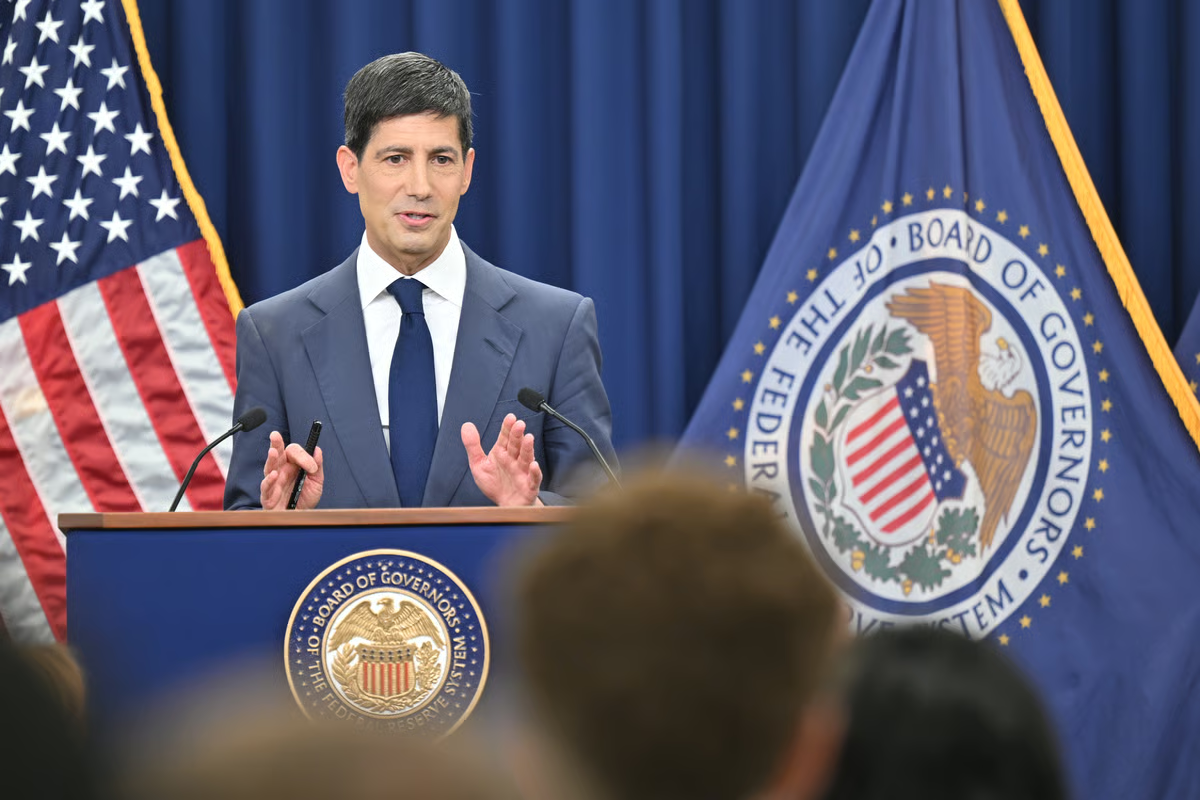
The financial landscape is undergoing a profound transformation under the leadership of Federal Reserve Chair Kevin Warsh, who took the helm on May 22, 2026, replacing Jerome Powell. In a series of recent appearances, including his first press conference on June 17, 2026, and testimony before Congress on July 14, 2026, Warsh has signaled a decisive break from the Fed's long-standing practice of forward guidance. This strategic pivot means markets are now left to "guess" the central bank's intentions until meeting days, a stark contrast to the previous regime where policy signals often emerged weeks in advance.

This shift is not merely cosmetic; it represents a fundamental philosophical change. Forward guidance, originally designed to manage expectations during periods of low inflation by pre-announcing sustained low interest rates, is now deemed less relevant by Warsh. As Rob Daly, author at Global Finance, noted regarding the June FOMC statement, it "dispenses with some of the older language," adding that Warsh explained, "That statement just gives you the facts as best as we can judge it. Absent also is so-called ‘forward guidance,’ which we agreed was not well suited to the current policy conjuncture." The implication for investors, as we navigate the second half of 2026, is a significant increase in uncertainty, forcing a re-evaluation of how monetary policy is anticipated and priced.

A Hawkish Committee Emerges from the Shadows

The June FOMC meeting, Warsh's first as chair, offered the clearest glimpse into the new Fed's operational style and policy leanings. While the committee held interest rates steady in the 3.50%-3.75% target range, the accompanying Summary of Economic Projections (SEP)—particularly the "dot plot"—revealed a notable hawkish shift. Of the 18 FOMC members who submitted projections, nine forecast at least one rate hike in 2026, while eight expected rates to remain steady, and only one called for a cut. This represents a "sharp shift from March," according to PIMCO, when all members had anticipated either cuts or a hold.

Adding to the sense of a less transparent, yet more hawkish, central bank, Warsh himself notably abstained from submitting his own projection to the dot plot. He clarified his decision by stating, "For me, it’s not helpful in the conduct of policy," as reported by Rob Daly of Global Finance. This deliberate non-participation, coupled with a significantly streamlined policy statement that was less than half the length of its predecessor, underscores Warsh's preference for allowing the committee's collective hawkish skew to speak for itself, rather than guiding market expectations through explicit forward-looking statements. The message is clear: the Fed intends to make decisions based on incoming data, unburdened by prior commitments or market conditioning.

Inflation's "Tax" and the Regime Change

At the heart of Warsh's new approach is an unwavering commitment to combating inflation, which he has repeatedly characterized as an "unfair burden" and a "tax on the American people and businesses." During his July 14, 2026, testimony to the House Financial Services Committee, Warsh declared, "If we get policy right — and we will — the inflation surge of the last five years will be a thing of the past." This strong rhetoric signals a "regime change" in monetary policy, moving away from past practices that, in his view, contributed to the current inflationary environment.

Warsh has been particularly critical of the flexible average inflation targeting policy adopted in 2020, which allowed for inflation to run above the 2% target after periods of lower prices. He explicitly called this policy a "mistake," stating, "That central bank wasn't the first central bank to ask for a little more inflation and end up with a lot more." His resolve to restore price stability is absolute, as he affirmed at the ECB Forum on July 1, 2026, "We're going to deliver price stability in the U.S." This commitment comes as the Fed's preferred gauge showed core inflation at 3.4% in May, with the headline all-items index even higher at 4.1%, both well above the central bank's 2% objective. The new Fed chair's stance leaves no room for ambiguity: inflation must be tamed, and the tools to do so will be deployed without the constraints of prior guidance.

Markets Brace for the Unknown: Yields and Futures React

The immediate market reaction to Warsh's "less disclosure" approach has been a palpable increase in volatility and a re-pricing of interest rate expectations. Treasury yields, sensitive barometers of future rate policy, have reflected this uncertainty. As of July 15, 2026, the benchmark 10-year Treasury note yields 4.55%, while the shorter-term 2-year note stands at 4.13%, resulting in a positive 2s/10s spread of +0.42%. Notably, the 2-year yield had already spiked to 4.2% following Warsh's first Federal Reserve rate decision in June, underscoring the market's sensitivity to his "price stability" focus.

Futures markets are also adjusting to the new reality. According to the CME FedWatch Tool, as of July 13, 2026, the probability of a rate hike at the upcoming July 29 Fed meeting had risen to 36%, a significant jump from just 18% on July 2. While markets still price a nearly 73% chance of rates remaining steady in July, the likelihood of at least a quarter-point hike by the subsequent FOMC meeting in September stands at approximately 65%. This reflects a clear shift away from earlier 2026 expectations of rate cuts, now replaced by the potential for further tightening. The U.S. Dollar Index (DXY) also surged to a 12-month high after Warsh's June press conference, further indicating a hawkish tilt in market sentiment. This environment of reduced communication is also manifesting in fewer public appearances by Fed officials, with only 12 speeches and interviews in the two weeks following the June FOMC meeting, compared to an average of 23 over similar periods since 2022, according to Bank of America.

The Fed's Internal Overhaul: Beyond Communication

Beyond the immediate shift in communication strategy, Chair Warsh has embarked on an ambitious internal overhaul of the Federal Reserve's operations, signaling a "quiet revolution" within the institution. Following his first FOMC meeting in June, Warsh announced the formation of five task forces, each charged with a comprehensive examination of critical areas defining modern monetary policy. These areas include Fed communications, the quality of data used to gauge the economy, the central bank's inflation frameworks, the impact of artificial intelligence on jobs, productivity, and inflation, and the size and composition of the Fed's $6.7 trillion balance sheet.

Warsh articulated the mandate for these task forces, stating they will "start with first principles, ask hard questions, examine current practice, consider alternatives, and ultimately propose next steps for policymaker consideration," as reported by CNBC on June 21, 2026. This initiative represents a profound commitment to making the Federal Reserve "clear-eyed about its mission, fit for purpose, and focused on the future." The reviews are expected to deliver results by the end of the year, potentially reshaping everything from how the Fed measures economic health to its long-term balance sheet strategy. This internal reform agenda, while less visible to daily market participants, underpins Warsh's vision for a more agile and effective central bank, one that relies less on pre-commitments and more on real-time data and adaptable policy.

Conflicting Signals: Analyst Perspectives on Warsh's Strategy

The market's interpretation of Chair Warsh's new Fed regime is far from monolithic, with analysts offering a range of perspectives on the implications for future rate policy. Freya Beamish, chief economist at TS Lombard, holds a decidedly hawkish view, writing in a July 1, 2026, note that "the economy will dictate a much more significant path of hiking than the market currently expects especially next year." This suggests that Warsh's policy wishes, while important, may ultimately be overshadowed by underlying economic trends that demand a more aggressive tightening cycle.

In contrast, strategists at J.P. Morgan Wealth Management anticipate a more stable path, expecting the Fed to keep interest rates steady through the end of 2026, arguing that recent declines in energy prices are not fully reflected in the Fed's inflation projections. Viktor Kopylov, PhD, CFA, commenting on LinkedIn, suggests "modestly higher odds of a hawkish shift this cycle," believing Warsh's language and the SEP will "preserve the option of later tightening — a structural end to the 'rate-cut trade' is plausible." However, Jaisal Pastakia, CFA, offers a contrarian view, suggesting a "dovish pivot might be hidden in plain sight." Pastakia posits that Warsh, a "highly sophisticated communicator," is deliberately building immediate inflation-fighting credibility, but his structural changes could lay the groundwork for a future, less hawkish stance. These divergent opinions underscore the heightened uncertainty in a market grappling with a less transparent Fed.

The Verdict: Navigating a Less Transparent Fed

Federal Reserve Chair Kevin Warsh has unequivocally ushered in a new era of monetary policy, characterized by a dramatic reduction in forward guidance and an intense focus on price stability. This shift, evident in the hawkish tilt of the June FOMC dot plot and Warsh's resolute rhetoric against inflation, signals a "higher for longer" interest rate environment that demands a fundamental rethink from investors. The market's initial reaction, including rising Treasury yields and increased probabilities for future rate hikes, confirms that the era of predictable Fed communication is over.

For investors, the key to navigating this less transparent landscape lies in adaptability and a scenario-based approach. The Fed's commitment to real-time data and its ongoing internal reforms mean that policy decisions will be more reactive and less telegraphed.

  • Entry Zone: Investors should consider positioning for a sustained period of higher rates, perhaps entering short-duration fixed income or quality cyclicals on dips, particularly when the 2-year Treasury yield approaches 4.00%.
  • 12-Month Target: The 10-year Treasury yield could retest the 4.75-5.00% range if inflation remains sticky and the Fed maintains its hawkish stance without clear forward guidance.
  • Invalidation Level: A decisive break below the 2-year Treasury yield of 4.00% or a sustained drop in the DXY below 99.00 would signal a significant dovish shift, invalidating the "higher for longer" thesis.

The new Fed playbook demands agility, not anticipation.


Want deeper research on any stock? Try Kavout Pro for AI-powered analysis, smart signals, and more. Already a member? Add credits to run more research.

SHARE THIS ON:

Related Articles

Category

You may also like

News4 weeks ago

Data Vs. Debate: Will The Bond Market Embrace Warsh's New Tone

The 2-year yield rose to 4.20%, a two-year high, after Fed Chair Kevin Warsh signaled a hawkish tilt in his debut, vowing the Committee will deliver price stability.
Stock News1 months ago

Kevin Warsh Ready to Stop Telegraphing Fed Policy. How Will the Market React to Flying Blind?

The Fed may stop telegraphing policy via dot plots and forward guidance under Kevin Warsh. Markets could face higher volatility without the usual clues.
News1 months ago

Kevin Warsh Is Walking Into A Bond Market Trap

Kevin Warsh faces significant macro headwinds as incoming Federal Reserve Chair, including persistent inflation and intense political pressure. His ability to manage interest rate policy remains const...
Forex News1 months ago

The Warsh Trade and the US Dollar: EUR/USD, GBP/USD and Dollar Index Overview

Kevin Warsh was confirmed as the next Federal Reserve Chairman following an unpredictable political process. Financial markets are already experiencing significant volatility and shifts in response to...

Breaking News

View All →

Top Headlines

View More →
Stock News1 hour ago

Japan's Enterprises and Startups Build Industry-Specialized AI With NVIDIA Nemotron Open Models

Stock News1 hour ago

My 3 Favorite AI Stocks to Buy on the Continued Chip Sell-Off

Stock News2 hours ago

Apple Could Buy an AI Chip Company. Its Hot Stock Just Set a Fresh Record High

Stock News2 hours ago

Why QQQM's 0.15% Fee Crushes QQQ for Long-Term Growth Investors

Stock News3 hours ago

MSFT Investors Have Opportunity to Lead Microsoft Corporation Securities Fraud Lawsuit