MarketLens
Are Recession Warnings Growing Louder for the U.S. Economy

Key Takeaways
- Despite some forecasts for continued moderate growth, mounting economic headwinds like a weakening labor market, persistent inflation, and rising oil prices are increasing the probability of a U.S. recession in 2026.
- The U.S. national debt, now at $38.6 trillion, is on an unsustainable trajectory, with interest costs projected to double to $2.1 trillion by 2036, posing a significant long-term fiscal risk.
- While Bitcoin has shown resilience with a market cap of $1.49 trillion, Moody's "point of no return" assessment suggests its true value could face a severe correction if a broad economic downturn triggers a flight from speculative assets.
Are Recession Warnings Growing Louder for the U.S. Economy?
Yes, despite some consensus for moderate growth, the chorus of economists warning about a potential U.S. recession in 2026 is growing louder, fueled by a mix of concerning indicators and geopolitical instability. While many forecasters still believe the economy will avoid a downturn, the underlying currents suggest a challenging year ahead, particularly for average Americans. The prevailing narrative points to a "K-shaped" recovery, where richer individuals and AI-related companies thrive, while a significant portion of the population struggles with affordability and stagnant wages.
This divergence in economic experience is a critical factor. The Federal Reserve Bank of St. Louis, analyzing the "Blue Chip survey" of professional forecasters, noted considerable disagreement, with GDP growth forecasts ranging from 1.2% to 2.5%. J.P. Morgan, while expecting global resilience driven by AI investment, still assigns a 35% chance of a U.S. recession in 2026, highlighting concerns over trade wars, inflation, and a weakening labor market. RSM US economists, meanwhile, anticipate a "stagflation-lite" scenario, where inflation remains elevated while real wage growth slows, further squeezing consumers.
The U.S. economy, with a GDP of $31.44 trillion as of October 2025, has shown remarkable resilience in recent years. However, this resilience is being tested by a complex interplay of domestic and international pressures. The Federal Funds Rate currently stands at 3.64%, and while the yield curve is normal with a 2s/10s spread of +0.52%, the broader economic picture is far from clear. Upcoming events, such as Fed Chair Powell's speech and various PMI flashes, will be closely watched for further clues on the economy's trajectory and the Fed's potential policy responses in this uncertain environment.
What Key Economic Indicators Are Flashing Red?
Several critical economic indicators are indeed flashing red, suggesting a noticeable darkening of the economic picture, particularly in the labor market and consumer confidence. The Bureau of Labor Statistics reported a startling decline of 92,000 nonfarm payrolls in February 2026, contradicting expectations for job growth and marking a significant weakness. This follows an overall contraction of 213,000 nonfarm civilian jobs from January 2025 through February 2026, and a staggering 571,000 jobs lost since April 2024.
The unemployment rate, currently at 4.40%, has been creeping higher, with the rate for native-born workers rising to 4.7% in February from 4.4% a year earlier. This indicates a broader weakening of labor demand, even as wage growth, though softening, has outpaced inflation for those still employed. The shift to a "low-hire, low-fire" equilibrium in the labor market suggests businesses are becoming more cautious, a classic precursor to economic contraction. Meanwhile, inflation, as measured by the CPI at 327.46 in February 2026, remains a persistent concern. While the annual inflation rate declined to 2.4% in January, RSM US expects it to remain well above the Fed’s 2% target, potentially moving higher if it doesn't fall below 3%.
Consumer sentiment also reflects public concern, with the University of Michigan’s index down 12.5% from a year earlier, despite a slight monthly uptick to 56.6 in February. This widespread unhappiness about supermarket and gas pump prices underscores the affordability crunch facing many households. The Atlanta Federal Reserve’s GDPNow forecast slid to an annual rate of 2.1%, and the New York Fed’s GDP Nowcast settled at 2.23%, both indicating weakening economic momentum. These combined signals paint a picture of an economy under increasing strain, where the Fed's dual mandate of stable prices and maximum employment faces an unusual "stagflation challenge."
How Are Rising Oil Prices and Geopolitical Tensions Impacting the Outlook?
Rising oil prices and escalating geopolitical tensions, particularly in the Middle East, are significantly impacting the U.S. economic outlook, acting as a major inflationary pressure and increasing recessionary risks. Crude oil (CLUSD) is currently trading at $93.58, reflecting a notable increase from its previous close of $93.50. This surge comes after Brent crude touched $120 recently, a stark contrast to the $71 level before the Middle East conflict began in late February. The volatility is palpable, with a day range between $93.23 and $98.42, and a 52-week high of $119.48.
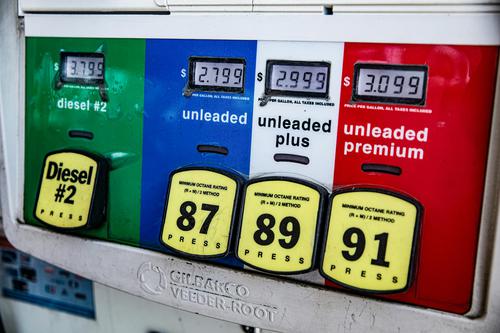
The ongoing war and the potential for a prolonged blockage of the Strait of Hormuz, a critical chokepoint for approximately 20% of the world's oil supply, pose a severe threat. Such a scenario would undoubtedly send oil prices soaring further, directly translating into higher gasoline prices, which already stand at $3.48 per gallon. This directly contradicts earlier claims of prices below $2.30 per gallon and places an additional burden on consumers already grappling with an affordability crunch. Higher energy costs feed into broader inflation, making the Federal Reserve's job of managing price stability even more challenging.
The impact on recession probabilities is evident. Polymarket, a prediction market, currently puts the chances of a recession at 29%. While this is down from 37% when oil prices were above $100 a barrel, it remains significantly higher than the 21% level recorded just before the war began on February 27. Should the Strait of Hormuz remain closed for an extended period, these odds are almost certain to climb further. The U.S. economy, though large and relatively closed to international trade, is not immune to such external shocks. A quick resolution to the conflict is crucial to mitigate these escalating risks and prevent a deeper economic downturn.
Is the National Debt a Looming Fiscal Crisis?
The U.S. national debt, currently standing at a staggering $38.6 trillion, is indeed a looming fiscal crisis, with economists and institutions like the Congressional Budget Office (CBO) warning of an unsustainable trajectory. This massive debt load is projected to surpass the historic high of 106% of GDP by 2030 and reach an unprecedented 175% of GDP by 2056. A primary driver of this meteoric rise is the surge in interest costs on servicing the debt, which are projected to more than double from $1 trillion in fiscal 2026 to $2.1 trillion by 2036. By then, interest payments alone will account for 4.6% of GDP, nearly one-fifth of all federal spending.
This burden is intensified by higher projected interest rates on Treasury securities, with most newly issued debt since 2023 paying interest rates between 4% and 5%, exceeding the expected long-term economic growth rate. The CBO projects that the average interest rate paid on the debt (R) will exceed the rate of economic growth (G) starting in 2031, a phenomenon known as R>G. This dynamic could lead to a "debt spiral," where higher debt pushes up interest rates and slows growth, which in turn boosts interest payments and reduces GDP, further escalating debt. Such a spiral could eventually become too rapid to correct without major disruption or crisis.
The Peterson Foundation calculates that net interest will total approximately $16 trillion over the next decade, roughly $47,182 per person. This unsustainable path is exacerbated by policy decisions, such as the 2025 reconciliation act, which permanently extended tax cuts and business investment incentives, adding an estimated $4.7 trillion to federal deficits through 2035. Jamie Dimon, CEO of JPMorgan Chase, has explicitly warned that the national debt is "not sustainable," describing it as one of two "tectonic plates" that may crash in the near future. The window for meaningful policy intervention is narrowing, and political gridlock makes comprehensive reforms, such as overhauling the tax code or adjusting entitlement programs, exceedingly difficult.
How Would a Recession Impact Bitcoin's Valuation?
A U.S. recession would likely have a significant and potentially severe impact on Bitcoin's (BTCUSD) valuation, particularly given its current elevated price and market cap. Bitcoin is currently trading at $74,394.24, with a market capitalization of approximately $1.49 trillion. While it has shown some recent resilience, holding value as ETF inflows offset slowing global liquidity growth, a broad economic downturn could trigger a flight from speculative assets, challenging its "digital gold" narrative.
Moody's Analytics economist Mark Zandi has warned that markets and the economy have decoupled, with valuations appearing increasingly tainted by speculation. He explicitly included crypto in the category of assets at risk of a meaningful sell-off, implying that even safe-haven assets like gold and silver, which benefited from geopolitical uncertainty in 2025, could face pressure. In a recessionary environment, investors typically de-risk, moving capital out of volatile assets like cryptocurrencies and into more traditional safe havens such as U.S. Treasuries or cash.
Bitcoin's 52-week range, from a low of $60,001.00 to a high of $126,296.00, demonstrates its inherent volatility. While recent news suggests breakout momentum building if it clears $76,000, a recession could easily reverse such gains. Moody's "point of no return" assessment for Bitcoin's true market value in a severe downturn implies that its current valuation might be inflated by speculative fervor rather than fundamental economic strength. If a recession leads to widespread job losses, reduced consumer spending, and tighter credit conditions, the appetite for high-risk, high-reward assets like Bitcoin would likely diminish significantly, potentially leading to a sharp correction from its current levels.
The confluence of weakening economic indicators, persistent inflation, and an unsustainable national debt paints a challenging picture for the U.S. economy in 2026. Investors should brace for increased volatility and consider de-risking portfolios, as the probability of a recession, though still debated, is clearly on the rise.
Want deeper research on any stock? Try Kavout Pro for AI-powered analysis, smart signals, and more. Already a member? Add credits to run more research.
Related Articles
Category
You may also like


Why Corporate Buybacks Are Rising Even As Executives Warn Of A Slowing Economy

The 'boomcession': Why Americans feel left behind by a growing economy

Are We Headed For a ‘Soft Landing’ or a Recession in 2026?
Breaking News
View All →Featured Articles
Top Headlines

What Is One of the Best Artificial Intelligence (AI) Stocks to Buy Right Now?

Nvidia Says Company Firing Up H200 Production for China

Samsung Elec plans to produce Tesla chips starting late 2027

LTM Named NVIDIA Partner Network ‘Rising Star Consulting Partner of the Year' at NVIDIA GTC 2026